HOME

The Tank Museum

The Tank Museum

King George V RoadBovingtonDorset,   BH20 6JG,   United Kingdom

The Tank Museum in Bovington, Dorset, is home to the world’s finest collection of tanks and armoured fighting vehicles. Established in 1923, the museum showcases over 300 vehicles, including iconic tanks such as the Tiger 131, Challenger 2, and the first British tank, Little Willie. The museum offers interactive exhibits, live events like TANKFEST, and educational programs, making it a must-visit destination for military history enthusiasts and families alike.
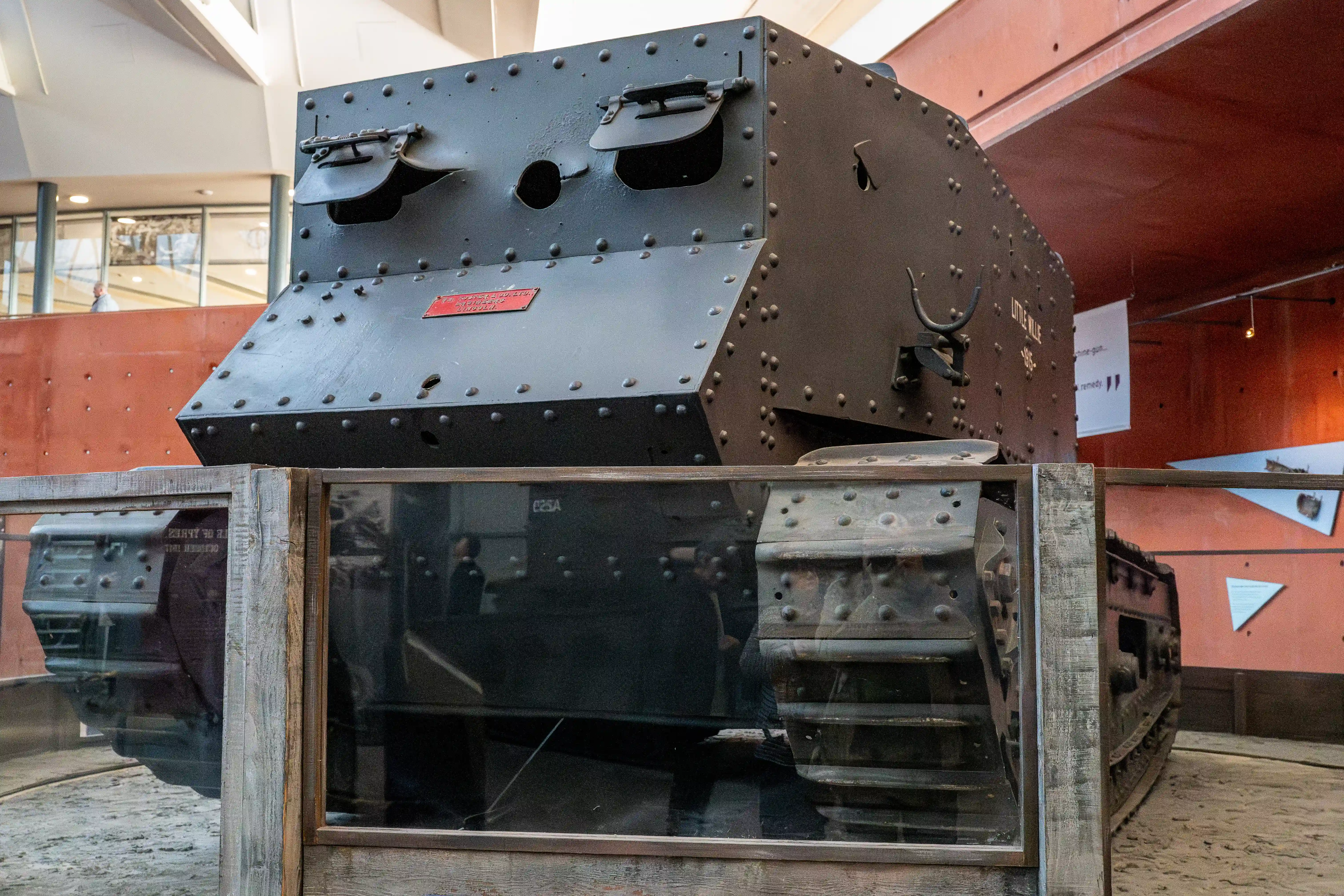
Little Willie was the world’s first completed tank prototype, built in late 1915 by William Foster & Co. in Lincoln, England. It was designed to break the stalemate of trench warfare during World War I, featuring a tracked, armoured hull and a dummy turret. However, its limited trench-crossing ability and top-heavy design led to the development of the improved
Little Willie ‐ 
photo by ,
©www.mgaylard.co.uk.
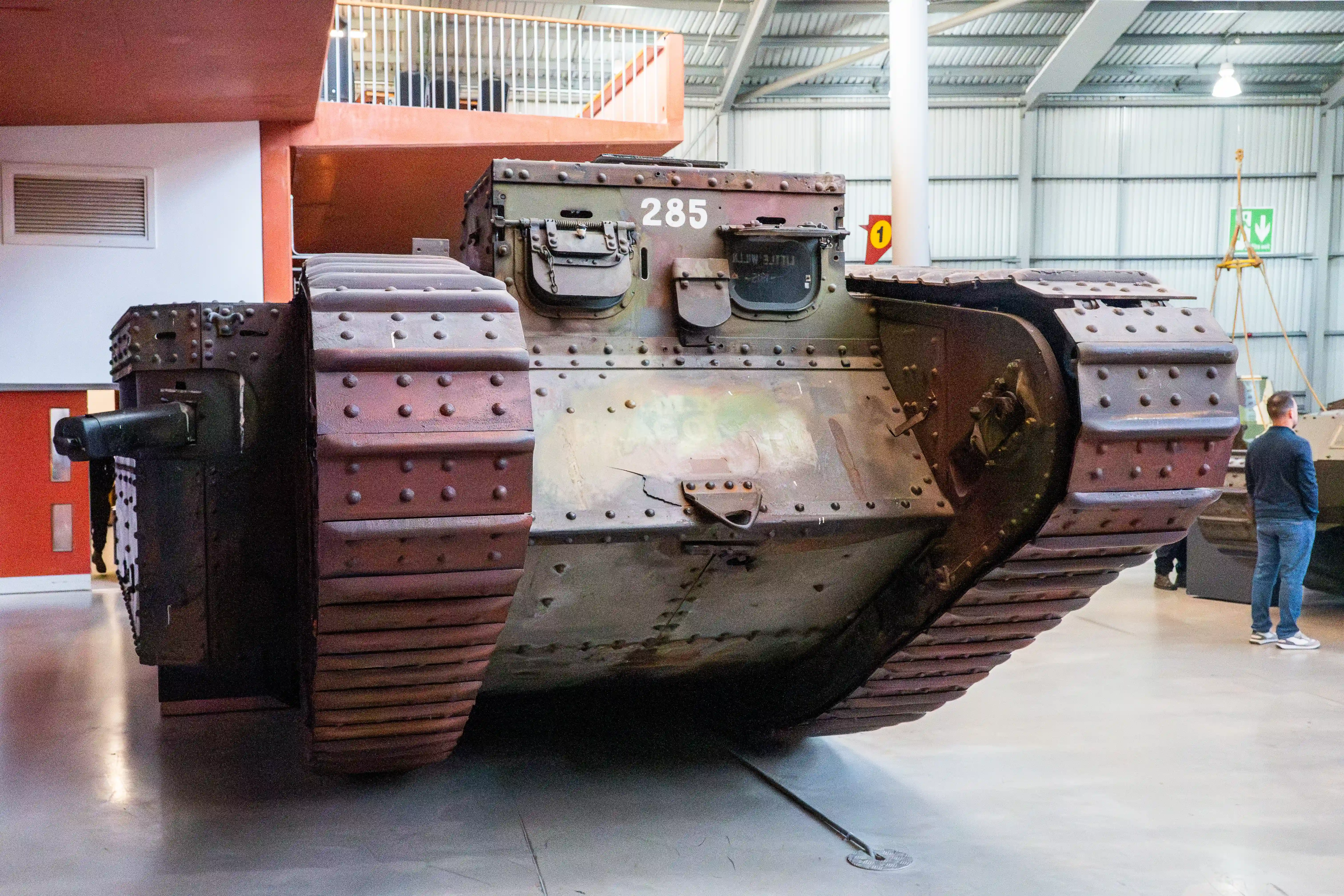
The image shows a vintage military tank on display in a museum. The tank, marked with the number 285, features riveted armor plating and a turret with a mounted gun. The setting appears to be an indoor exhibit area with a high ceiling and industrial-style architecture. A person is seen observing the tank, providing a sense of scale to the size of the vehicle.
View of location ‐ 
photo by ,
©www.mgaylard.co.uk.
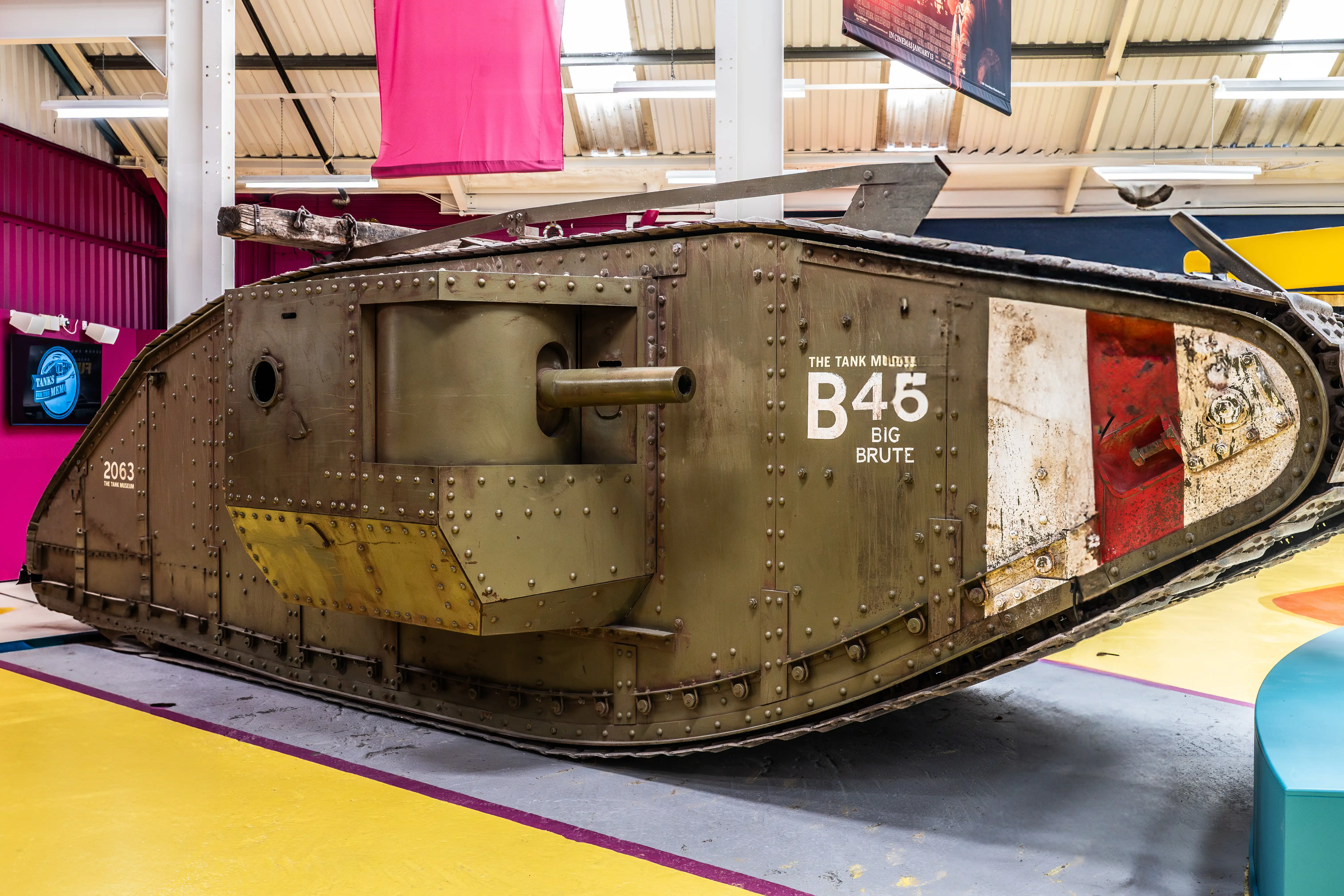
The image shows a historical military tank, specifically a British Mark IV tank used during World War I. The tank is displayed indoors, likely in a museum setting. It has a rugged, boxy structure with riveted armor plating and a prominent central barrel. The tank is labeled with 'B45 Big Brute' and 'The Tank Museum' along with the number '2063'. The surrounding area is colorful, suggesting an educational or interactive exhibit.
"Big Brute" Tank on Display ‐ 
photo by ,
©www.mgaylard.co.uk.

Early British tanks, specifically the Mark I and subsequent models, were designated as "male" or "female" based on their armament:
Male tanks carried both heavy machine guns and 6-pounder (57 mm) naval guns mounted in side sponsons. These guns were intended to destroy enemy fortifications, artillery, and armoured vehicles, making male tanks the primary offensive weapon against hardened targets.
Female tanks were armed only with machine guns (typically Vickers or Hotchkiss .303 caliber). They were designed to support infantry by suppressing enemy troops and clearing trenches, rather than engaging armoured targets or fortifications.
The Mark II Female tank F53, nicknamed "The Flying Scotsman", is a historic British World War I tank now preserved at the Bovington Tank Museum. Originally built as a training tank, it was later modified and sent to the front, where it is believed to have served with the 6th Battalion at the Battle of Cambrai in November 1917. The tank still bears battle damage from the Battle of Arras in April 1917, where it sustained hits that left visible exit holes in its armour. After the war, it was restored and eventually returned to its original Mark II configuration, complete with its distinctive name, which was discovered under layers of paint during restoration.

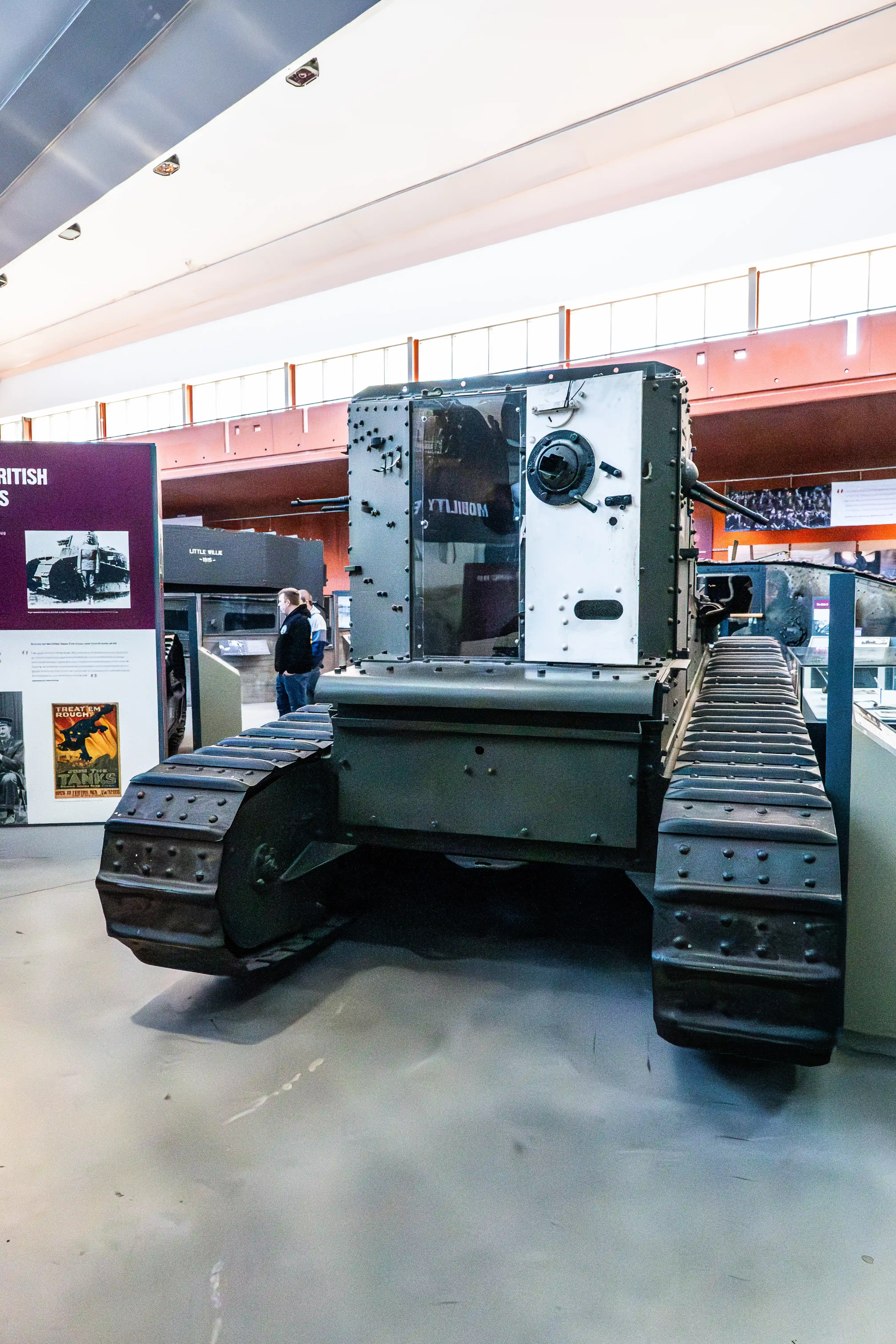
The image shows a historical tank on display in a museum. The tank has a robust, armored structure with tracks designed for rugged terrain. It is positioned in an indoor exhibit area with informational displays in the background, suggesting it is part of a larger collection or exhibition related to military history. The setting appears to be well-lit and spacious, with other exhibits and visitors visible in the background.
Medium Mark A Whippet ‐ 
photo by ,
©www.mgaylard.co.uk.
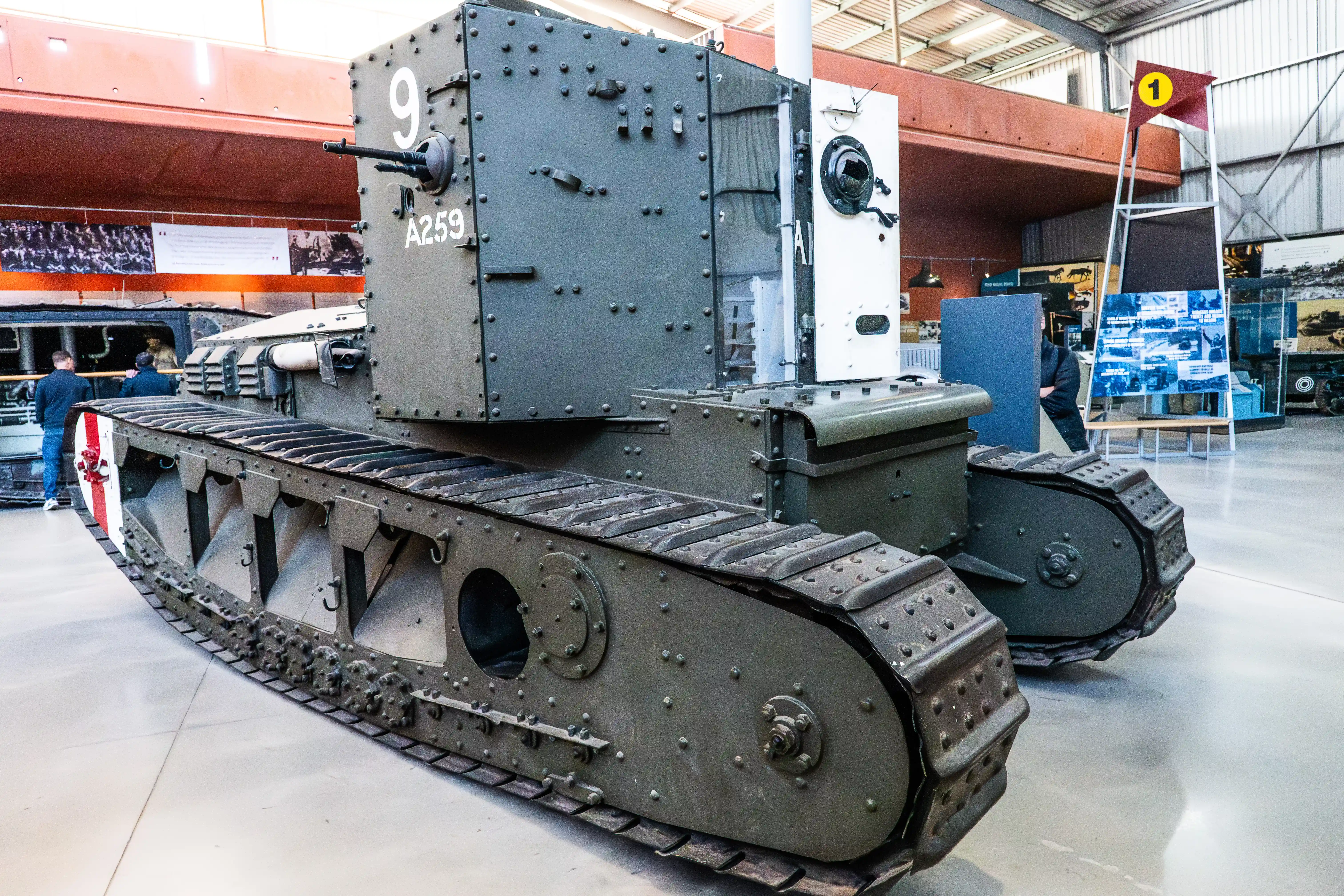
The image depicts a vintage tank on display in a museum. The tank, marked with the number 9 and the identifier A259, features riveted armor and continuous track links characteristic of early 20th-century tank designs. The museum setting includes various informational displays and other military artifacts, providing educational context about the historical significance and technical details of the tank.
View of location ‐ 
photo by ,
©www.mgaylard.co.uk.
The image shows a historical tank on display in a museum. The tank has a robust, armored structure with tracks designed for rugged terrain. It is positioned in an indoor exhibit area with informational displays in the background, suggesting it is part of a larger collection or exhibition related to military history. The setting appears to be well-lit and spacious, with other exhibits and visitors visible in the background.
Medium Mark A Whippet ‐ 
photo by ,
©www.mgaylard.co.uk.

The Medium Mark A Whippet was a British medium tank developed during World War I, designed to exploit breakthroughs in enemy lines created by heavier, slower tanks like the Mark I and Mark IV. It was the first British "fast" tank, with a top speed of about 8 mph (13 km/h)—twice as fast as contemporary heavy tanks—earning it the nickname "Whippet." The Whippet was lightly armoured (6–14 mm) and armed with four .303 Hotchkiss machine guns, making it effective against infantry but vulnerable to artillery and armoured vehicles
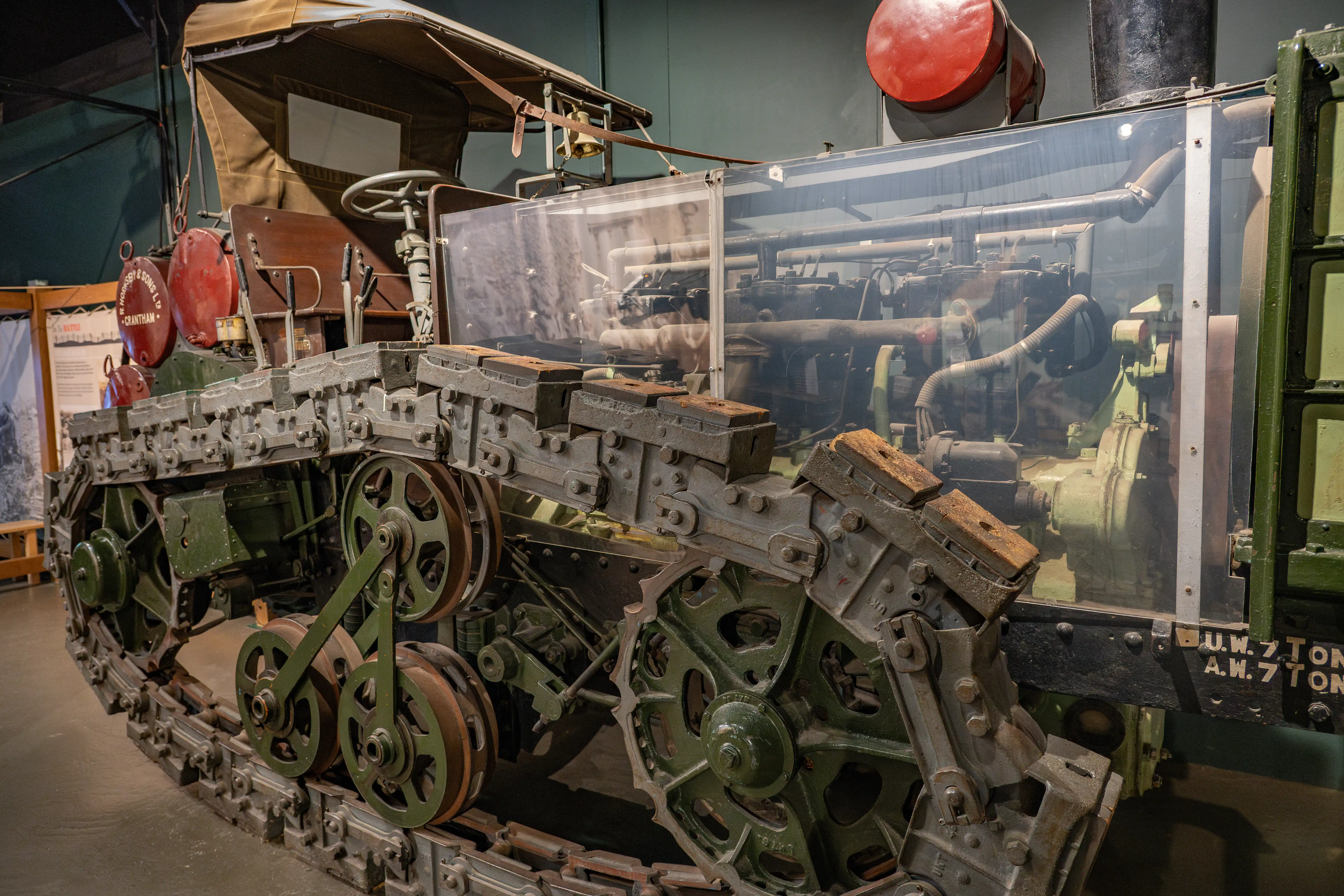
The image depicts an old, possibly antique, machine with a complex mechanical structure. The machine is encased in a protective cover, likely for display purposes. The visible components include large gears, belts, and various metallic parts, indicating it might be an industrial or agricultural machine from a bygone era. The machine has a greenish hue, suggesting it has been exposed to the elements or has been preserved in that state. There are also red spherical objects attached to the machine, which could be part of the machinery or safety features.
Heavy-Duty Hornsby Crawler Tractor on Display ‐ 
photo by ,
©www.mgaylard.co.uk.
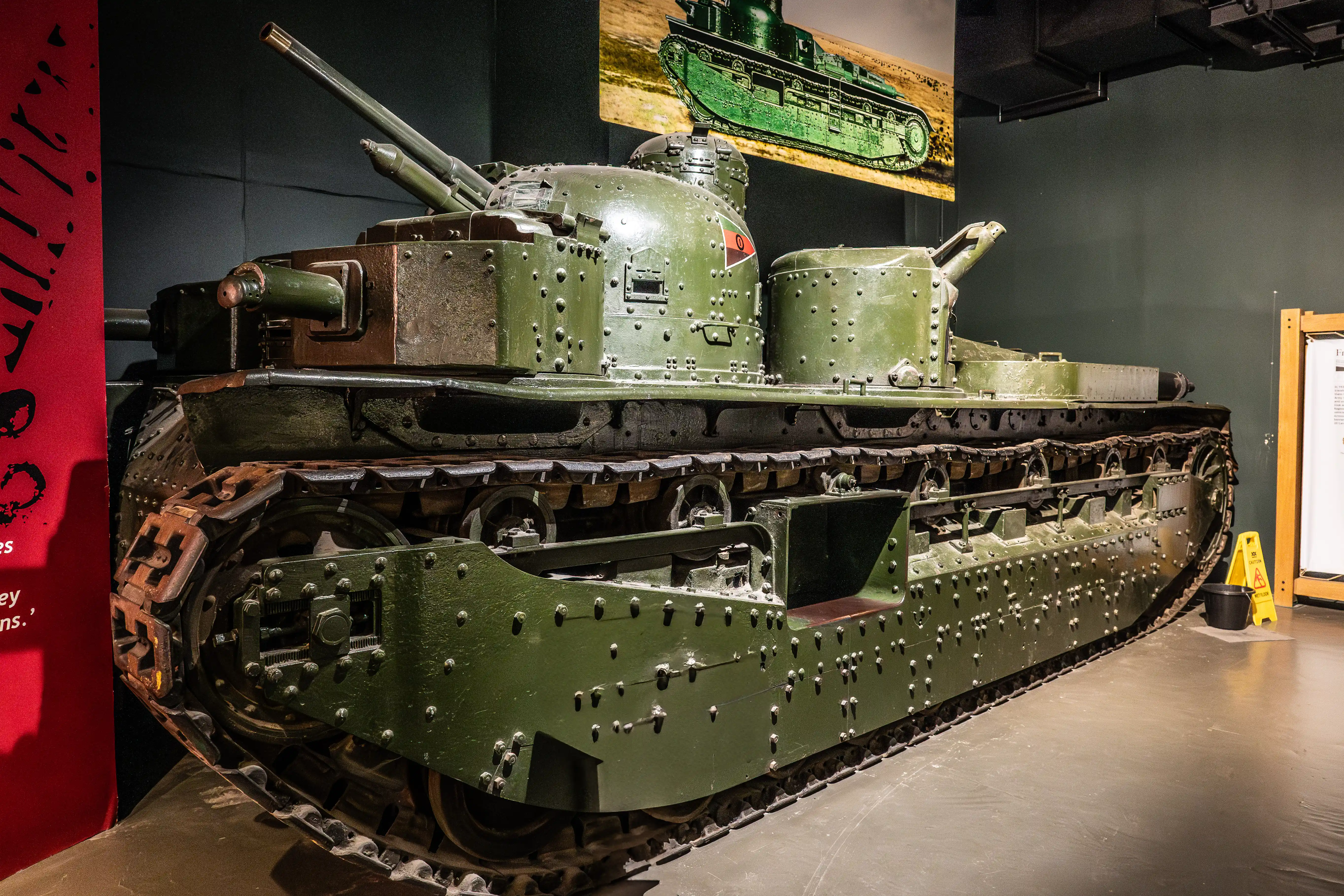
The image shows a historical military tank on display, likely in a museum setting. The tank is painted in a green color and has a riveted armor design. It features a turret with a mounted gun and various other armaments. The tank tracks and undercarriage are visible, showcasing the detailed mechanics of the vehicle. The background includes informational displays and a large poster of the tank.
Independent Heavy Tank A1E1 ‐ 
photo by ,
©www.mgaylard.co.uk.
The document discusses the history and evolution of model making, particularly focusing on military models like tanks. It highlights the popularity of model making as a hobby and its growth into an established industry. The text mentions various methods and materials used in model construction, including plastic and metal. It also notes the role of media, such as magazines, in popularizing the hobby. Additionally, it touches on the historical context of model making, particularly during and after the World Wars.
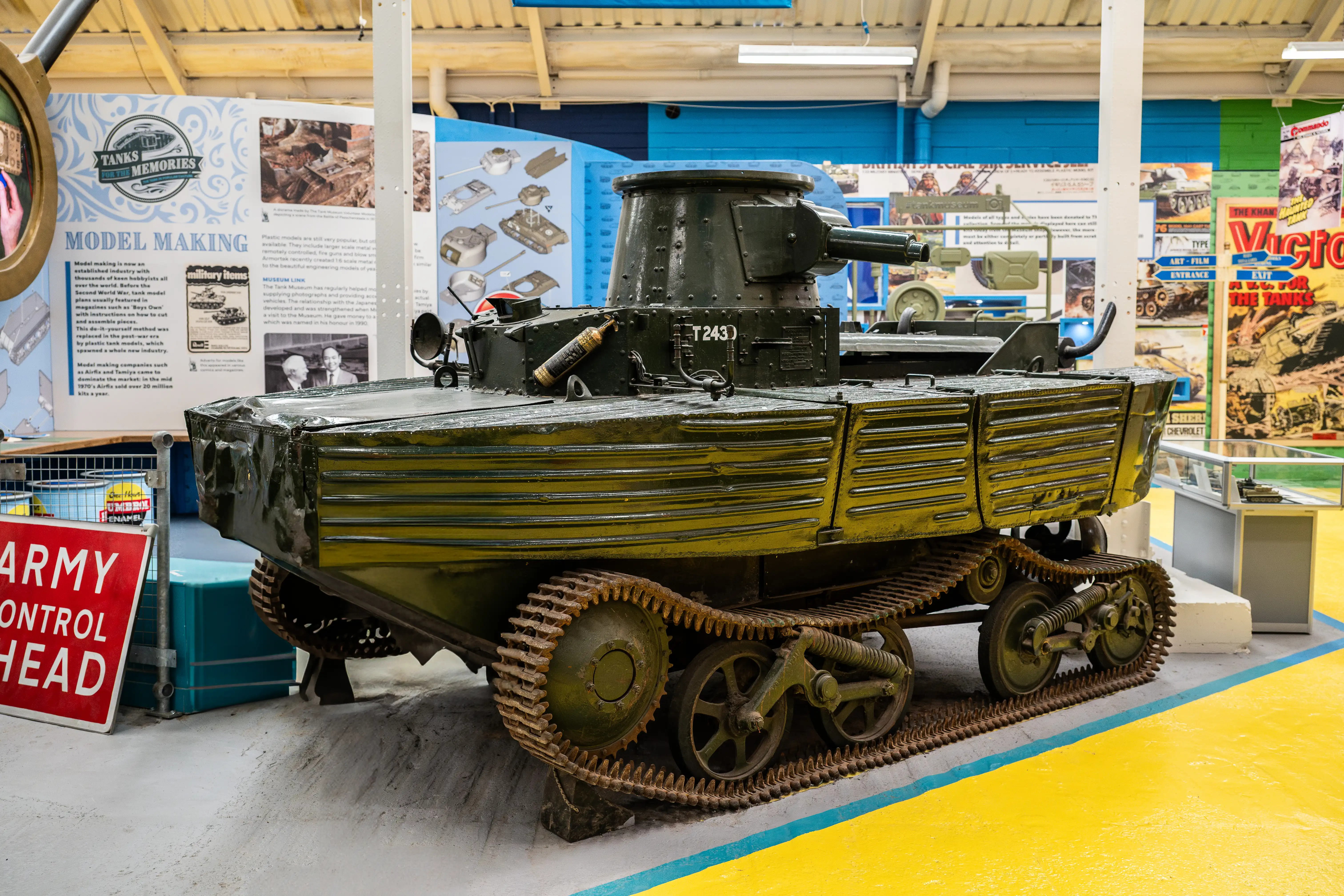
The L1E3 (also known as the Vickers Amphibious Light Tank) was a British experimental amphibious tank developed in 1939 by Vickers-Armstrongs. It was designed to meet a British War Office requirement for a light, fast, and amphibious reconnaissance vehicle. ‐ 
photo by ,
©www.mgaylard.co.uk.
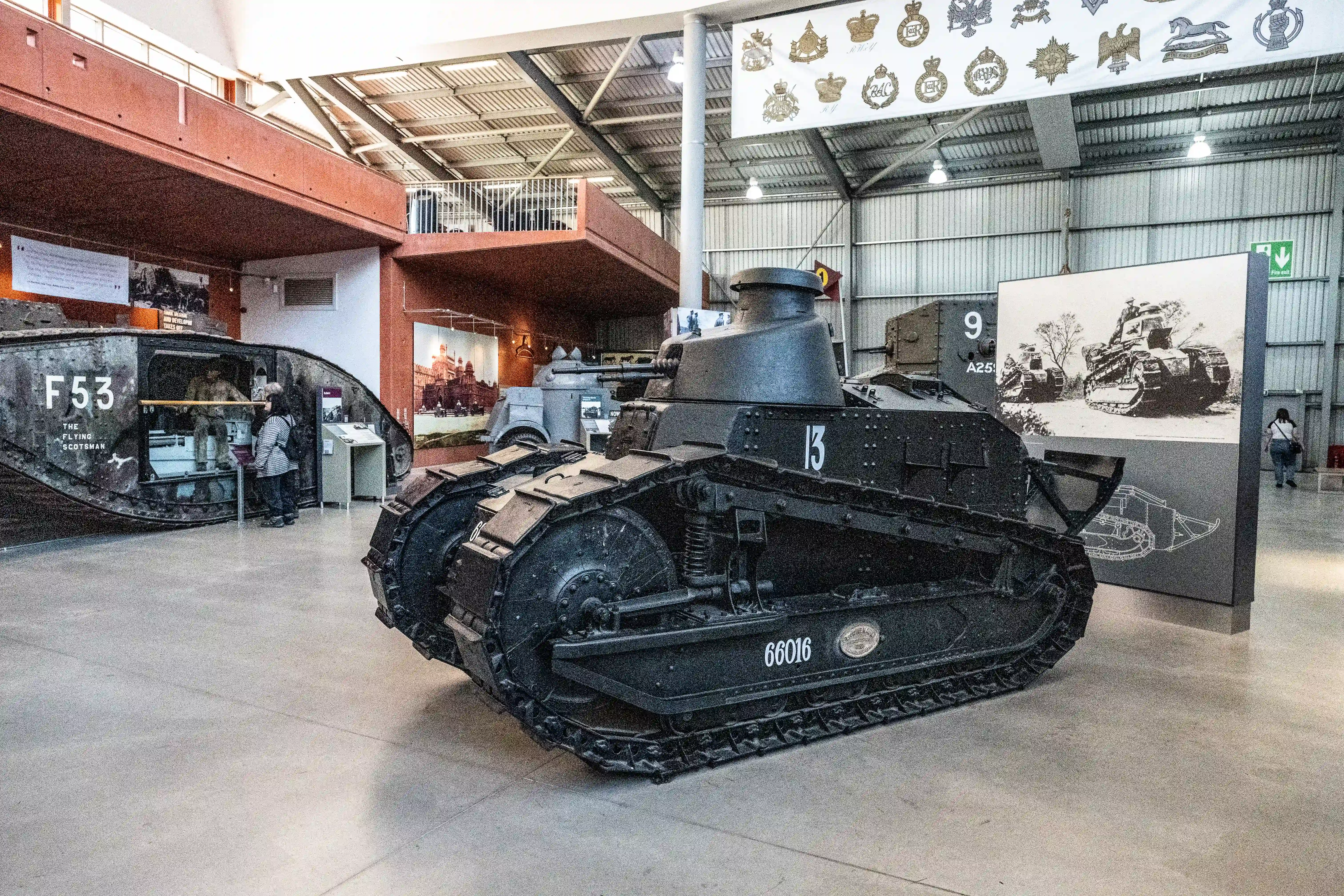
The image depicts a museum exhibit featuring historical military tanks. The central focus is on a black tank with the number 13 prominently displayed on its side. Other tanks and military artifacts are also visible in the background, along with informational displays and photographs. The museum setting includes a high ceiling, various insignia on the walls, and a few visitors observing the exhibits.
Renault FT Light Tank ‐ 
photo by ,
©www.mgaylard.co.uk.

Scout and Armoured Cars
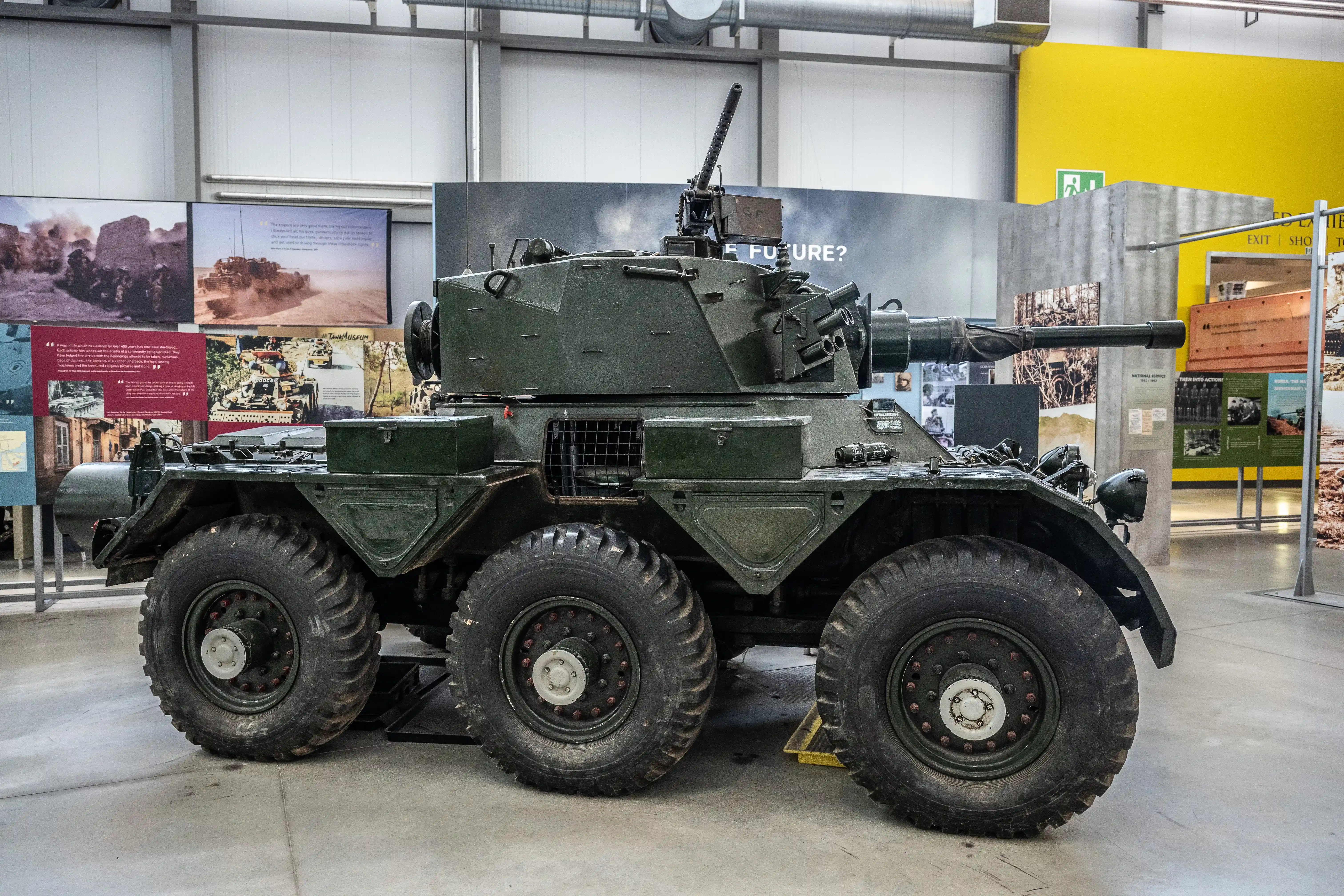
The image depicts a military vehicle on display in a museum or exhibition setting. The vehicle is a six-wheeled armored car equipped with a large gun turret on top. The surroundings include informational panels and displays, suggesting that the vehicle is part of an exhibit on military history or technology. The setting appears to be indoors, with a clean and organized environment. The vehicle's design and the context of the display indicate it may be a historical or prototype model.
Alvis Saladin (FV601)  ‐ 
photo by ,
©www.mgaylard.co.uk.
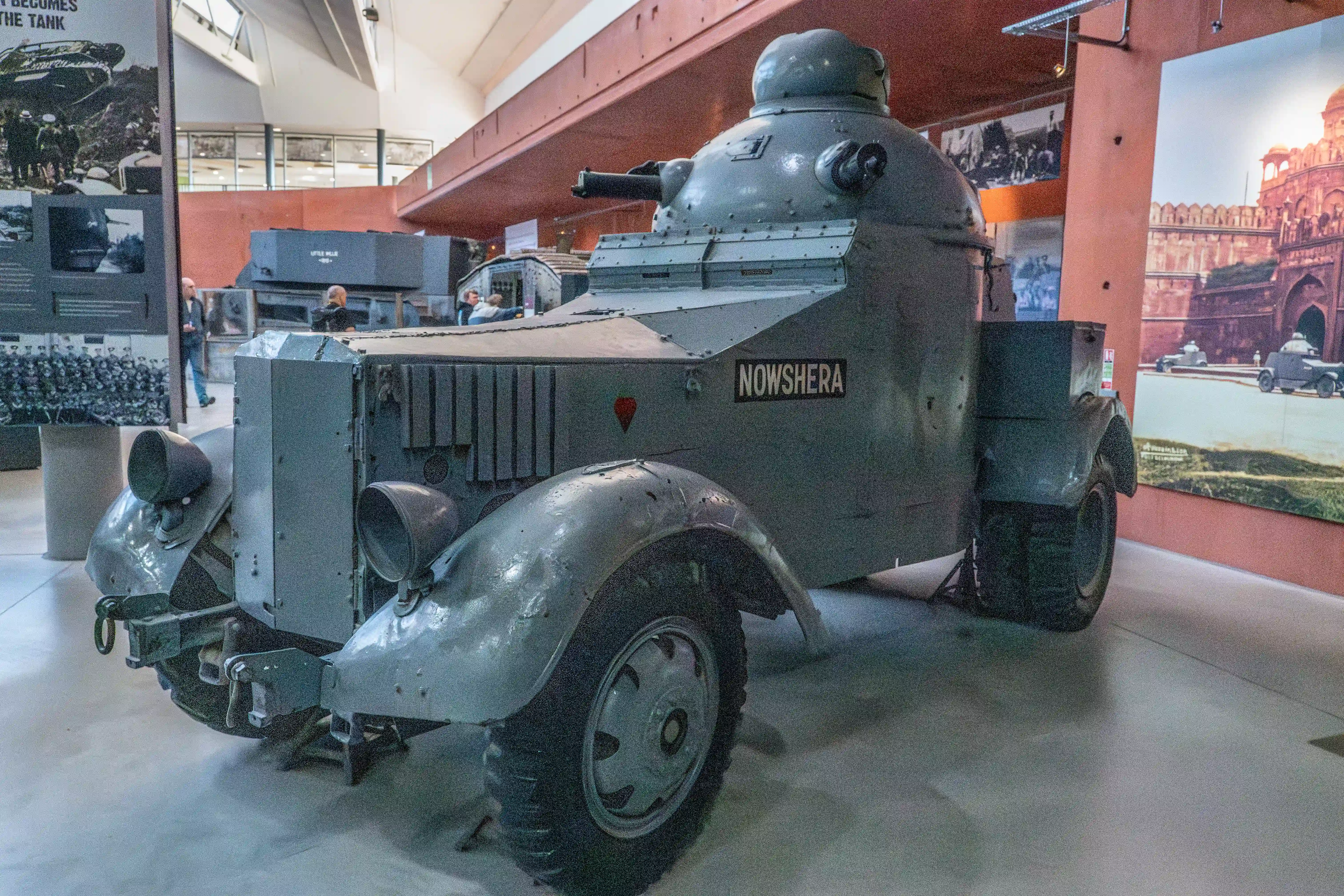
The image depicts an armored vehicle named 'Nowshera' on display in a museum. The vehicle has a rugged, metallic exterior with a turret on top, equipped with a cannon. It is displayed in an indoor exhibit area with historical photographs and informational panels in the background, suggesting its historical significance and use in military contexts.
Crossley-Chevrolet Armoured Car ‐ 
photo by ,
©www.mgaylard.co.uk.
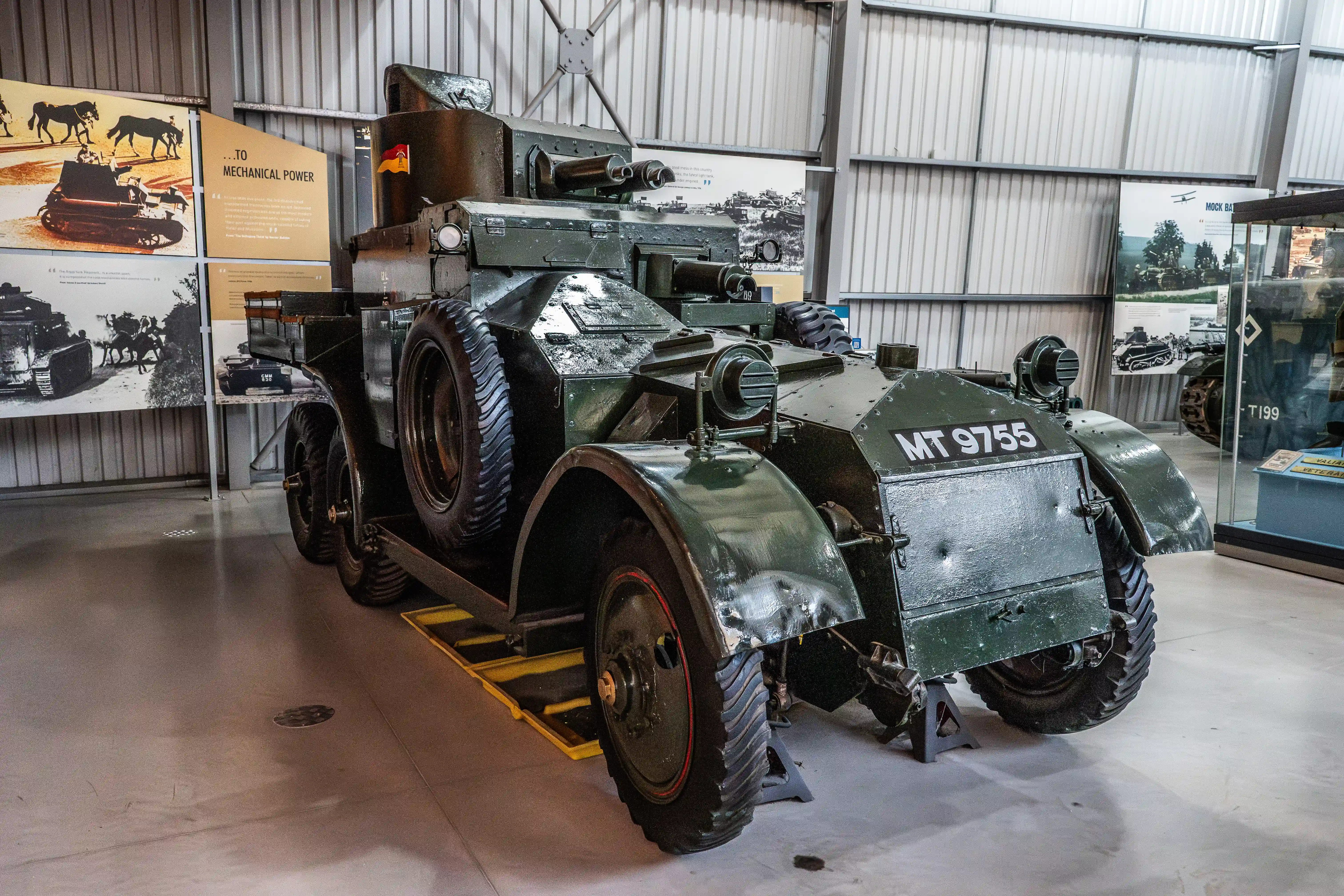
The image shows a vintage military vehicle, specifically an armored car, displayed in a museum setting. The vehicle has the designation 'MT 9755' marked on its side and features large, rugged tires and a heavily armored body. The display area includes informational panels with historical photographs and text, providing context about the transition from horse-drawn vehicles to mechanized ones. The setting appears to be well-lit and organized, with the vehicle positioned on a raised platform for viewing.
Lanchester Mark II Armoured Car ‐ 
photo by ,
©www.mgaylard.co.uk.
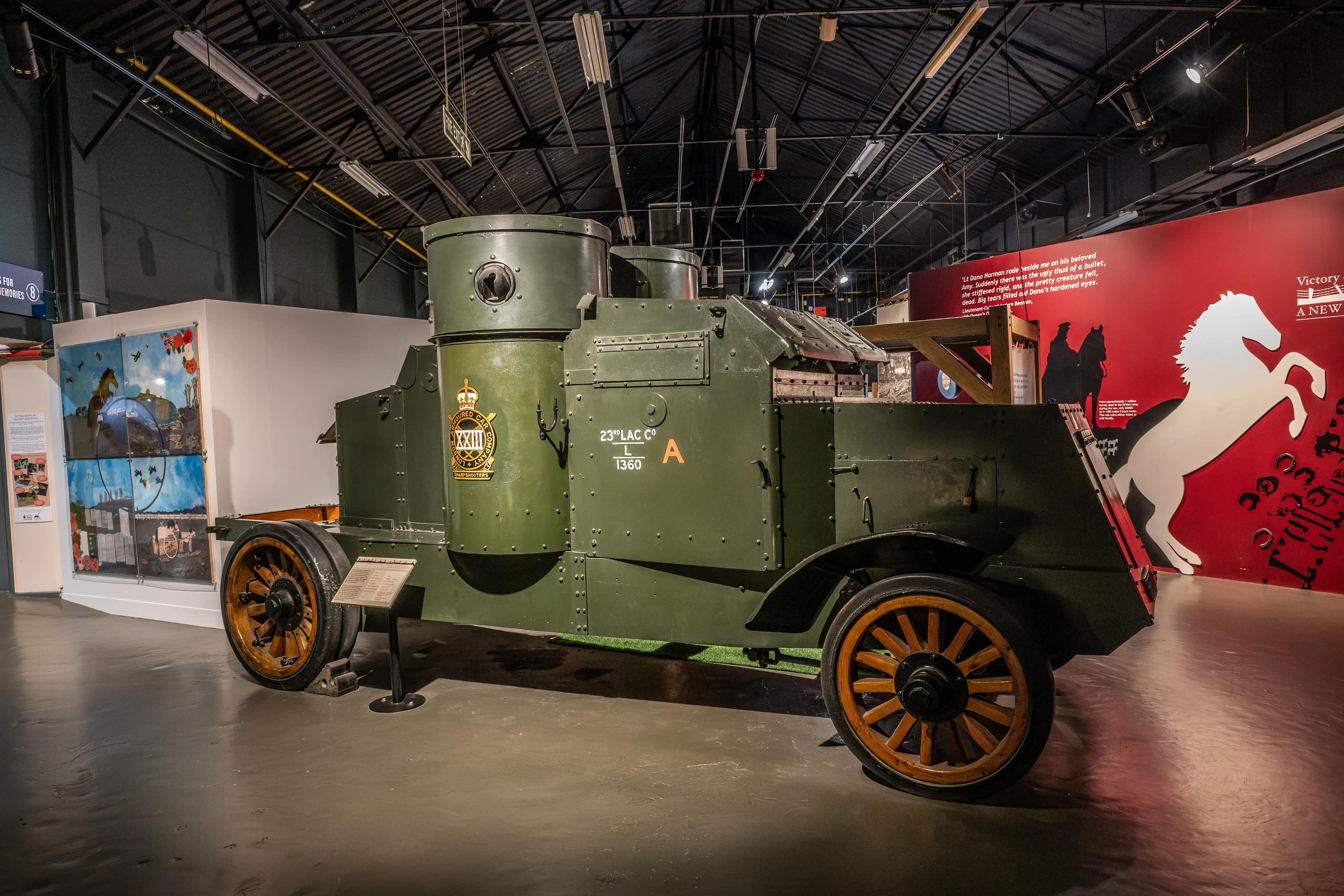
The image depicts a vintage military vehicle, specifically an armored car, displayed in a museum setting. The vehicle is painted in a dark green color and features wooden-spoked wheels. It has various markings and insignia, including the text '23rd LAC CO' and 'L 1360' on its side. The museum exhibit includes informational displays and a large red backdrop with a white horse illustration, suggesting a historical or military theme.
Peerless Armoured Car ‐ 
photo by ,
©www.mgaylard.co.uk.
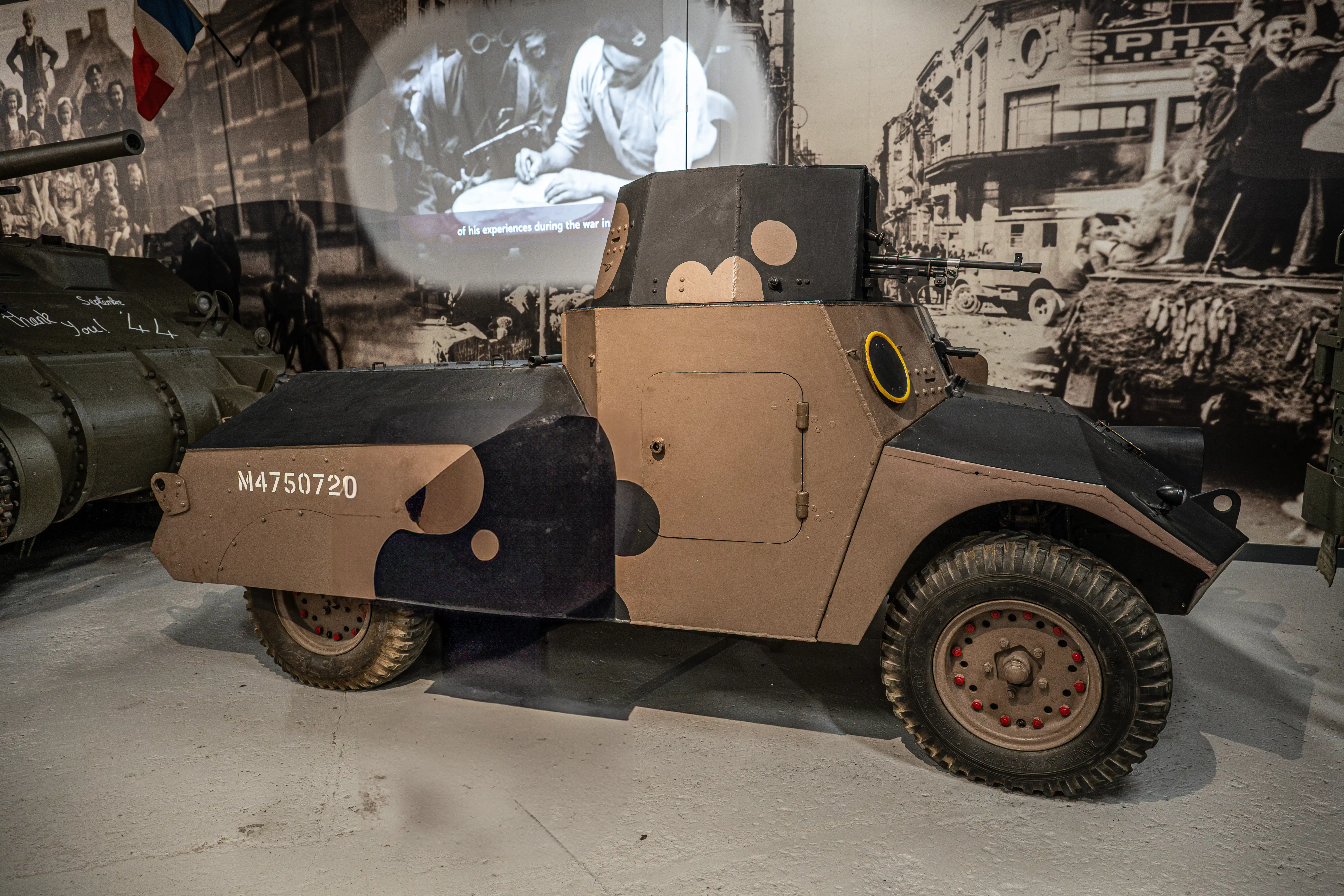
The image depicts a military armored vehicle, specifically an armored car, displayed in a museum setting. The vehicle has a camouflage paint scheme with a mix of brown and black colors. The side of the vehicle has a serial number 'M4750720' marked on it. The background features black-and-white photographs and a projection, likely depicting historical scenes or information related to the vehicle's use and context. The overall scene suggests an exhibit focused on historical military equipment, possibly from World War II.
Morris Light Reconnaissance Car ‐ 
photo by ,
©www.mgaylard.co.uk.
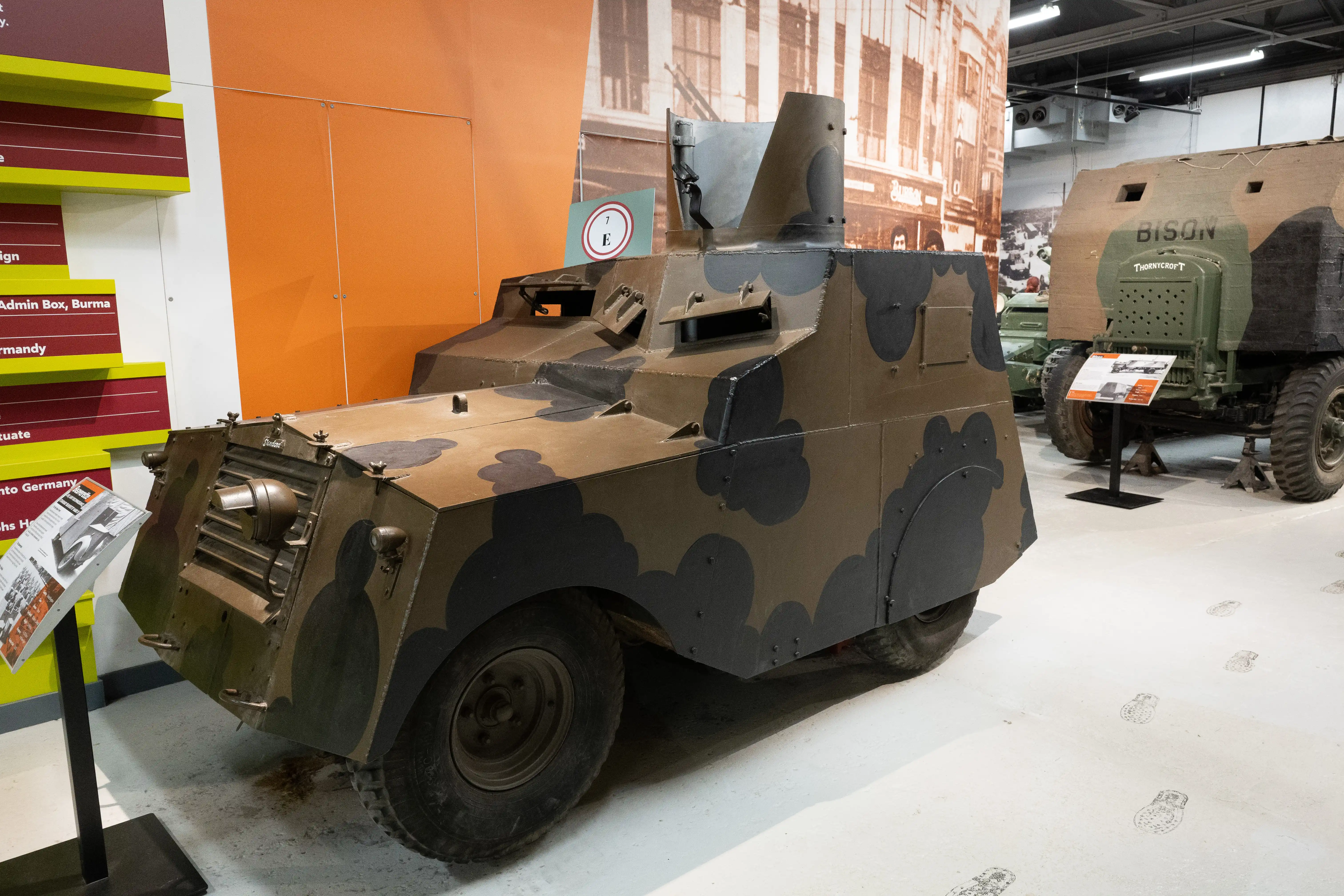
The image depicts a military exhibition featuring two vintage armored vehicles. The foreground vehicle is a small, camouflaged armored car with a turret, likely used in reconnaissance or light combat roles. The background vehicle is a larger, green armored truck labeled 'Bison' with the manufacturer's name 'Thornycroft' visible. Both vehicles are displayed indoors, with informational placards in front of them, providing context and historical details about their use and significance.
Beaverette Armoured Car ‐ 
photo by ,
©www.mgaylard.co.uk.
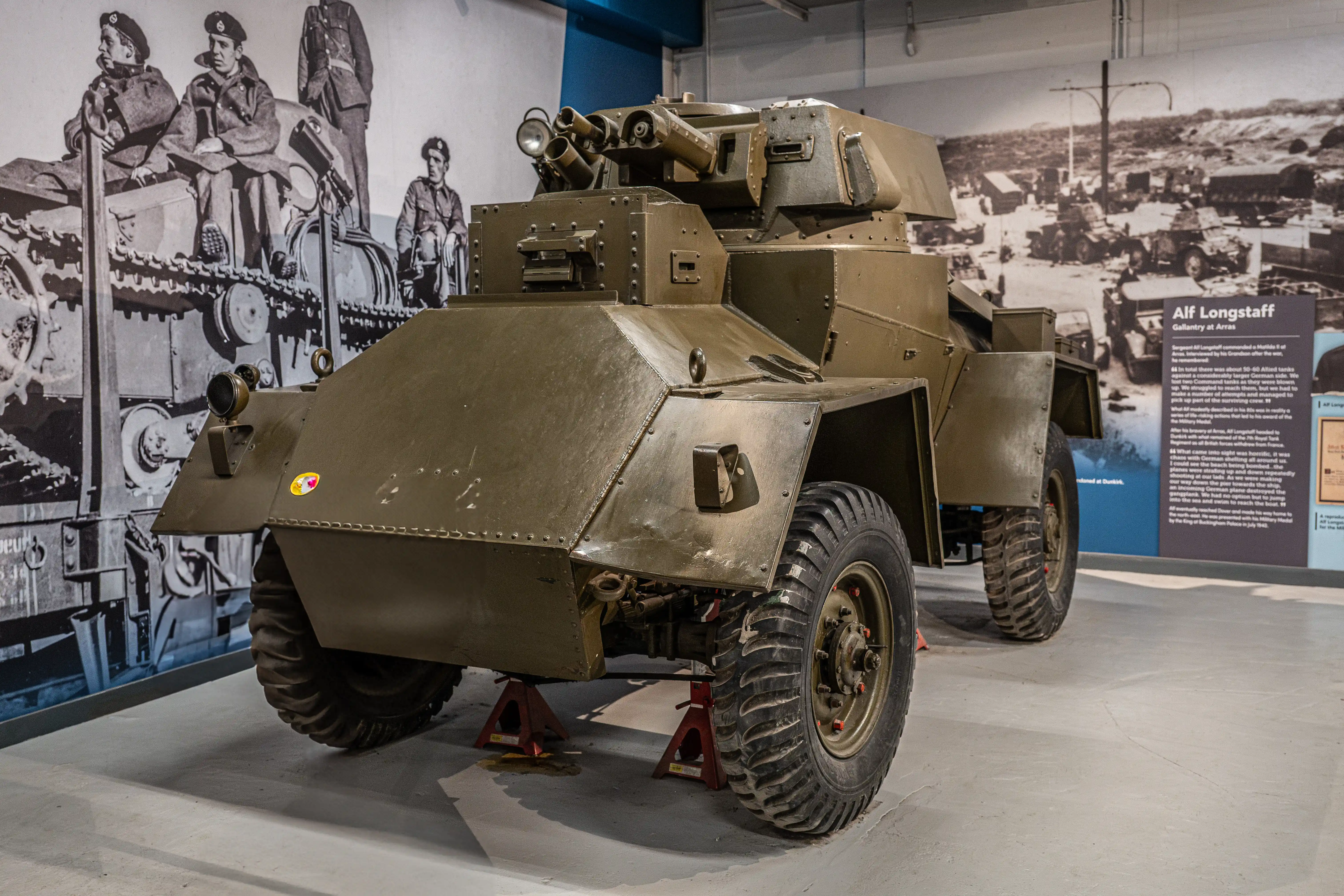
The image depicts a military vehicle, specifically an armored car, displayed in a museum setting. The vehicle is elevated on stands, likely for maintenance or display purposes. Surrounding the vehicle are historical photographs and text panels, one of which highlights the story of Alf Longstaff, a gallantry recipient. The context suggests the vehicle and the displayed information are related to historical military events, possibly from World War II, given the attire of the soldiers in the photographs and the type of vehicle shown.
Guy Armoured Car ‐ 
photo by ,
©www.mgaylard.co.uk.
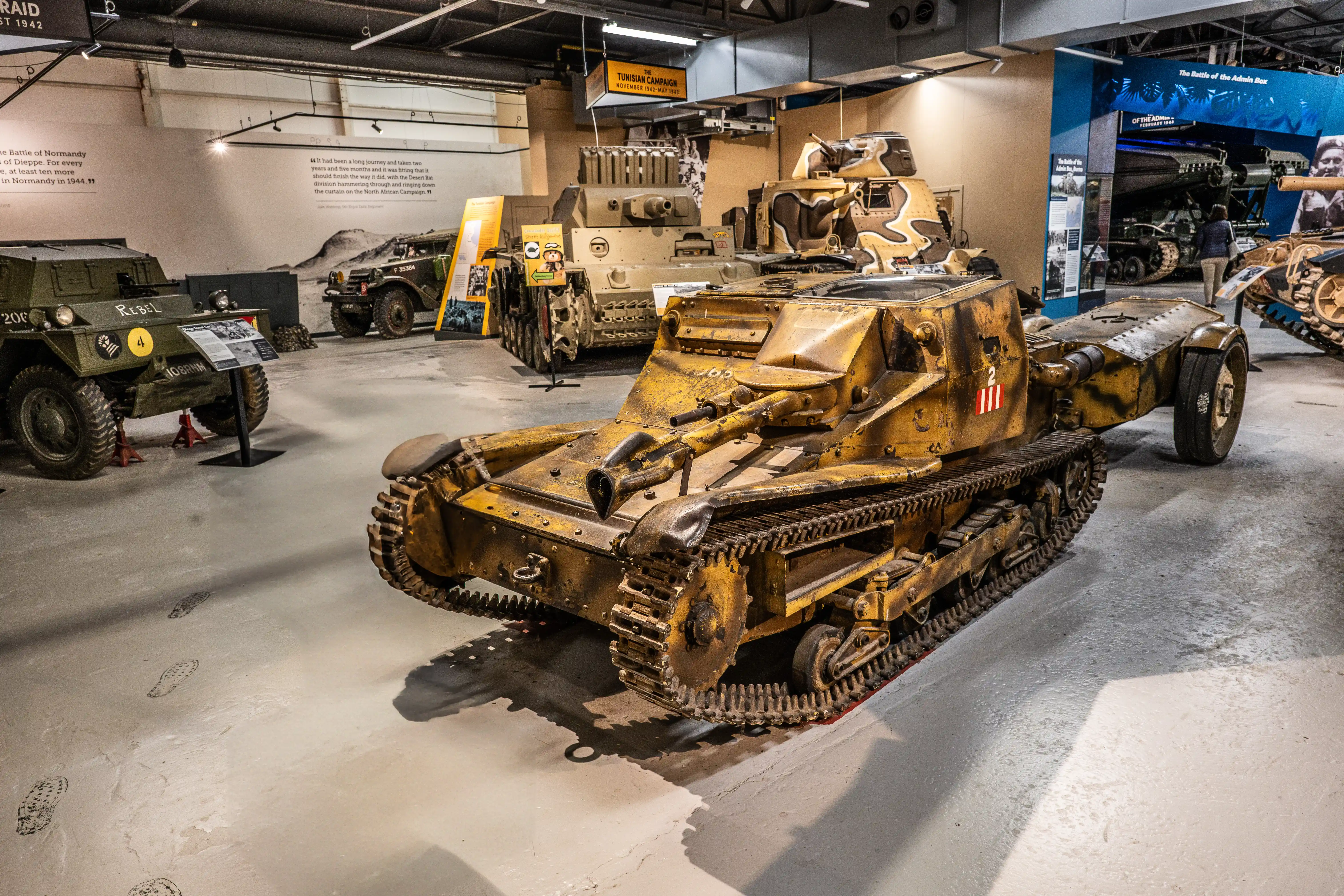
The image depicts a military museum exhibit featuring various armored vehicles, including tanks and reconnaissance vehicles, from different historical periods. The vehicles are displayed in a well-lit indoor space with informational placards and background displays providing context about specific battles and campaigns, such as the Battle of Normandy and the Tunisian Campaign.
World War II Armour - Carro L3 ‐ 
photo by ,
©www.mgaylard.co.uk.
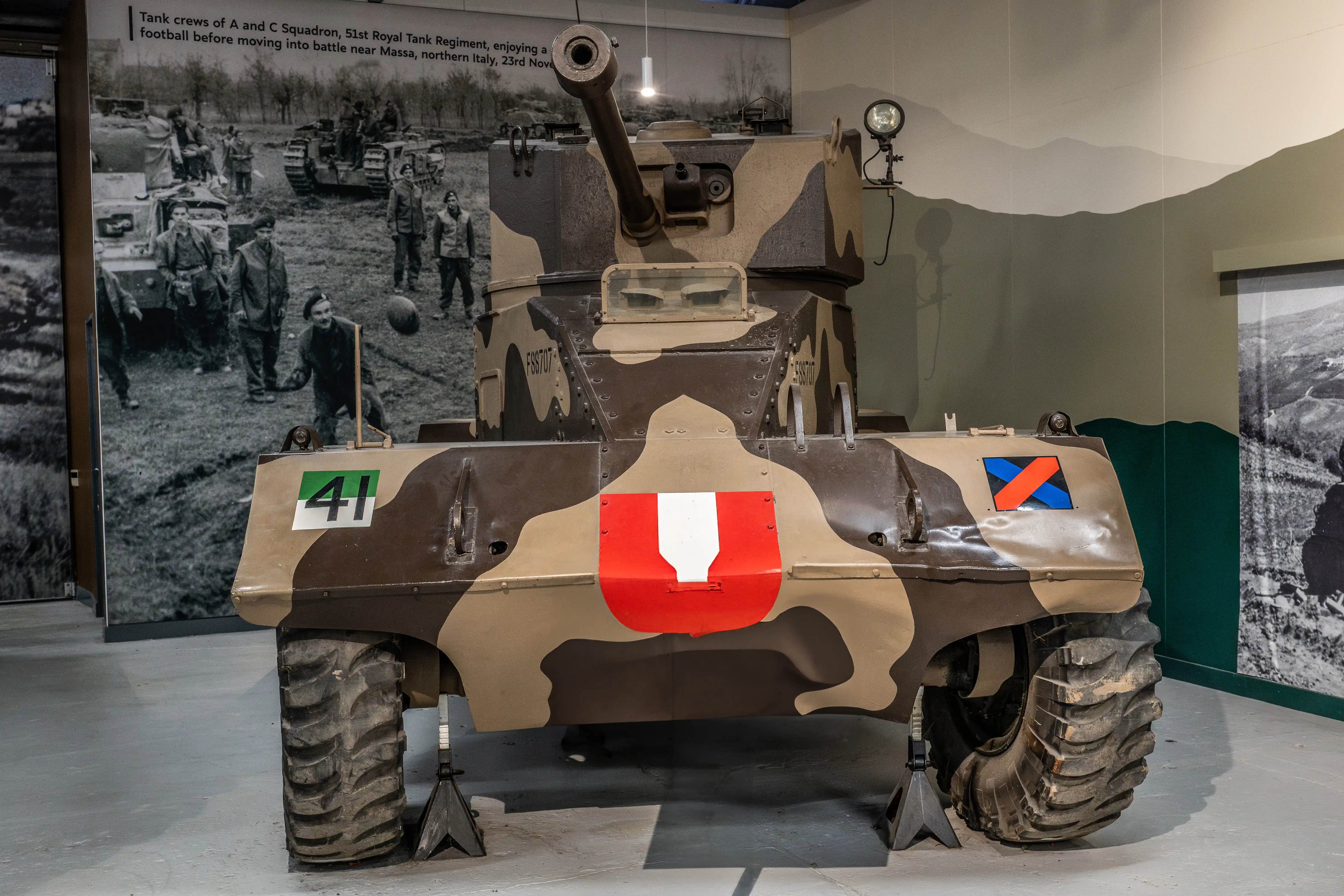
The image shows a military vehicle, specifically a tank, on display in a museum. The tank is painted with camouflage and has various markings, including a large red and white emblem on the front and smaller symbols on the sides. Behind the tank, there is a black-and-white photograph depicting tank crews from the 51st Royal Tank Regiment enjoying a game of football before heading into battle near Massa, northern Italy, on November 23rd.
AEC Armoured Car Mk II ‐ 
photo by ,
©www.mgaylard.co.uk.
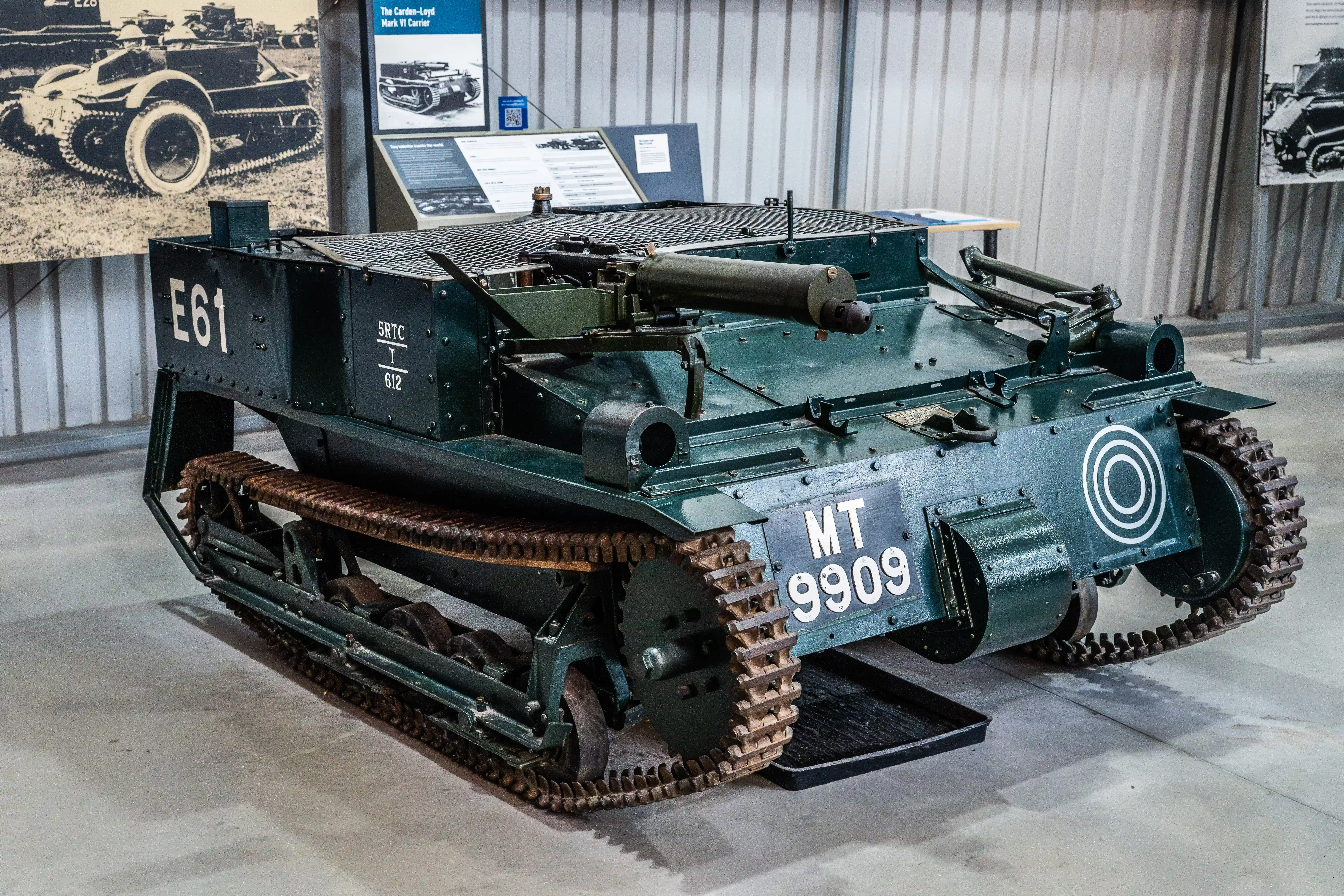
The image depicts a historical military tracked vehicle, specifically a Carden-Loyd Mark VI Tankette, on display in a museum setting. The vehicle is painted in a dark green color and has the markings 'E61' and 'MT 9909' on its side. The tankette features a mesh-covered rear compartment and a cylindrical object on top, likely a mounting for a machine gun. The background includes informational displays and black-and-white photographs of similar vehicles, providing context and historical information about the vehicle's design and usage.
Carden-Loyd Mark VI ‐ 
photo by ,
©www.mgaylard.co.uk.
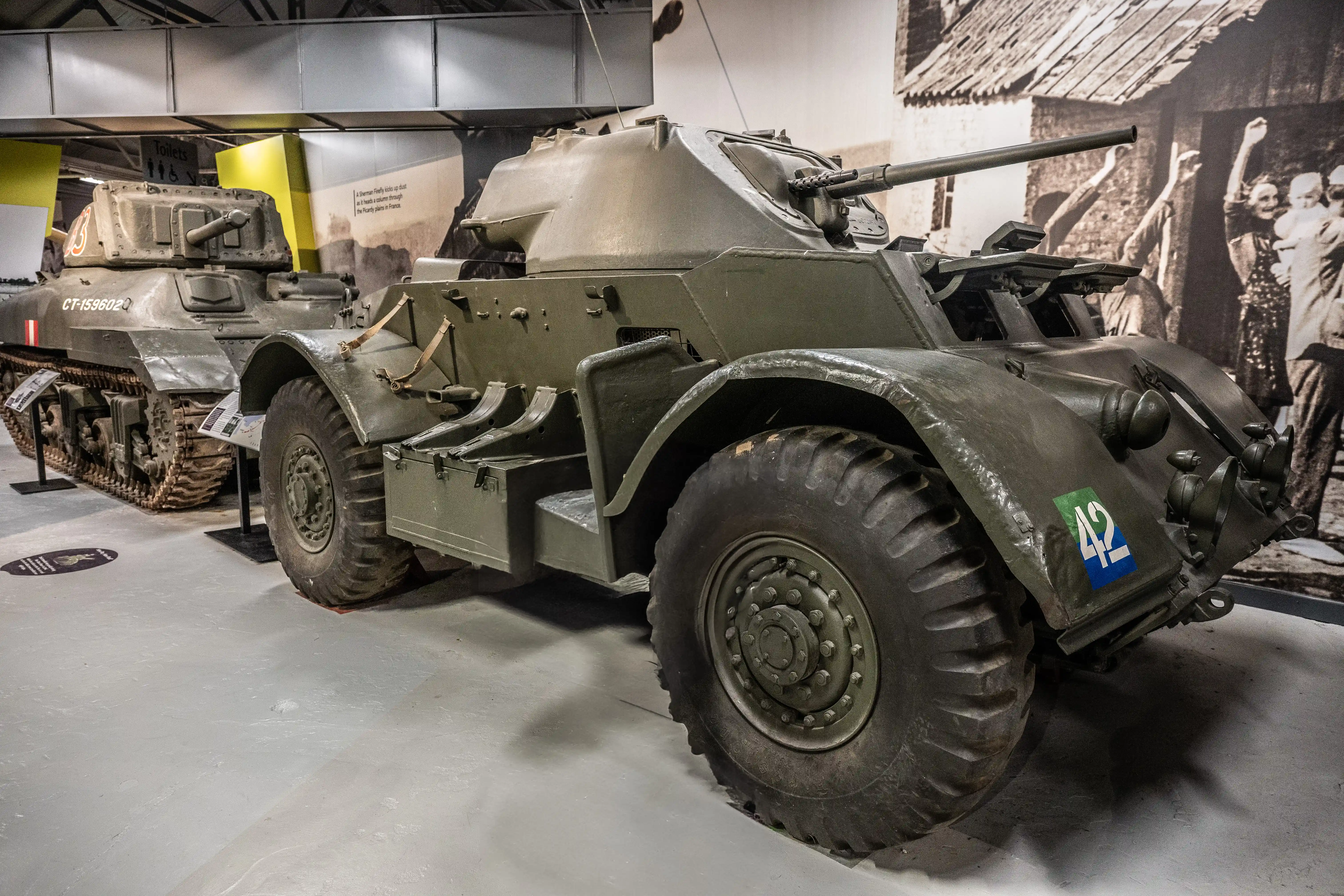
The image shows a military vehicle, specifically an armored car, displayed in a museum setting. The vehicle has large, rugged tires and a mounted gun on top. It is painted in a military green color and features various markings and equipment. The background includes other military vehicles and historical photographs, suggesting the exhibit focuses on military history.
Staghound (T17E1) ‐ 
photo by ,
©www.mgaylard.co.uk.
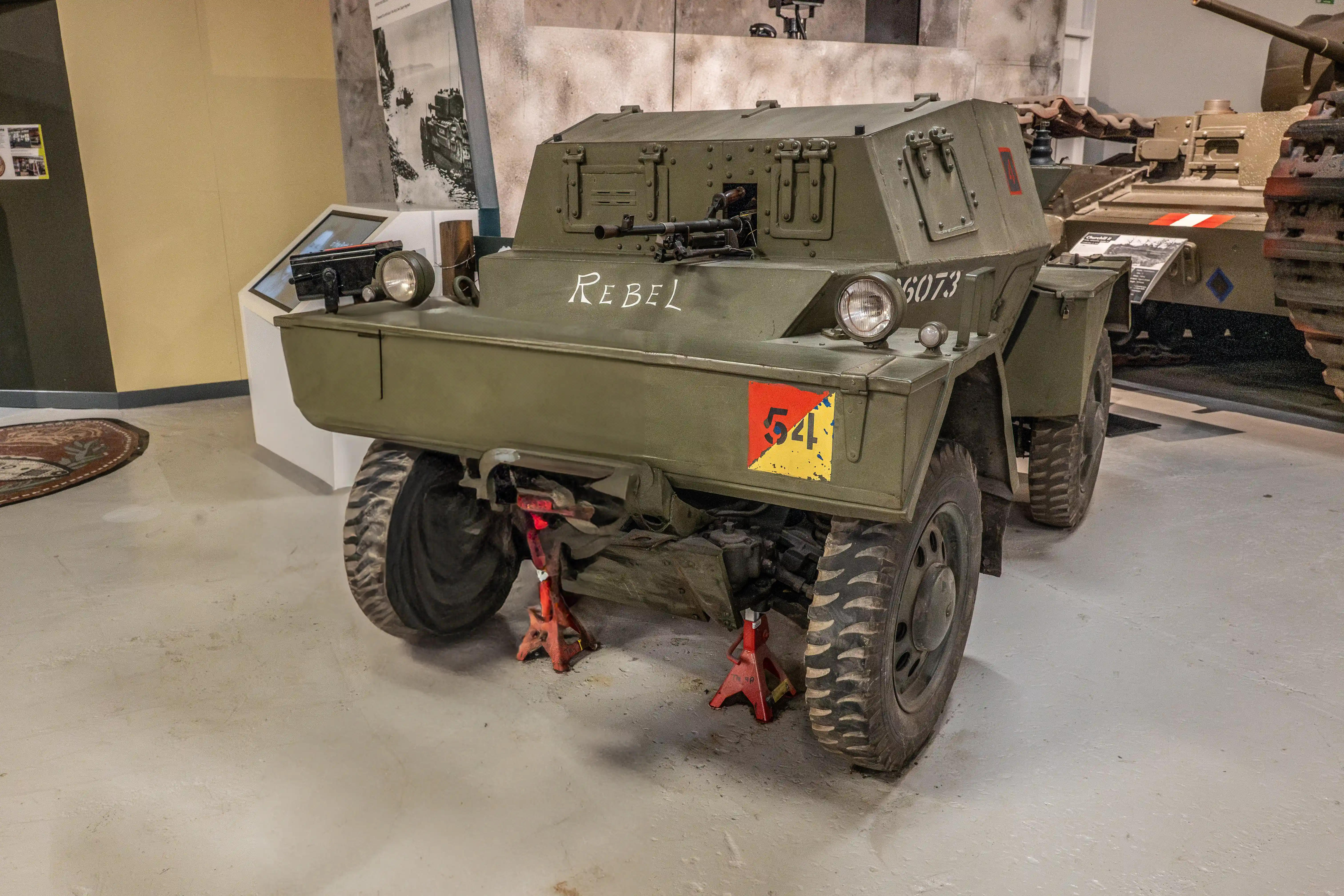
The image depicts a military vehicle, specifically an armored car, on display in a museum or exhibition setting. The vehicle is painted in a military green color and has various markings, including the word 'Rebel' and the number '6073' on its front. It is elevated on red jack stands, suggesting it is being maintained or displayed in a stationary position. The vehicle is equipped with heavy-duty tires and has a machine gun mounted on top. The background includes other military artifacts and displays, indicating a historical or military museum context.
Daimler Dingo Scout Car  ‐ 
photo by ,
©www.mgaylard.co.uk.
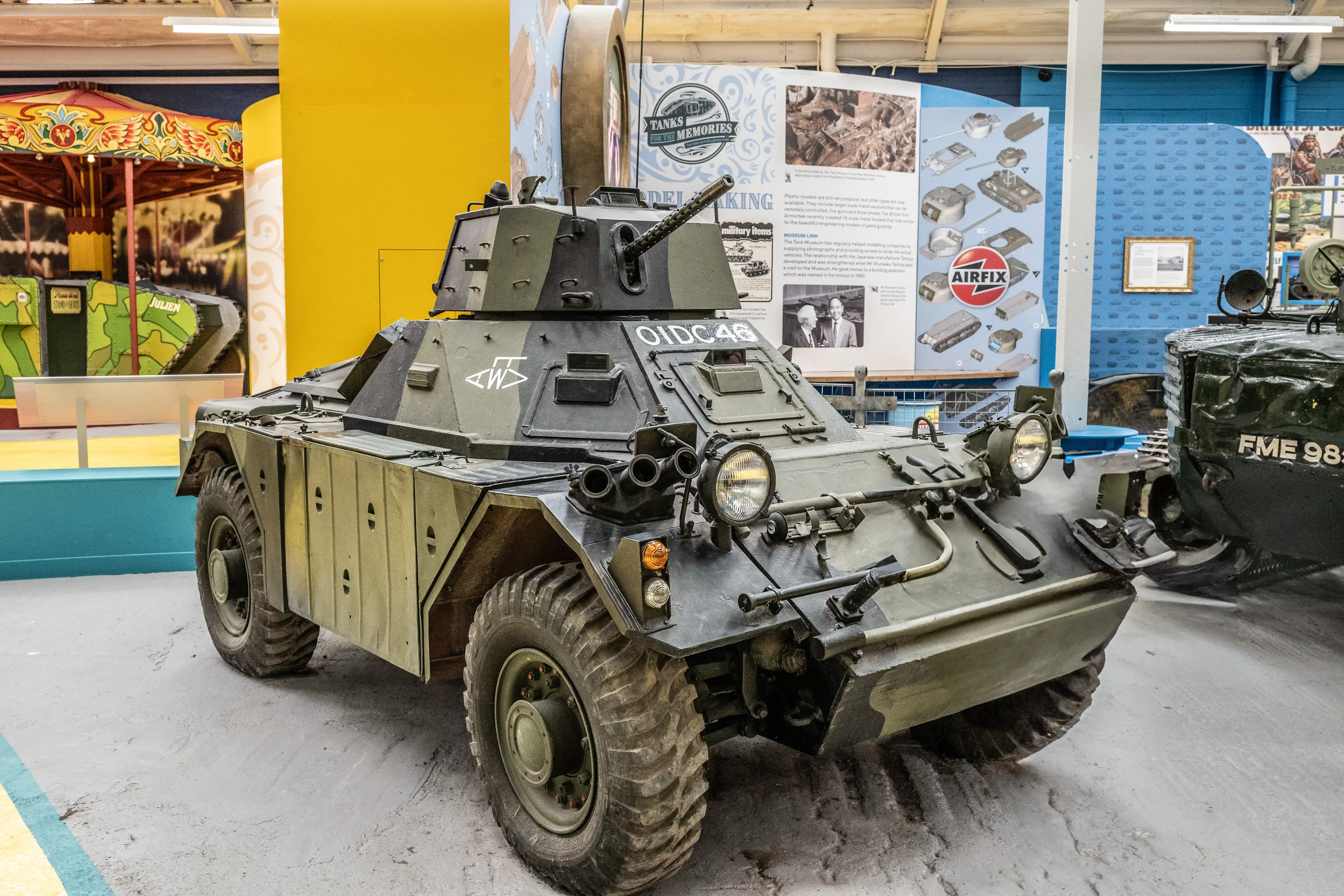
The image depicts a military armored vehicle on display in a museum. The vehicle, labeled 'OILCAR,' is an armored car with various military features such as mounted lights, a machine gun, and reinforced plating. The display area includes informational posters about the vehicle and related exhibits. The setting appears to be part of a larger exhibit on military history, with other vehicles and displays visible in the background.
Ferret Scout Car Mk 2 / Mk 3 ‐ 
photo by ,
©www.mgaylard.co.uk.
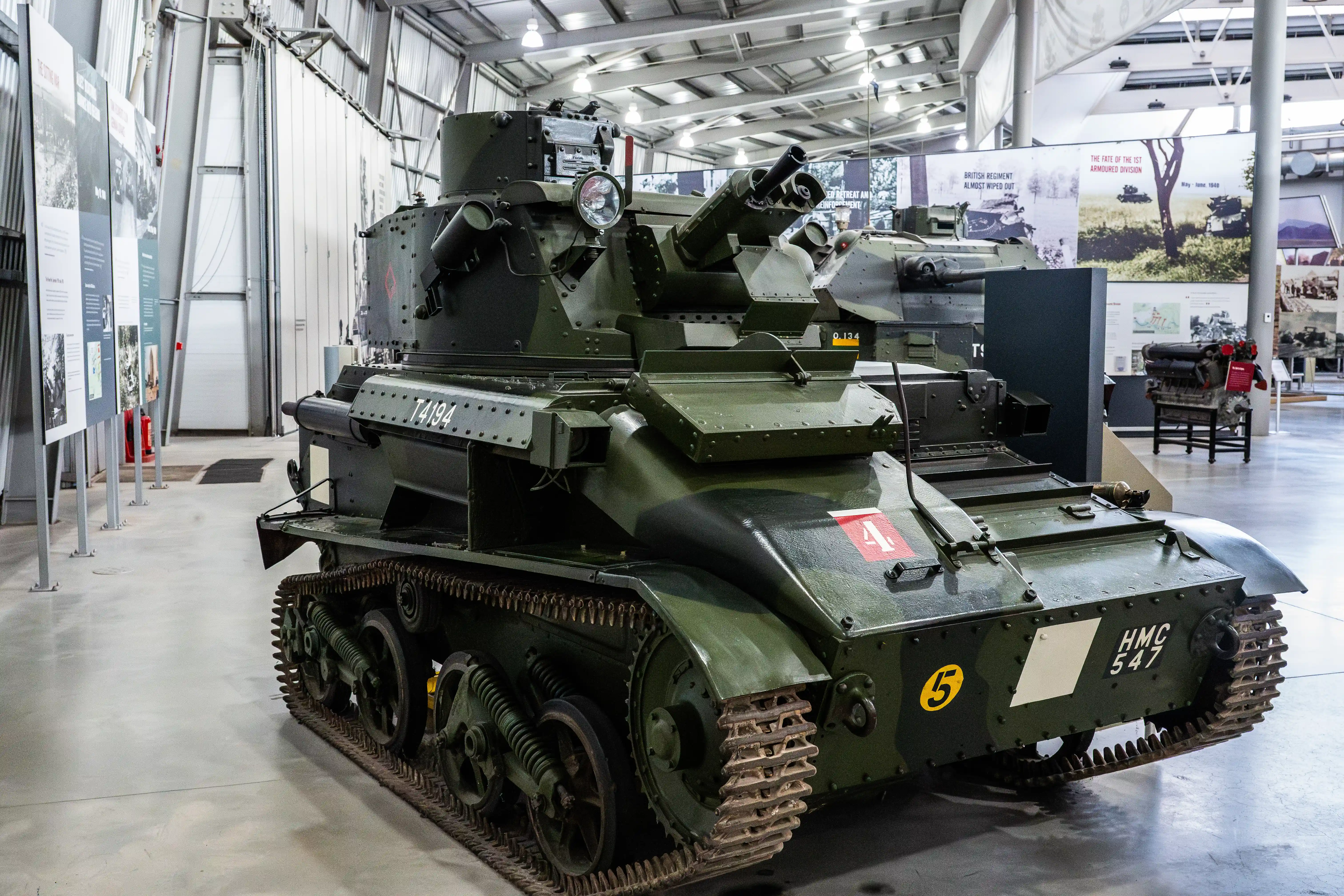
The image depicts a vintage military tank on display in a museum. The tank is green and has caterpillar tracks, with various markings and numbers on its body, including 'T4194' and 'HMC 547'. It is equipped with a turret mounted on top, which houses a large gun. The museum setting is evident from the informational displays and other military artifacts visible in the background.
Vickers Light Tank Mk VI ‐ 
photo by ,
©www.mgaylard.co.uk.

Cold War Armour

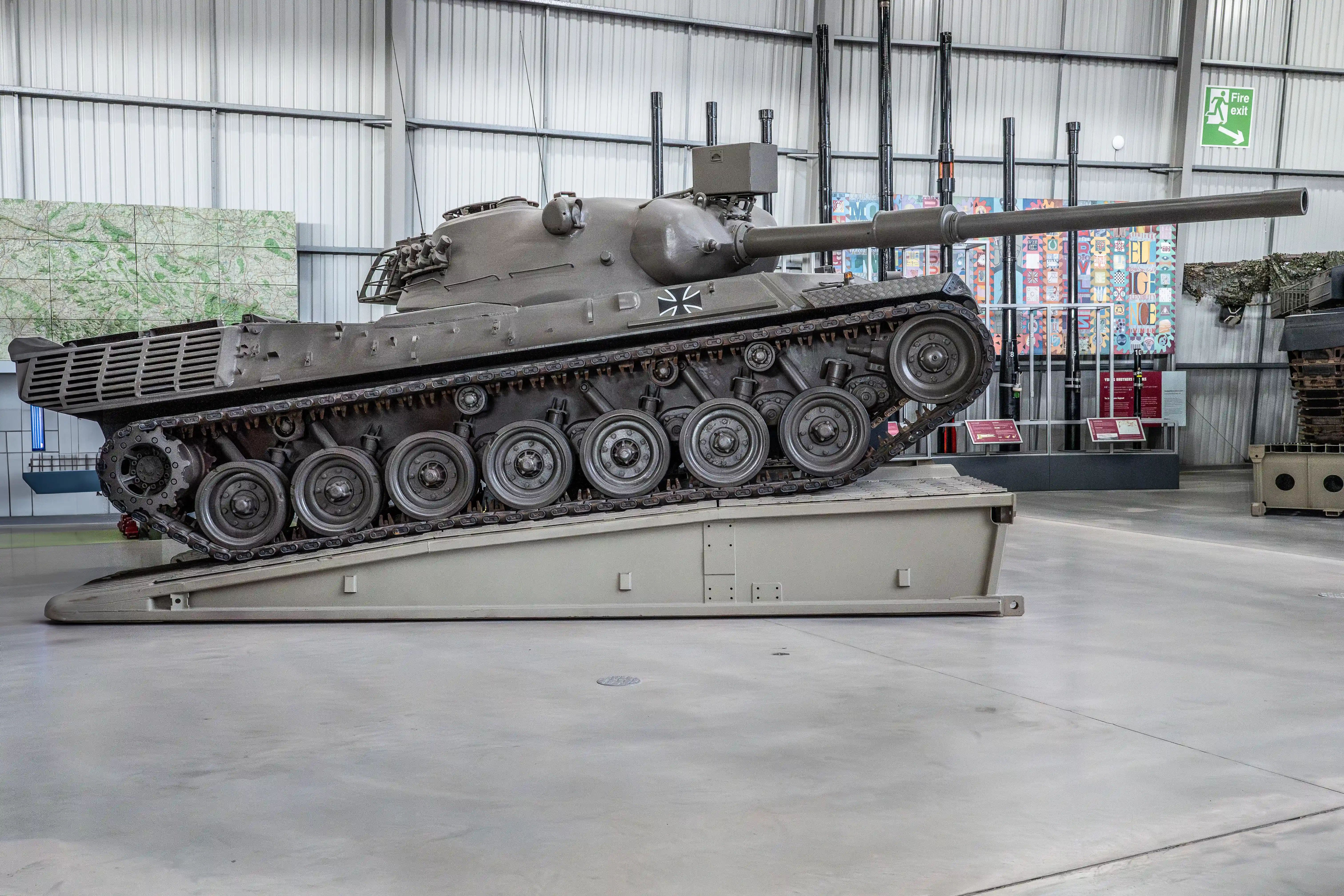
The image depicts a tank displayed in a museum setting. The tank is elevated on a platform, showcasing its tracks and underbelly. The environment appears to be indoors with a large, open space and high ceilings. There are informational placards near the tank, likely providing details about its history and specifications. The overall setting suggests an educational exhibit focused on military history.
German Leopard 1 Main Battle Tank  ‐ 
photo by ,
©www.mgaylard.co.uk.
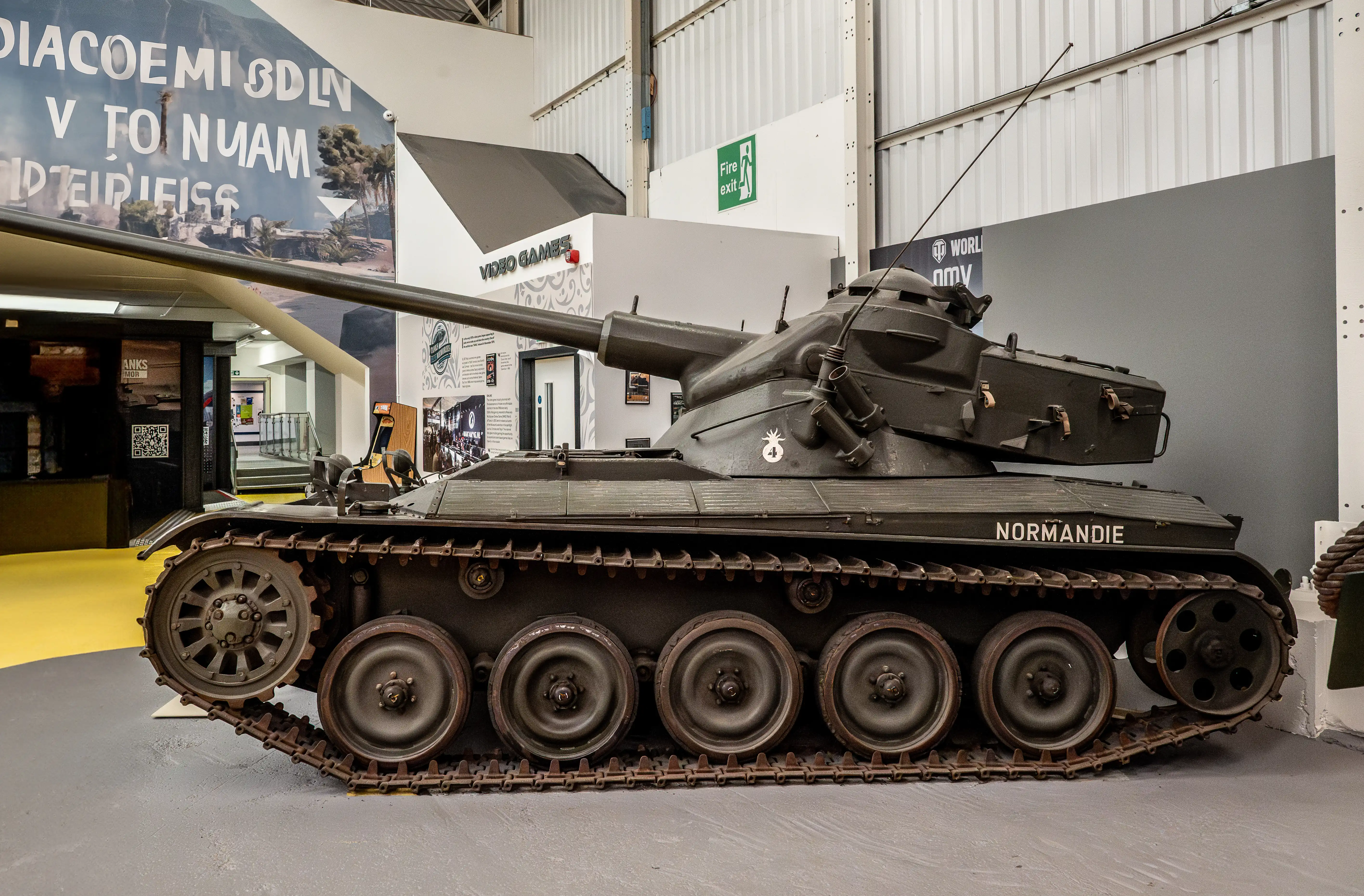
The image depicts a military tank named 'NORMANDIE' displayed indoors, likely in a museum or exhibition setting. The tank is positioned on a flat surface with tracks visible, and it features a large gun barrel extending from its turret. Surrounding the tank are various informational displays and signs, including a fire exit sign and a QR code on a nearby wall. The environment suggests an educational exhibit focused on military history, specifically related to World War II.
AMX-13 ‐ 
photo by ,
©www.mgaylard.co.uk.
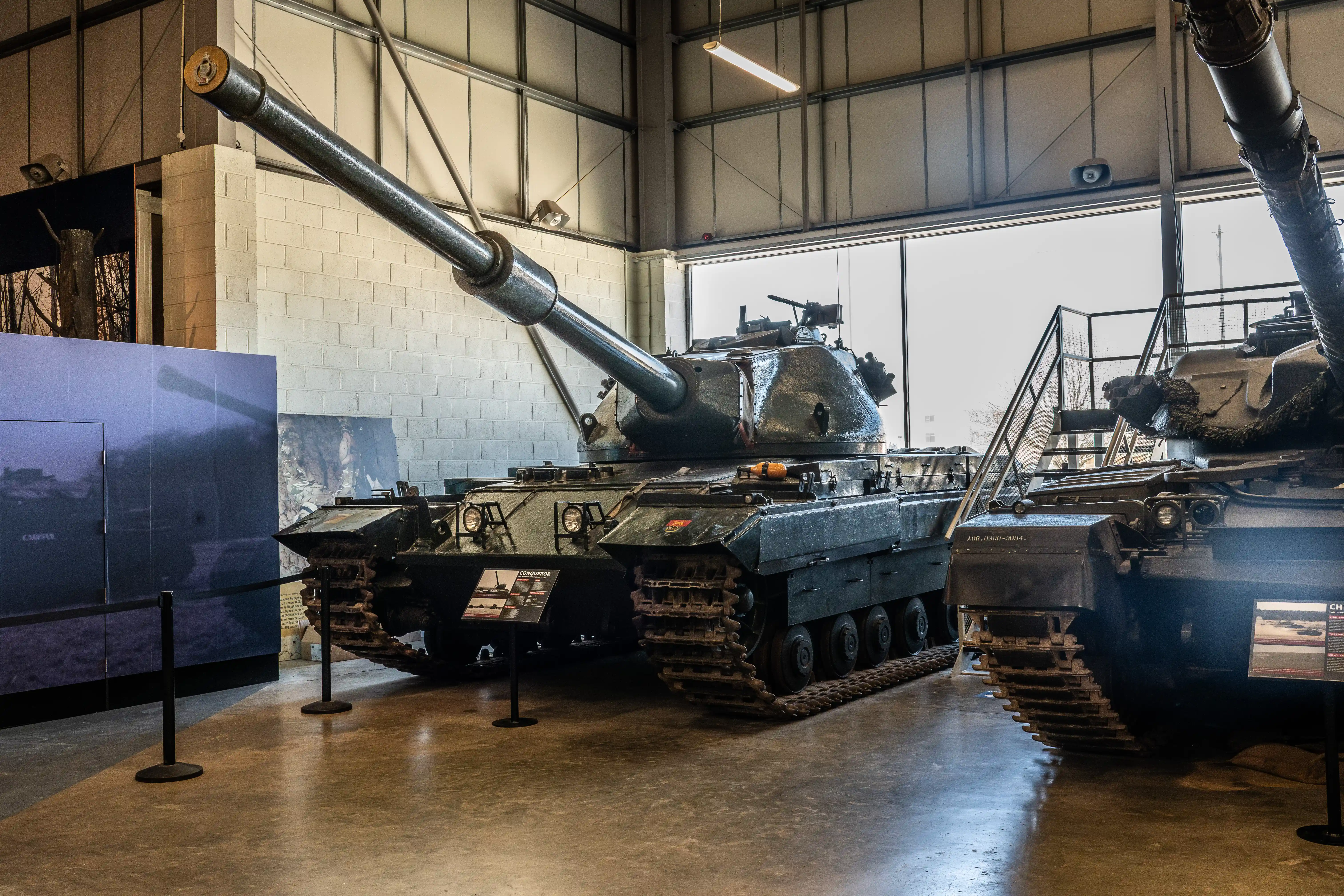
The image depicts a military museum exhibit featuring several tanks. The central tank has a large, prominent gun barrel, and there are informational placards in front of each tank, likely providing details about their history and specifications. The exhibit is housed in a spacious, well-lit hangar with large windows, allowing natural light to illuminate the display area.
FV214 Conqueror ‐ 
photo by ,
©www.mgaylard.co.uk.
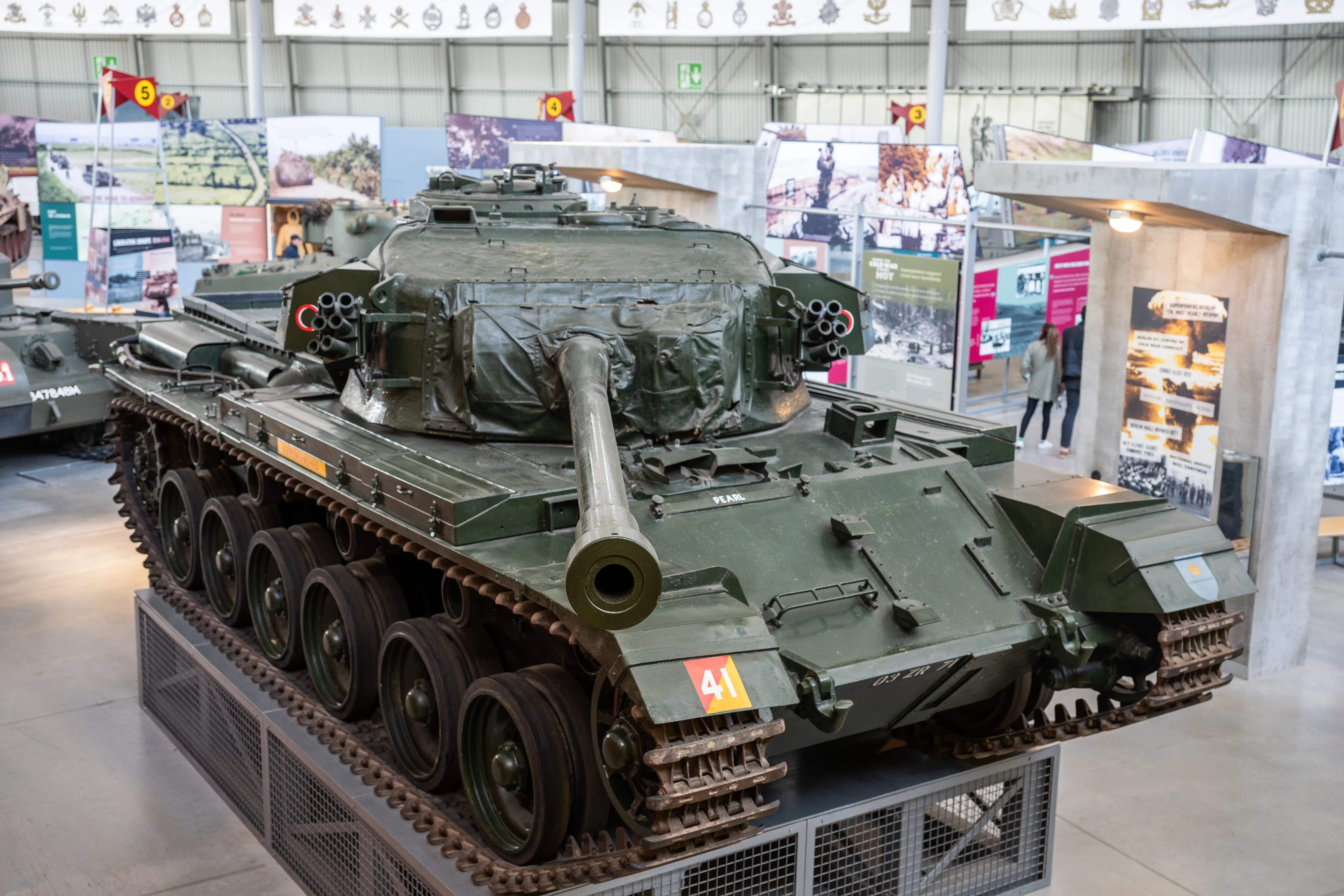
The image depicts a military tank displayed in a museum setting. The tank is painted in a green camouflage pattern and features a large cannon mounted on its turret. The surroundings include various informational displays and banners, suggesting an exhibition focused on military history or armored vehicles. The tank is positioned on a raised platform with protective barriers around it, indicating it is a significant exhibit. The overall scene suggests an educational environment aimed at showcasing historical military equipment.
Centurion ‐ 
photo by ,
©www.mgaylard.co.uk.
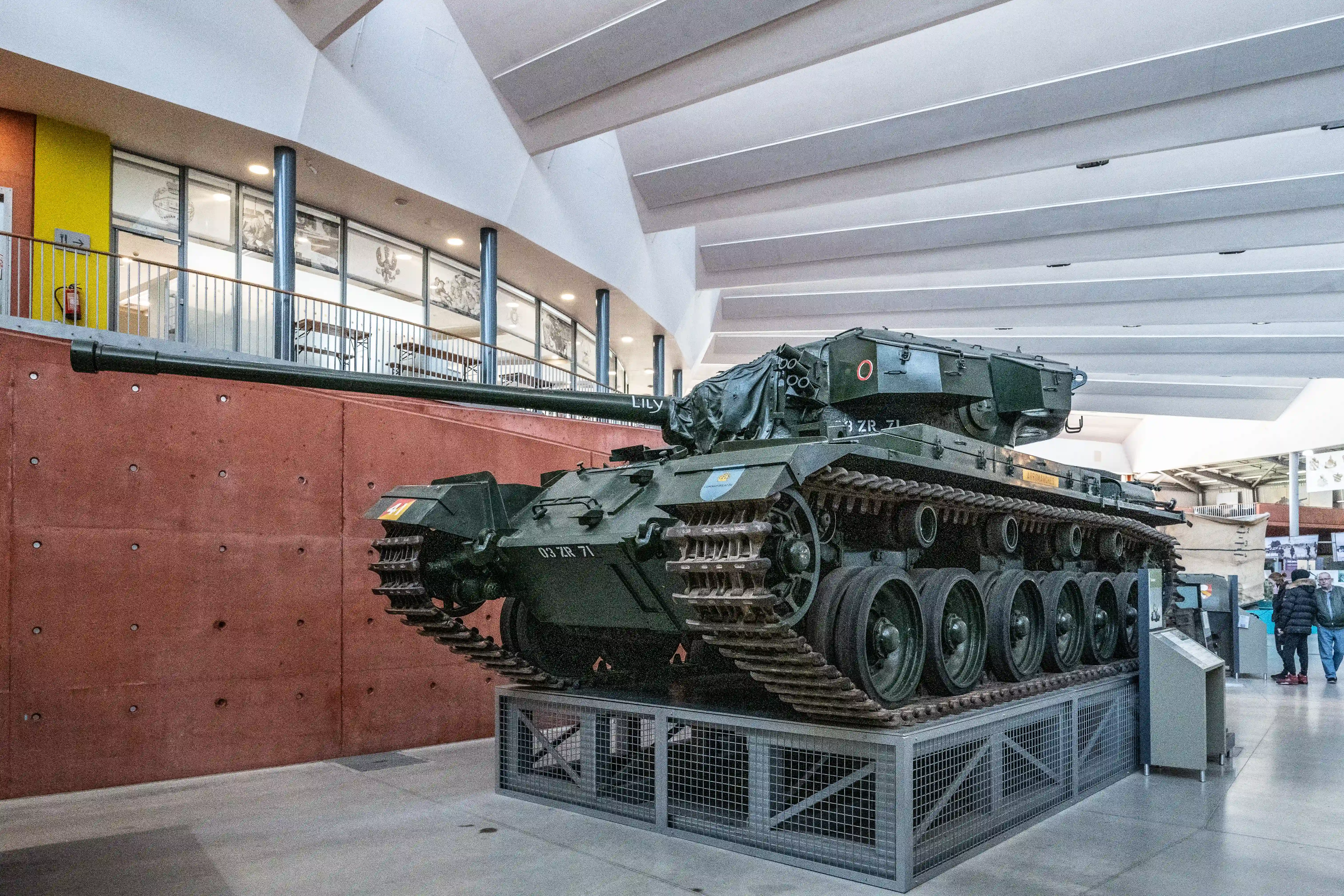
The image shows a military tank displayed indoors, likely in a museum or exhibition setting. The tank is mounted on a platform with a protective metal grate surrounding it. The interior space features modern architectural elements, including a high ceiling with linear lighting, large windows, and a balcony with railings. There are informational displays and a few people observing the exhibit.
Centurion ‐ 
photo by ,
©www.mgaylard.co.uk.

The Centurion is the archetypal post-war British main battle tank — the machine that finally solved Britain’s WWII armour problems by combining heavy-tank protection, cruiser-tank mobility, and world-class firepower. With 4,423 built, combat service from Korea to the Gulf, and a design life stretching over 60+ years, it is arguably the most successful Western tank of the Cold War.
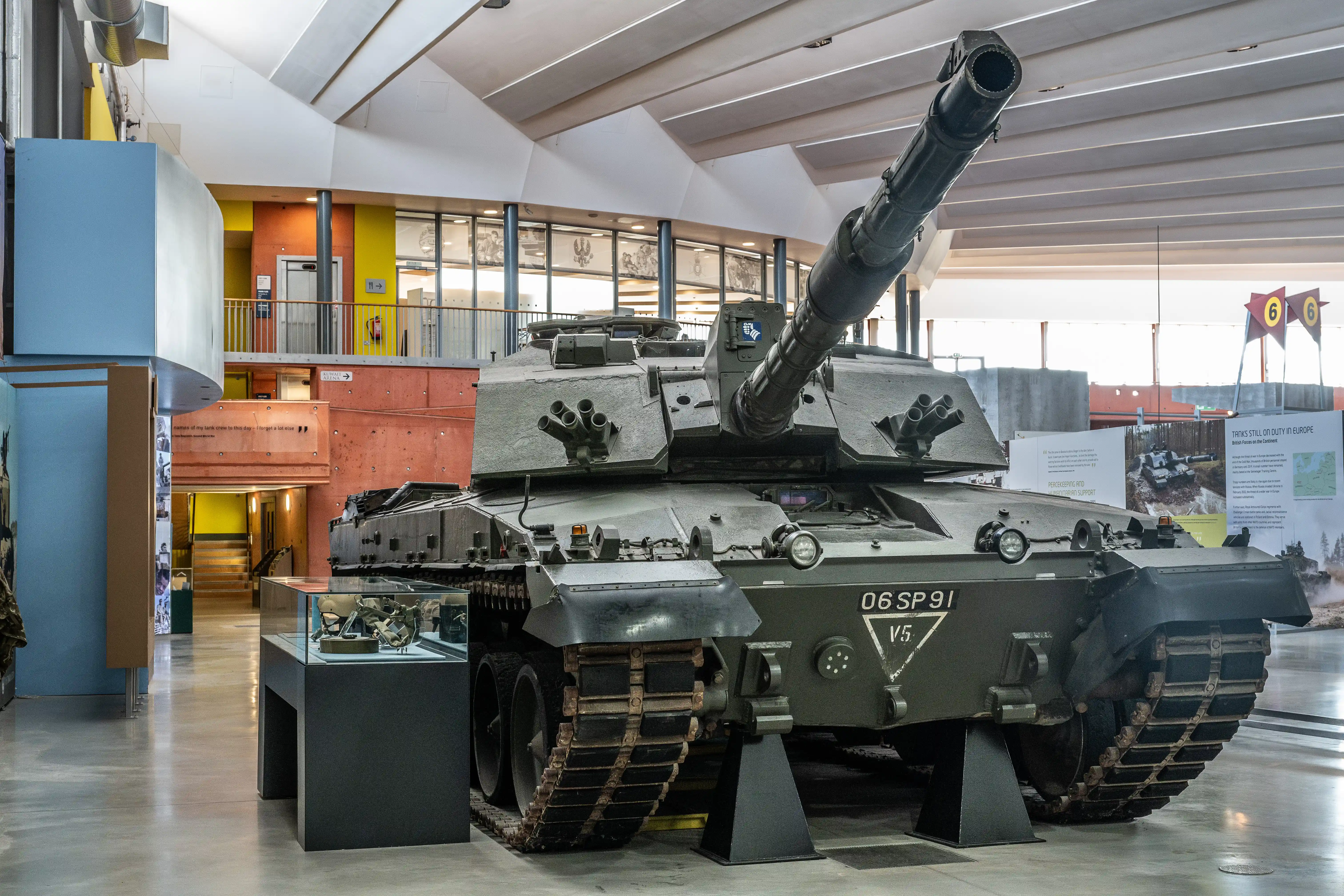
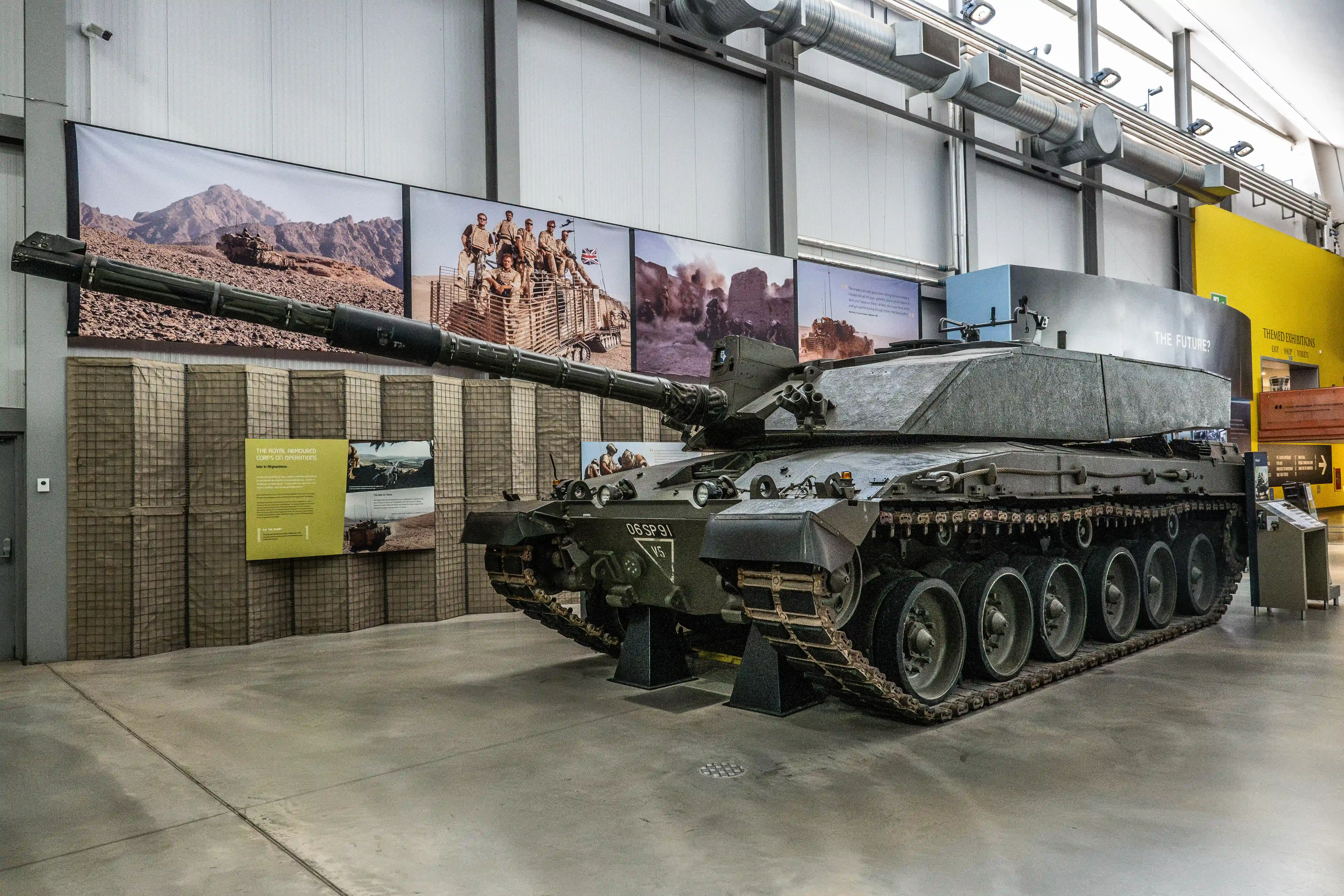
The image shows a military tank displayed in a museum setting. The tank is labeled '06 SP 91 V5' and is positioned indoors with various informational displays and artifacts around it. The museum has a modern design with large windows and multiple floors, providing a well-lit and spacious environment for visitors to explore.
Challenger I ‐ 
photo by ,
©www.mgaylard.co.uk.
The image depicts a military tank displayed in a museum setting. The tank is prominently positioned in the center of the image, with its large gun barrel extending forward. The surroundings include informational panels and photographs related to the tank and its historical context, suggesting that this exhibit is part of a larger display about military history. The environment appears to be well-lit and organized, indicating a well-maintained exhibition space.
Challenger I ‐ 
photo by ,
©www.mgaylard.co.uk.
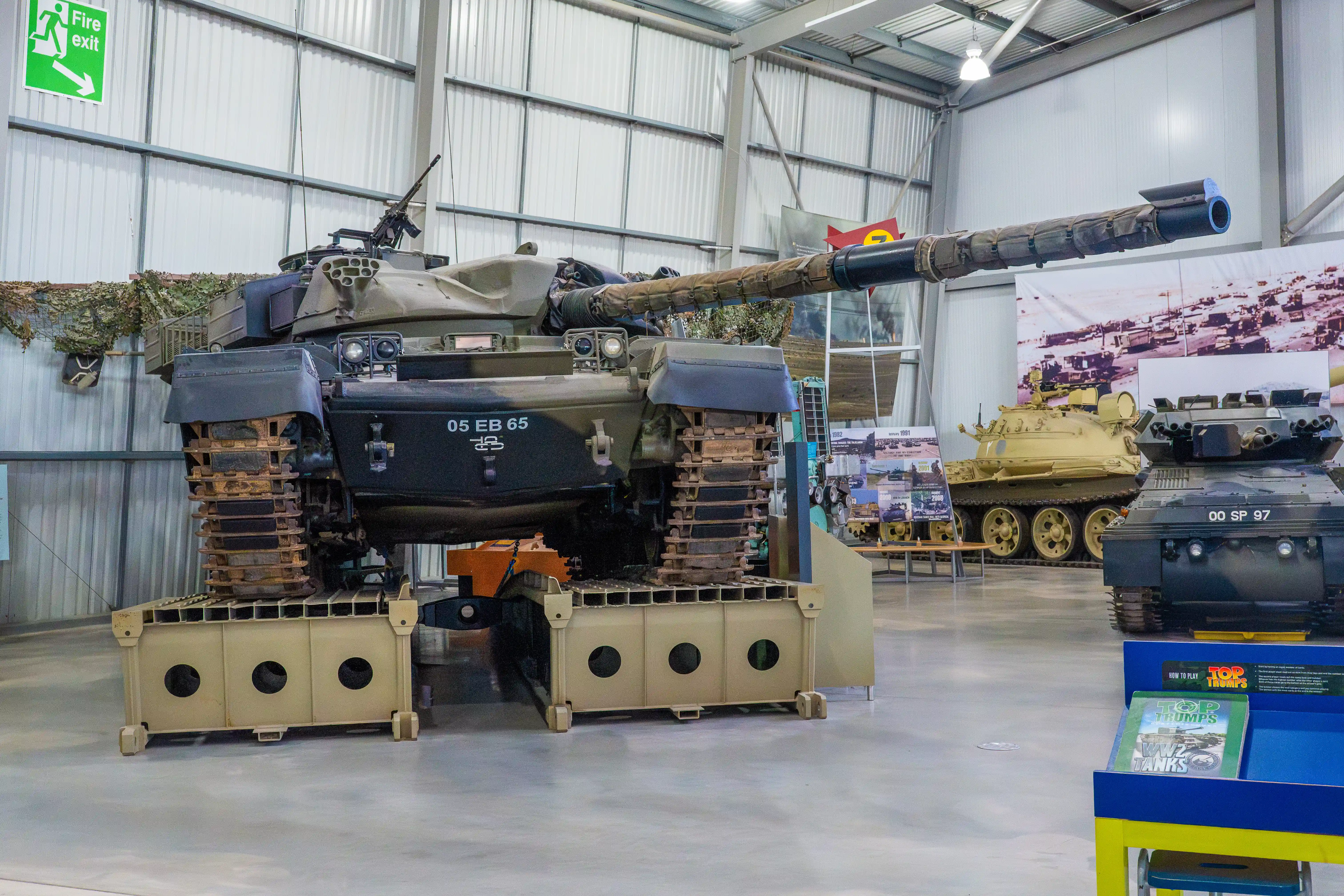
The image depicts an indoor exhibition of military tanks. The main tank in the foreground is elevated on supports, showcasing its underside. Other tanks are also on display in the background. The setting appears to be a well-lit, spacious hangar with informational displays and a fire exit sign visible. The exhibition likely focuses on military vehicles, providing educational insights into their design and historical significance.
Chieftain ‐ 
photo by ,
©www.mgaylard.co.uk.
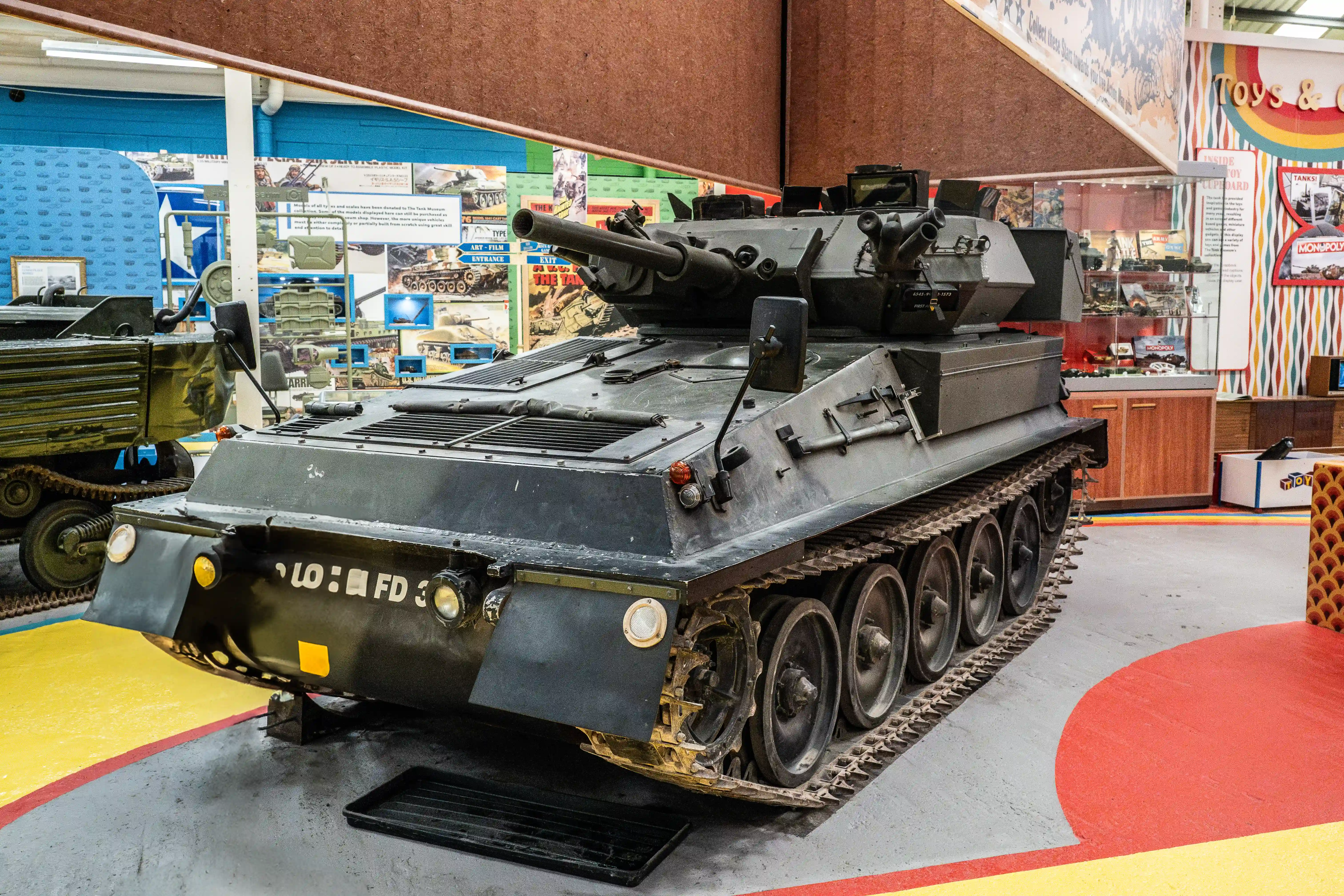
The image shows a military tank on display in a museum setting. The tank is positioned on a colorful floor with a yellow, red, and blue design. The tank has a large gun mounted on top and is surrounded by various informational posters and displays related to military vehicles. The environment suggests an educational exhibit aimed at informing visitors about the history and types of tanks.
FV101 Scorpion ‐ 
photo by ,
©www.mgaylard.co.uk.
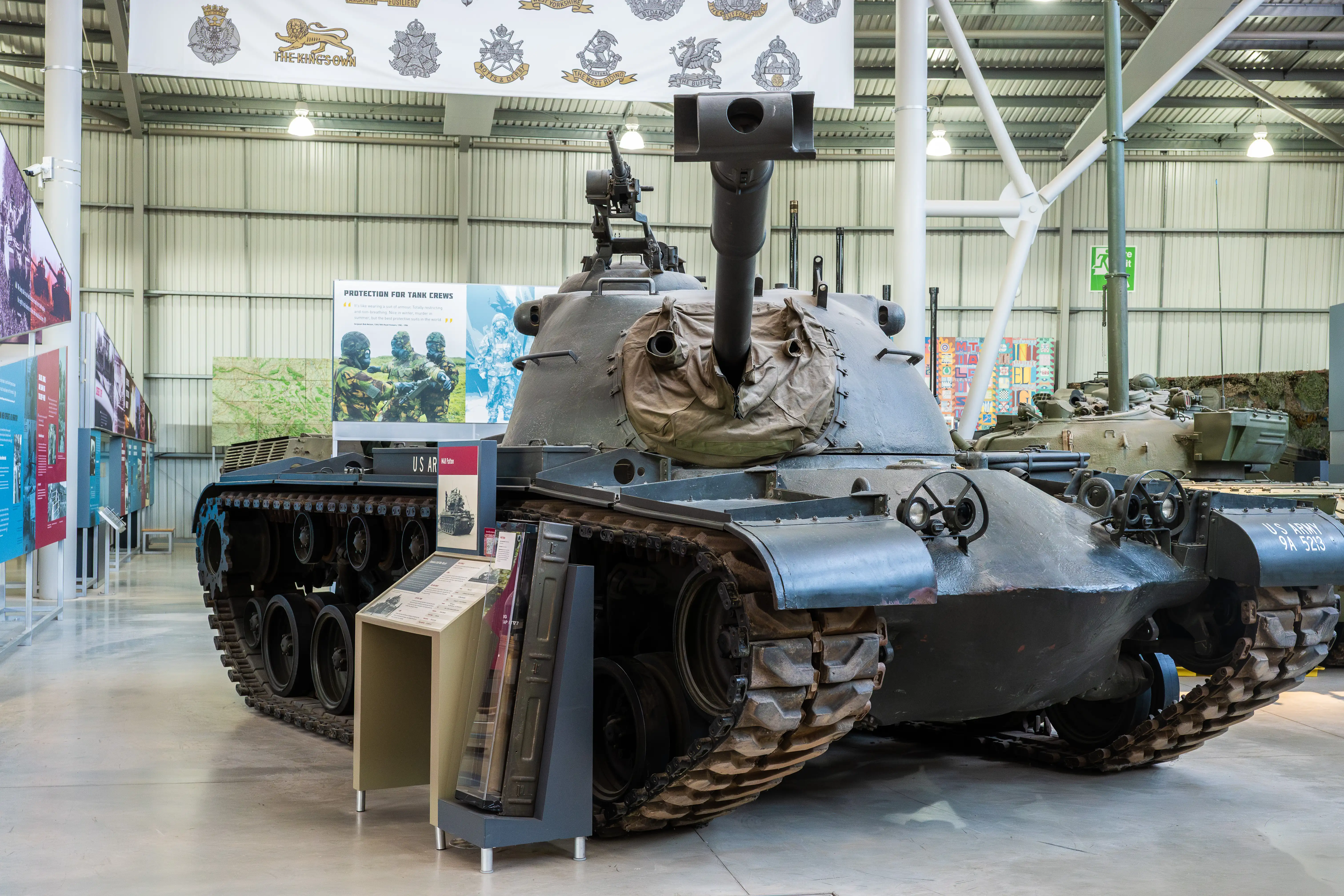
The image depicts a military tank displayed in a museum. The tank is surrounded by informational placards and is housed in a large, well-lit exhibition hall. Various military insignia and banners are visible on the ceiling, and other military vehicles and exhibits can be seen in the background.
M48 Patton ‐ 
photo by ,
©www.mgaylard.co.uk.
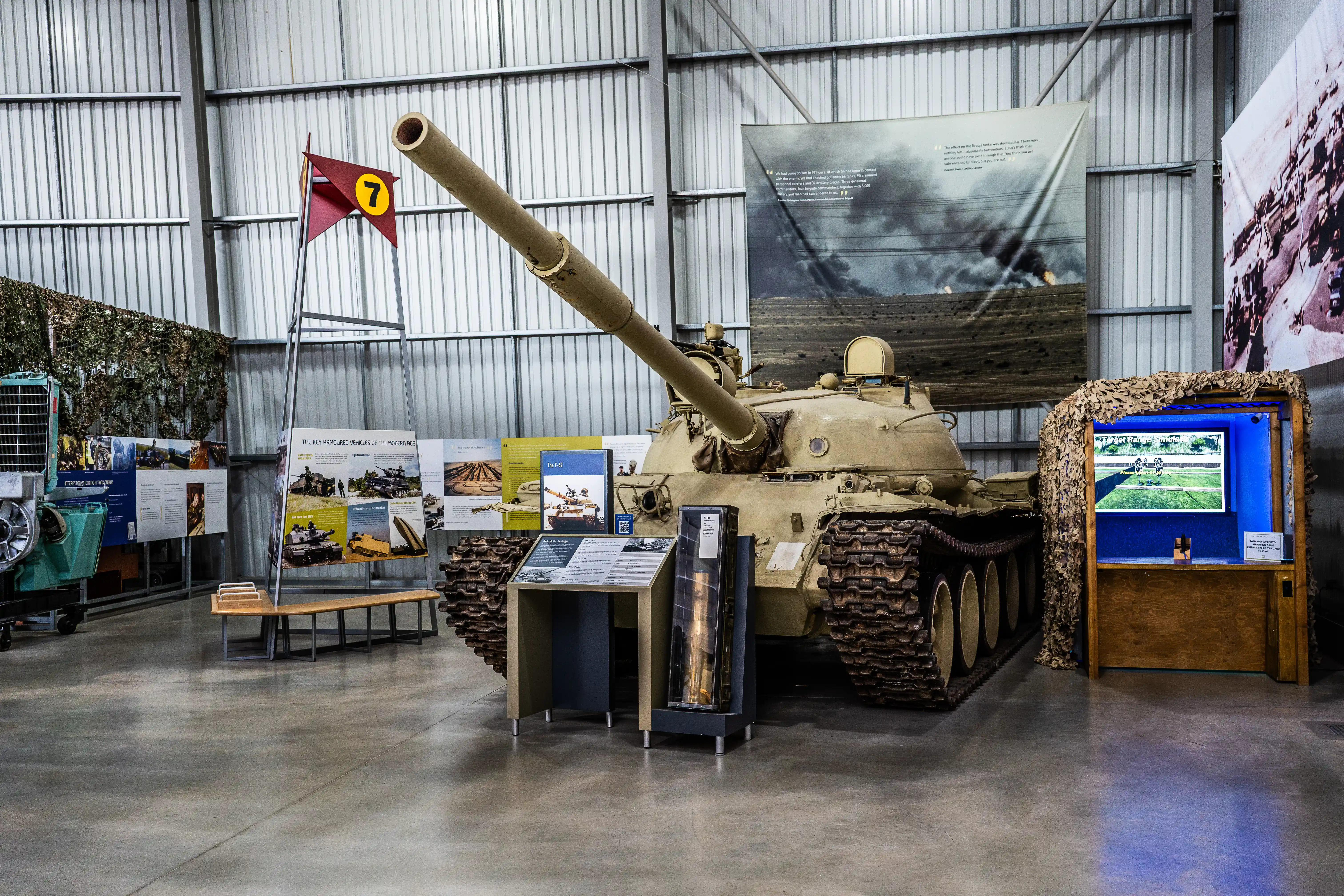
The image depicts an indoor exhibit featuring a military tank as the central piece. Surrounding the tank are various informational displays and panels providing context and details about the tank and related military vehicles. The exhibit is housed in a spacious, well-lit hangar-like structure with high ceilings and large windows. There are additional artifacts and educational materials placed around the tank, enhancing the educational experience for visitors. The overall setting suggests a museum or educational facility focused on military history and technology.
T-62 ‐ 
photo by ,
©www.mgaylard.co.uk.
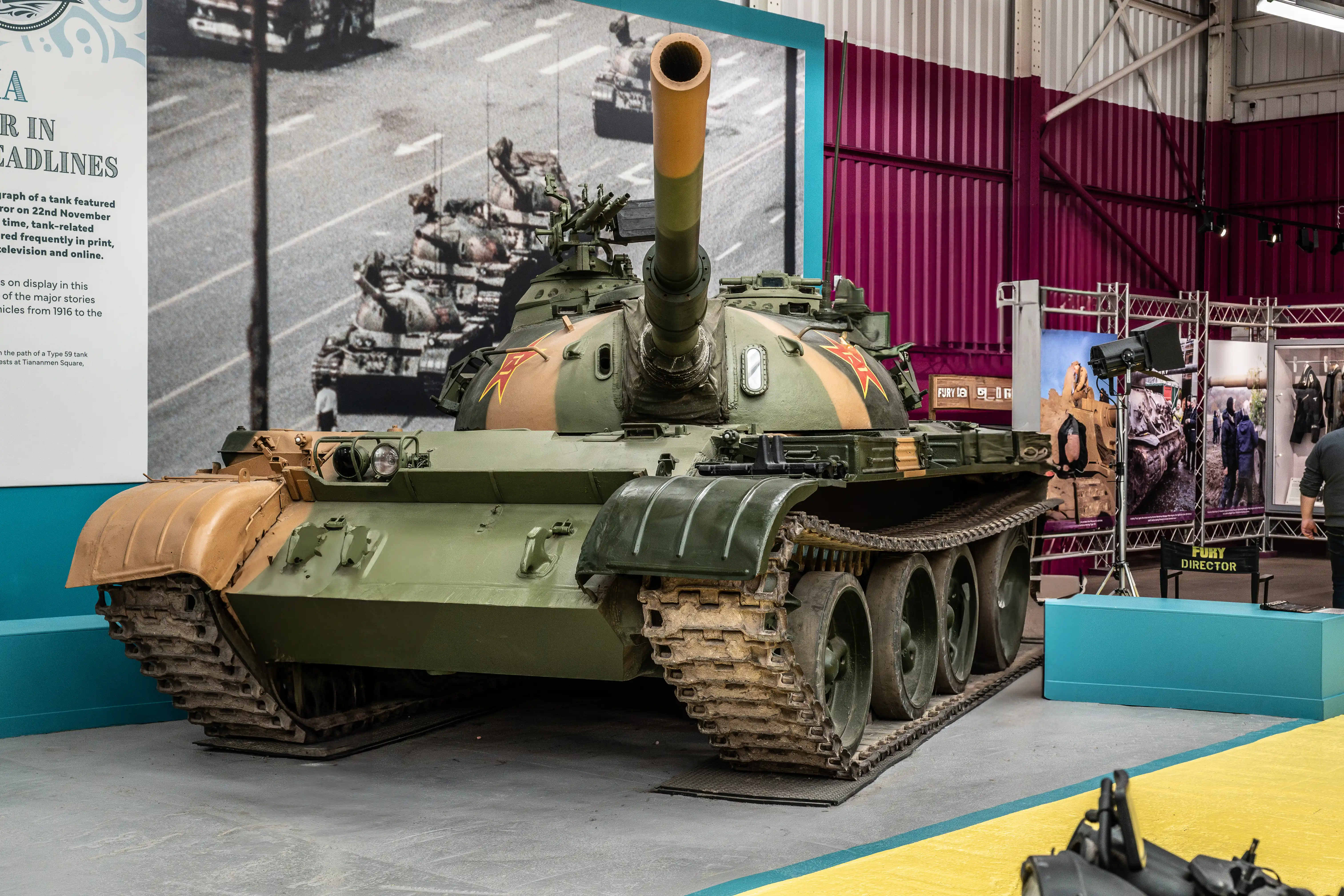
The document discusses the prominence of tanks in news headlines, noting that a photograph of a tank featured prominently in a news report on 22nd November. It highlights that tanks are frequently covered in various media formats, including print, television, and online platforms. The text also mentions a display of major tank models from 1916 to the present, including a Type 59 tank involved in the events at Tiananmen Square.
Type 59 ‐ 
photo by ,
©www.mgaylard.co.uk.
Open the full set flickr button this page

The Tank Museum, Bovington: Where Iron Giants Tell Their Stories

The Tank Museum in Bovington, Dorset, is home to the world’s finest collection of tanks and armoured vehicles, spanning from World War I to modern marvels like the Challenger 2. The museum is renowned for its immersive exhibits, including the world’s only working Tiger 131 tank, live tank demonstrations, and family-friendly interactive displays. It is open daily, with most visitors spending 3–5 hours exploring the indoor and outdoor exhibits. Special events like TANKFEST, featuring arena displays and historical re-enactments, are highlights of the museum’s calendar

The Birthplace of the Tank

Perched on the windswept Dorset heathland, the Tank Museum at Bovington is more than a collection of armored beasts—it is the spiritual home of the tank itself. It was here, in 1916, that the British Army first mustered its tank regiments, training crews in the art of mechanized warfare before sending these clanking titans into the mud and blood of the Western Front. The museum’s origins lie in the aftermath of the Great War, when the poet and storyteller Rudyard Kipling visited Bovington and, moved by the sight of battle-scarred tanks rusting in the fields, urged that they be preserved as a memorial to the men who fought and died in them. His vision gave birth to a museum that now houses the world’s finest collection of armored vehicles, a living chronicle of warfare’s evolution from the trenches to the digital age.

A Parade of Steel and Sacrifice

Within the museum’s halls, the story of the tank unfolds in steel and fire. Here stand the pioneers: “Little Willie,” the first British prototype, its riveted hull a testament to the desperate ingenuity of 1915; the Whippet, sleek and swift, designed to exploit breakthroughs in the enemy lines; and the mighty Tiger 131, the only operational Tiger I tank in the world, its restored engine growling with the same menace it once brought to the battlefields of North Africa. Each vehicle carries its own tale—of crews who endured the infernal noise and heat of battle, of designers who pushed the boundaries of technology, and of battles that turned the tide of history. The museum’s exhibits are not just static relics; many are lovingly restored to running condition, their tracks rumbling to life during dramatic “Tanks in Action” displays, a thunderous reminder of their fearsome past.

From the Somme to the Modern Age

The Tank Museum’s collection spans a century of armored warfare, from the crude, lumbering machines of 1916 to the sophisticated killing machines of the 21st century. Here, the visitor can trace the evolution of the tank—from the Mark I’s first faltering advance at the Somme to the Challenger 2’s precision strikes in the deserts of Iraq. The museum does more than display hardware; it tells the human stories behind the metal. Exhibits like “War Stories” bring to life the experiences of the Royal Armoured Corps, while interactive displays and immersive dioramas place visitors in the heart of the action, from the mud of Passchendaele to the sands of the Gulf. It is a place where history is not just observed, but felt

A Living Memorial

Bovington is more than a museum; it is a shrine to the men and women who served in armored units, a place where their courage and sacrifice are honored. The tanks here are not merely machines—they are monuments to the crews who lived, fought, and often died within their steel hulls. The museum’s mission is to educate and inspire, to ensure that the lessons of the past are not forgotten, and that the stories of those who shaped the history of armored warfare endure. For anyone who has ever been captivated by the romance of military history or the raw power of these mechanical giants, a visit to Bovington is a pilgrimage—a chance to stand in the presence of legends

References

en.wikipedia.orgwarfarehistorynetwork.comwww.historyhit.comwww.dorsets.co.uktankmuseum.org , Text generated by Mistral AI
To the top
Powered by w3.css. The images are all stored on link to www.gaylard.co.uk Photostream on Flickr   This website is hosted by link to 123Reg Web Hosting