HOME

Palácio da Bolsa

Palácio da Bolsa

Palácio da Bolsa

Praça do Infante D. HenriquePorto4050-292,   Portugal

The Palácio da Bolsa (Porto Stock Exchange Palace) is a 19th-century neoclassical palace located in the historic center of Porto, Portugal. Built between 1842 and 1910, the palace was designed to serve as the headquarters of the Porto Commercial Association and symbolizes the city’s economic and cultural prosperity during the 19th century. Today, it is one of Porto’s most iconic landmarks and a UNESCO World Heritage Site, renowned for its opulent interiors, grand architecture, and historical significance. The palace is open to the public for guided tours, offering visitors a glimpse into Porto’s rich commercial and cultural past.
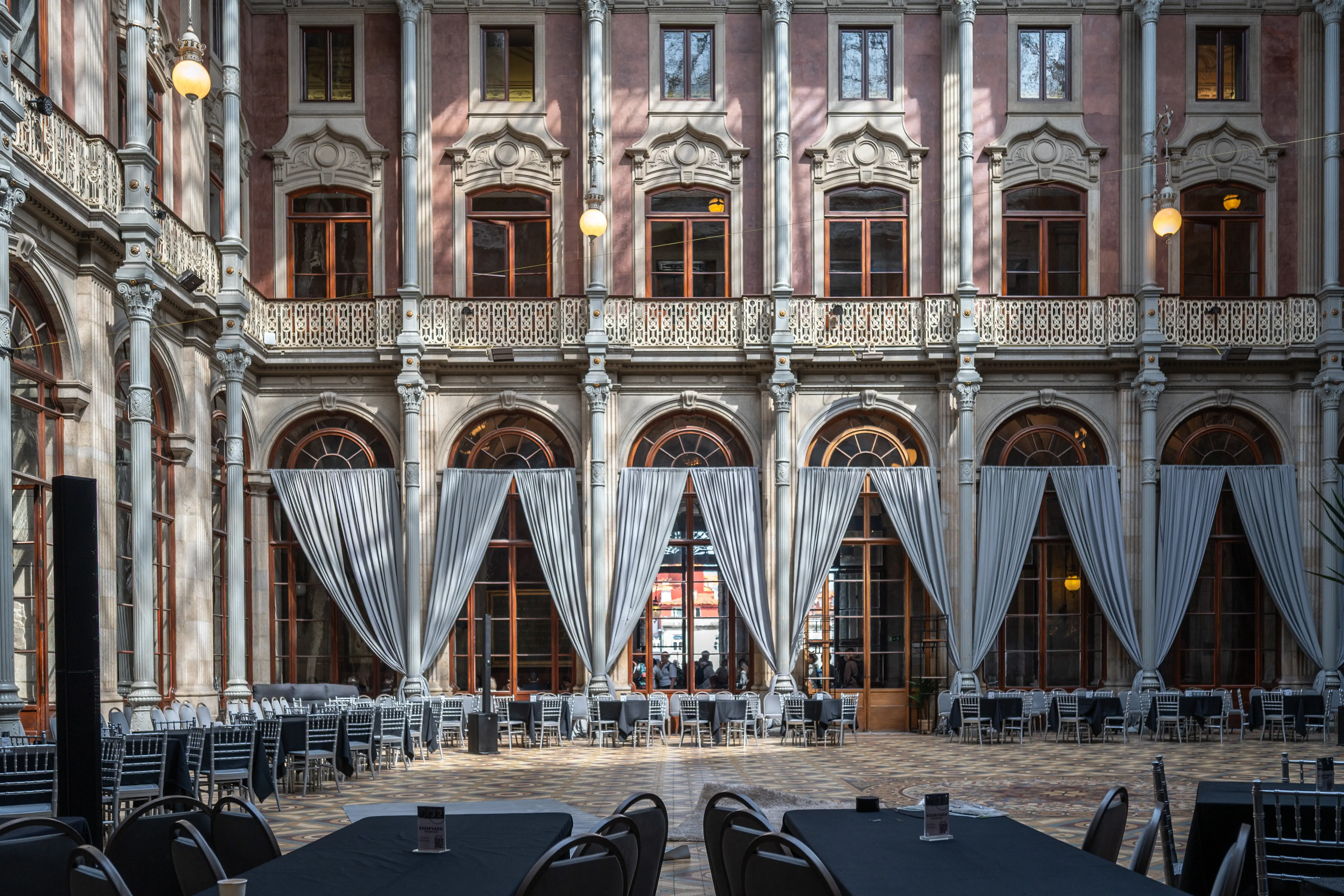
A wide shot of an ornate indoor courtyard, decorated for an event with rows of black-covered tables and chairs. Large windows with arched tops are draped with grey curtains. The architecture features multiple levels, decorative columns, and balconies with intricate metalwork.
An Ornate Courtyard Set for an Event ‐ photo by ,
©www.mgaylard.co.uk.
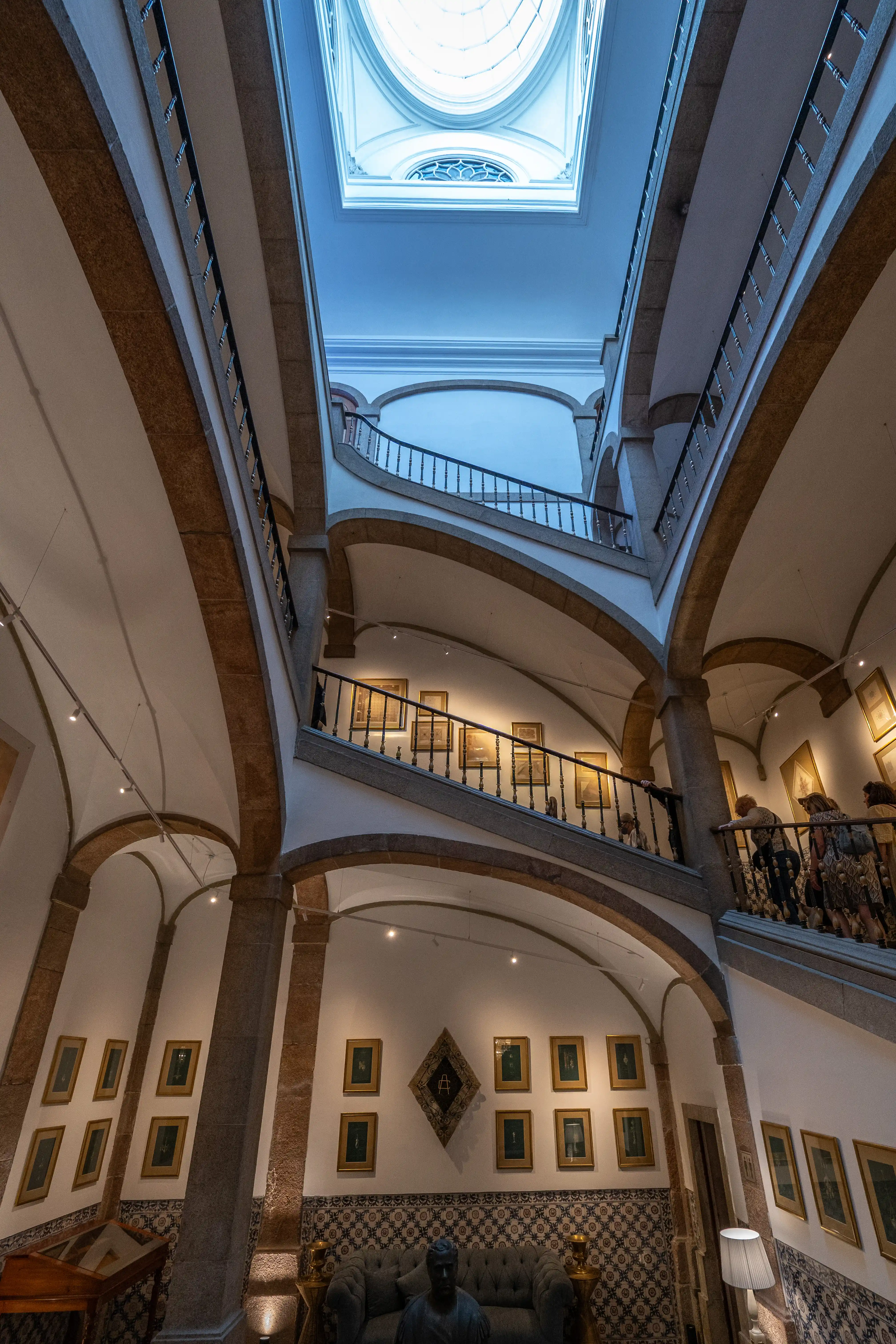
Wide-angle view looking up at a grand, multi-tiered staircase in a museum, featuring stone arches, a central skylight, framed artwork on the walls, and several visitors.
A Multi-Level Museum Staircase with Artwork ‐ photo by ,
©www.mgaylard.co.uk.
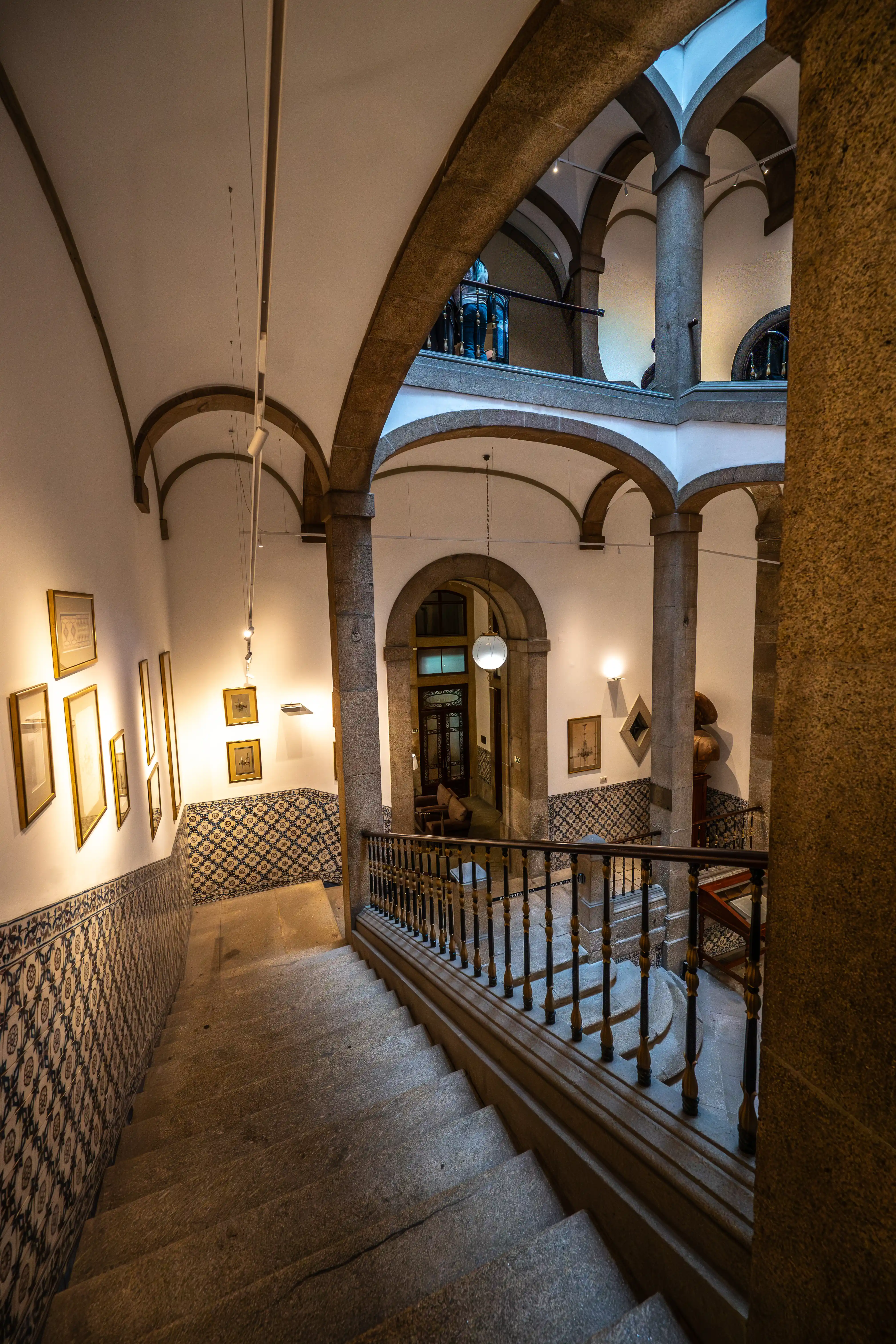
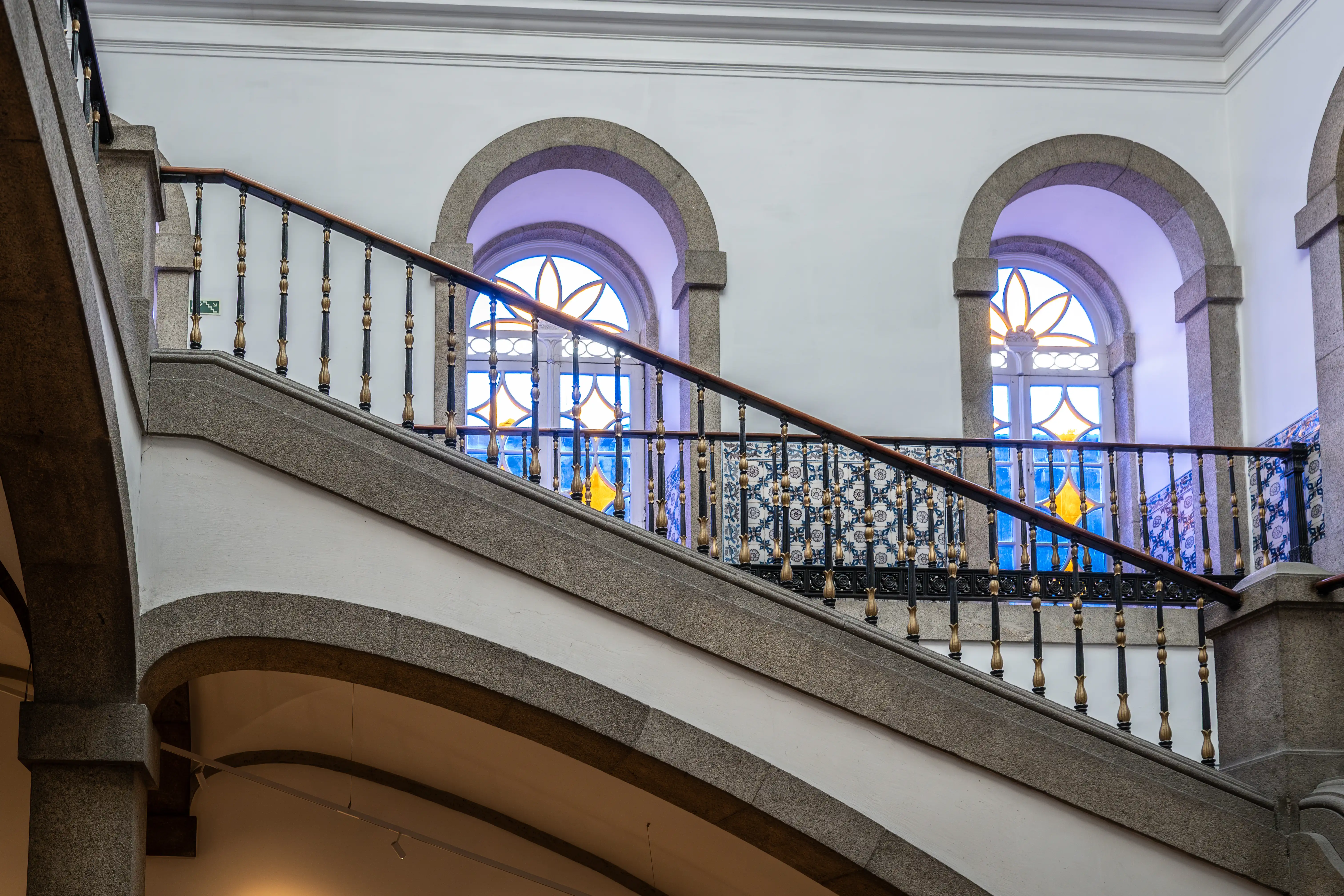
A wide stone staircase curves downwards, flanked by walls decorated with framed paintings and traditional blue and white tiled patterns. Arched stone columns and vaulted ceilings create a sense of grandeur in the interior space, with a decorative wooden banister guiding the way.
Ornate Staircase with Arches and Artwork ‐ photo by ,
©www.mgaylard.co.uk.
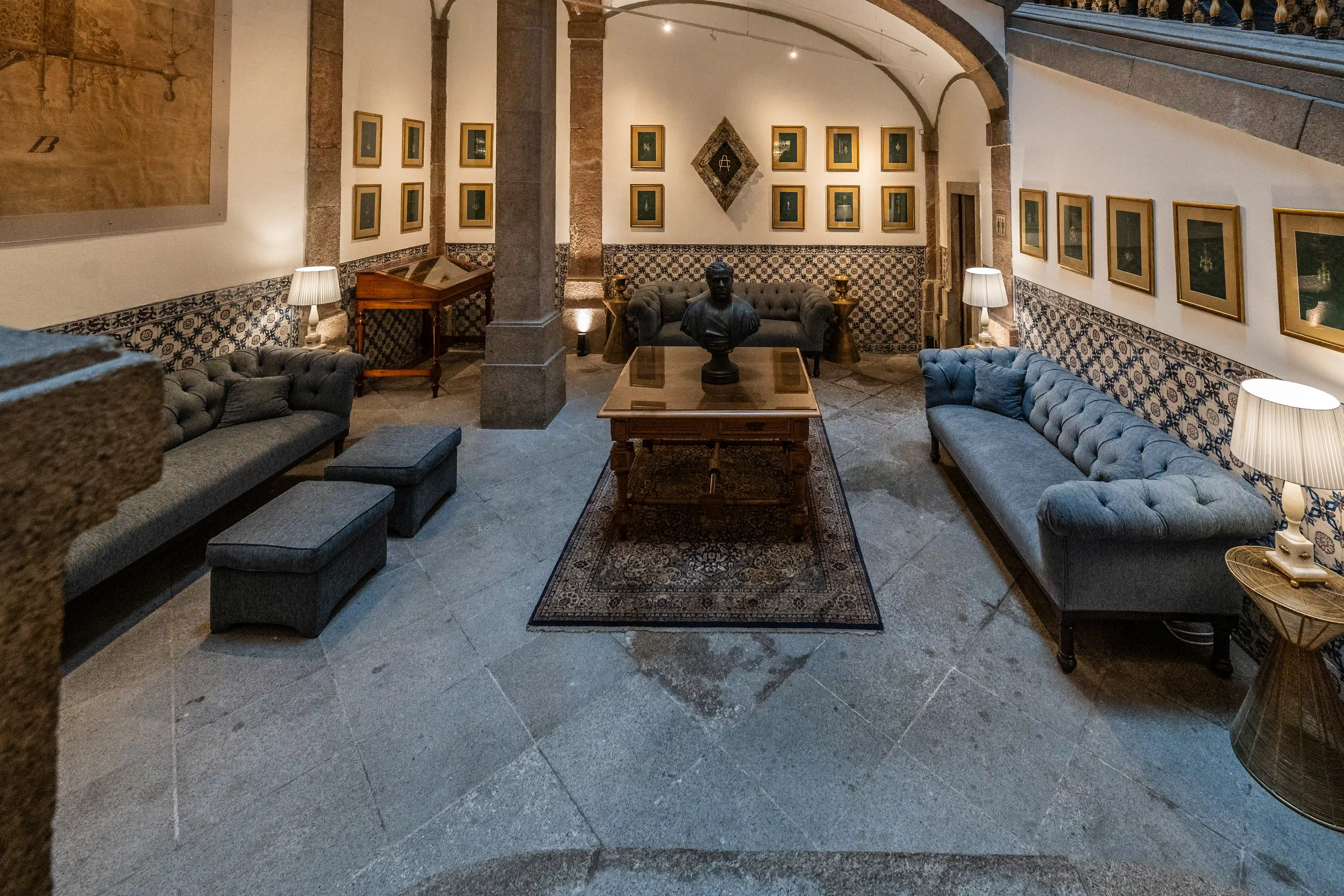
A formal lounge area with two deep blue tufted sofas, a wooden coffee table with a bust, a patterned rug, and a tiled wall featuring framed artwork. Stone pillars and arched doorways add to the room's historic ambiance.
Palácio da Bolsa ‐ photo by ,
©www.mgaylard.co.uk.
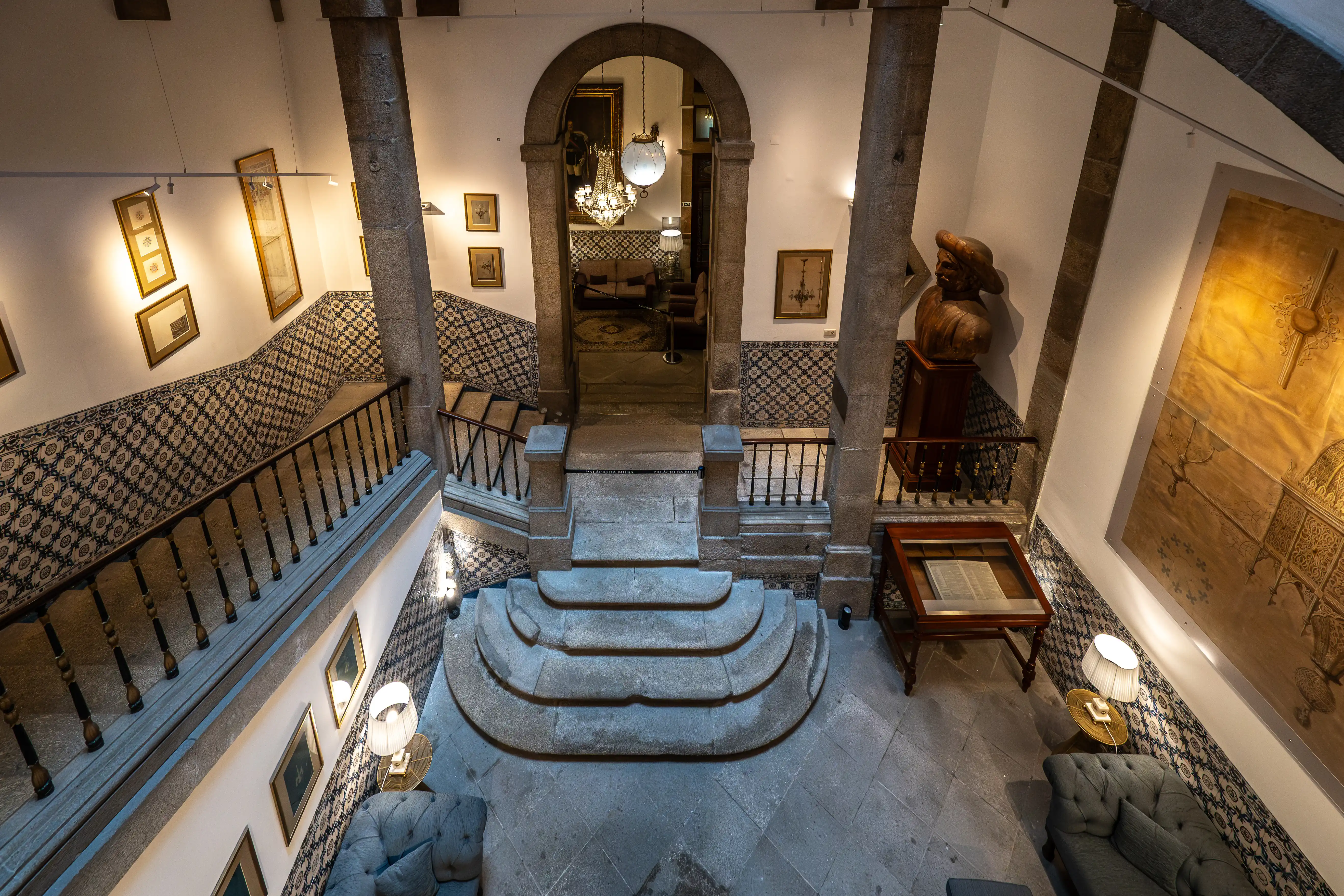
 Interior view from above of a grand staircase hall with patterned tiles, stone steps, a bust, paintings, and antique furniture.
Staircase Hall with Azulejo Tiles and Art ‐ photo by ,
©www.mgaylard.co.uk.
High-angle view of a grand interior staircase with curved stone steps, walls covered in black and white patterned azulejo tiles, framed artwork, a bust on a pedestal, a wooden banister, and a grey sofa with a lamp in the foreground.
Interior View of a Historic Building with a Grand Staircase ‐ photo by ,
©www.mgaylard.co.uk.
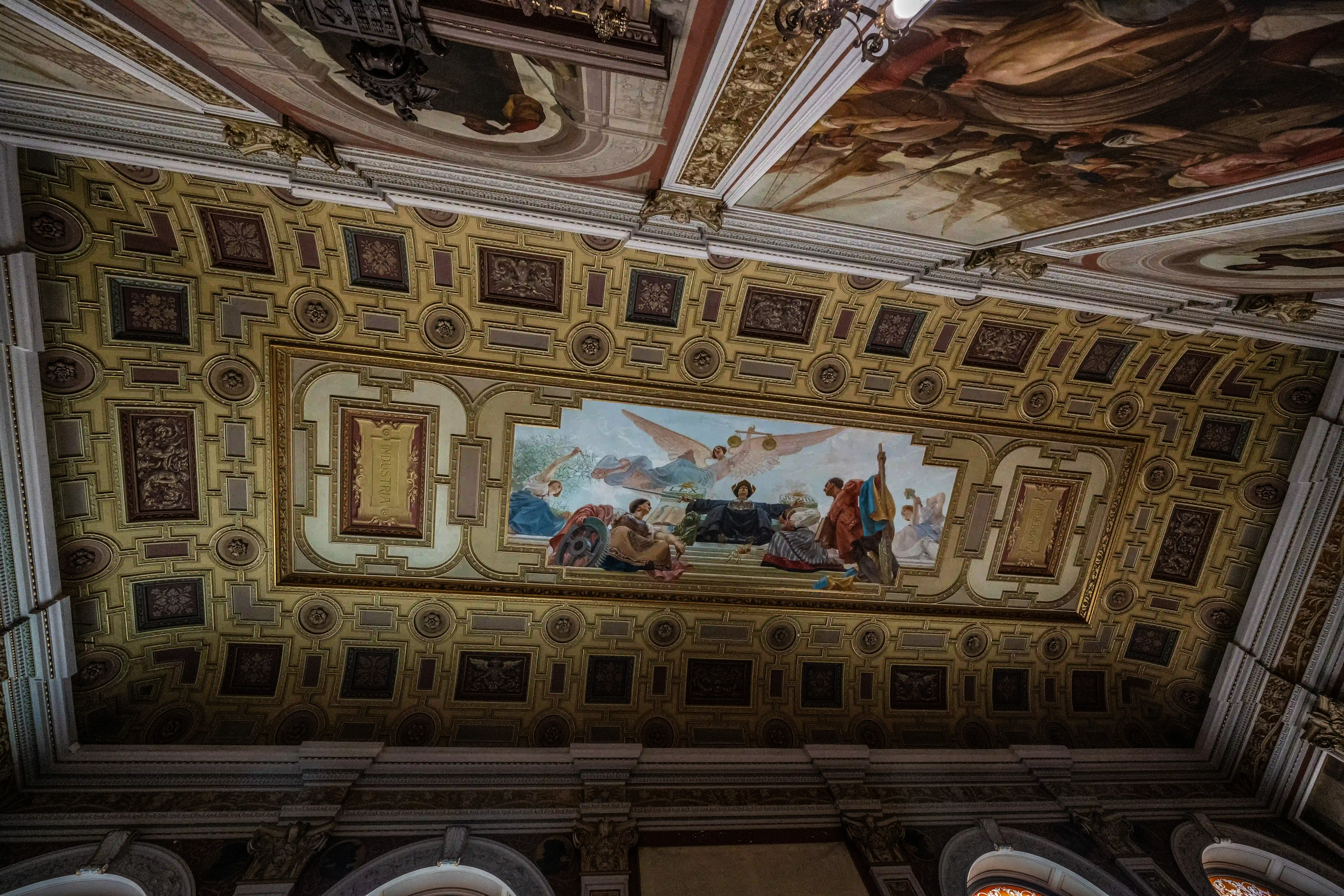
Low-angle view of a highly ornate gold ceiling with a central fresco depicting figures and an angel, surrounded by decorative patterned panels and elaborate cornices.
A Grand, Ornate Ceiling ‐ photo by ,
©www.mgaylard.co.uk.
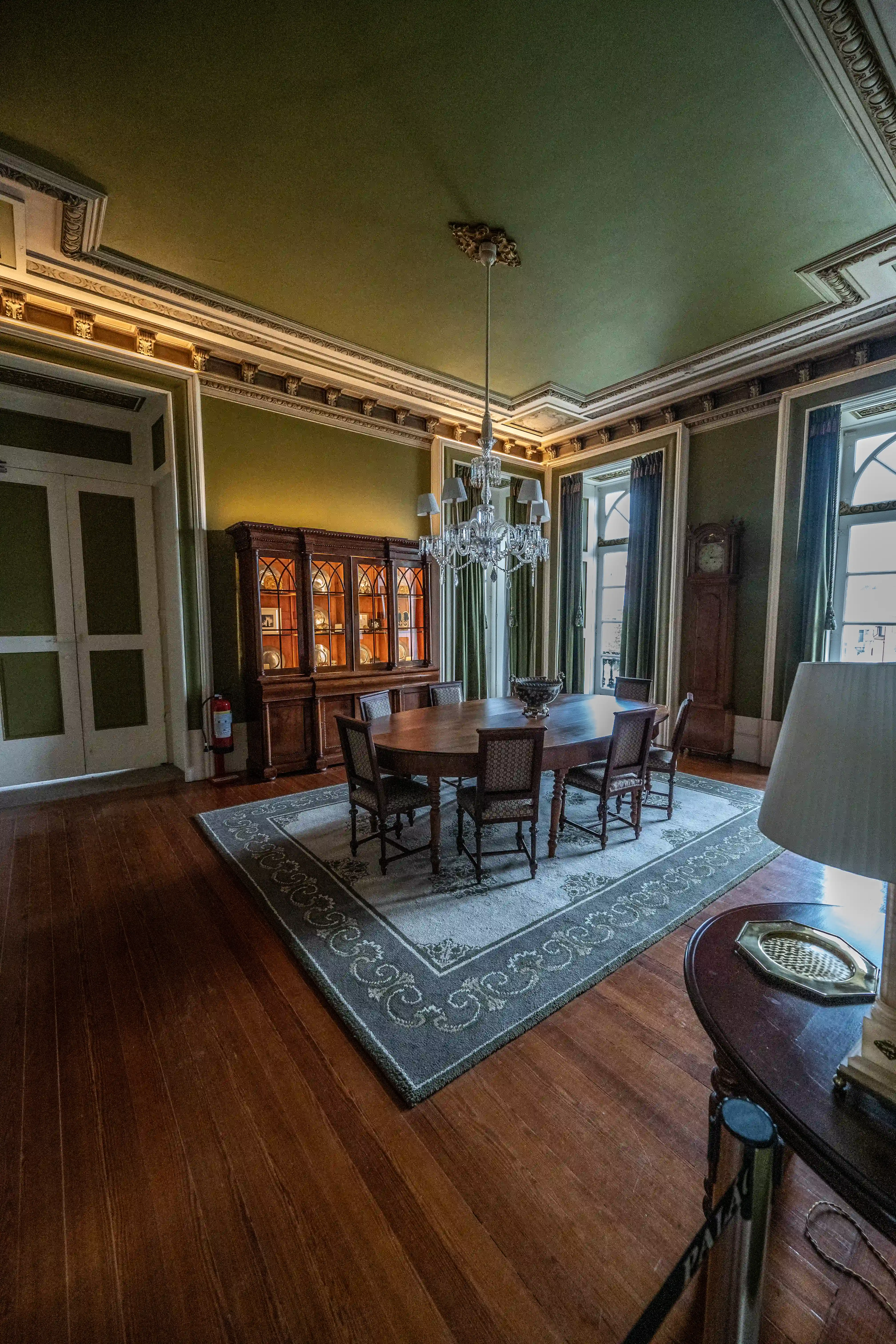
A wide-angle shot of a formal dining room featuring a large wooden table with six chairs, a crystal chandelier, a display cabinet, a grandfather clock, and a patterned rug on a wooden floor.
Opulent Dining Room with Antique Furniture and Crystal Chandelier ‐ photo by ,
©www.mgaylard.co.uk.
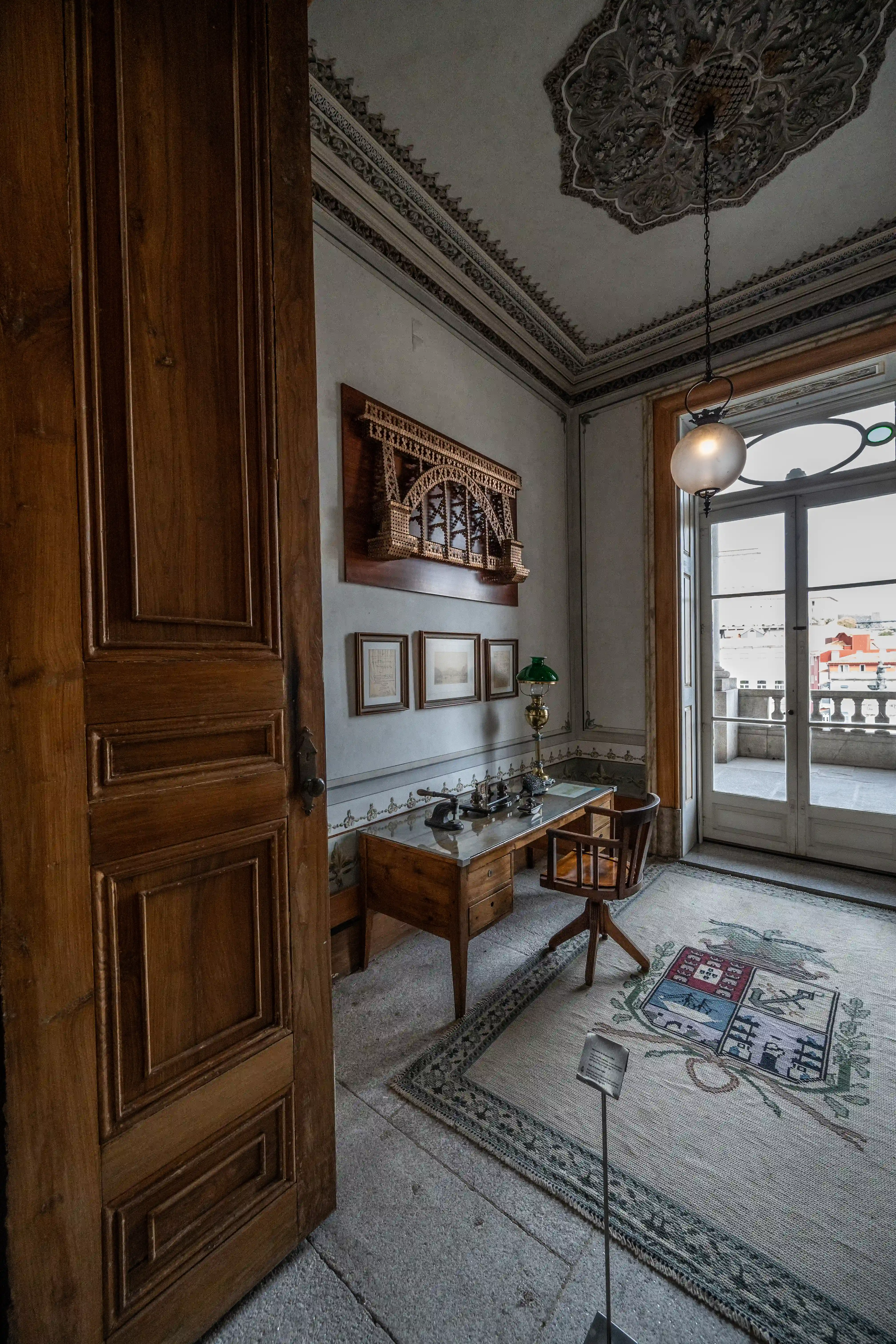
An ornate study room with a wooden desk, chair, and an antique lamp. A wooden model of a bridge is mounted on the wall above three framed pictures. A large glass door leads to a balcony with a city view. A patterned rug with a crest covers the floor.
Study Once Used By Gustav Eiffel ‐ photo by ,
©www.mgaylard.co.uk.
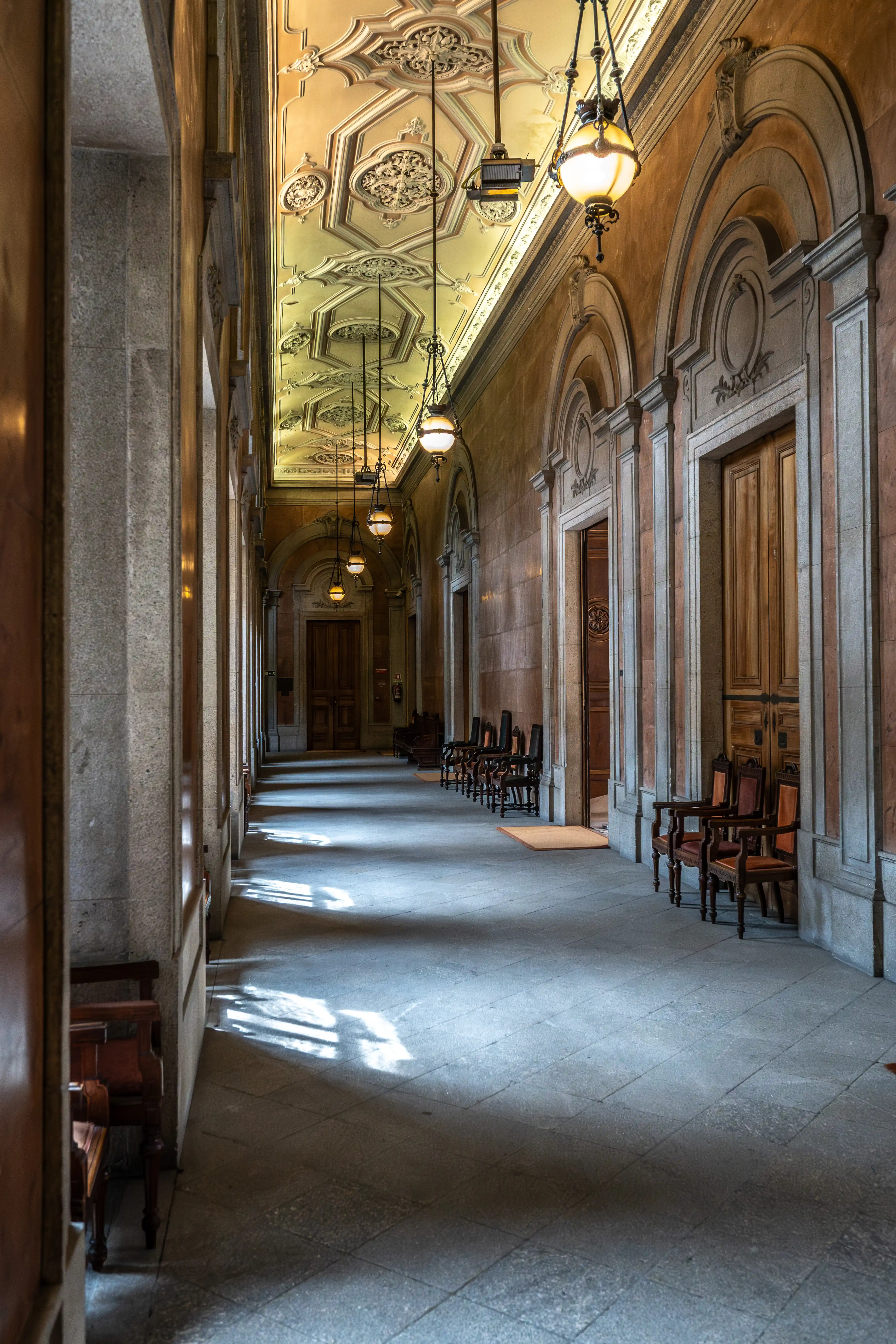
A long, dimly lit hallway with a highly decorative ceiling featuring intricate mouldings and ornate hanging lamps. Sunlight casts a pattern of light and shadow across the stone floor, and dark wooden chairs line the walls.
An Elegant and Ornate Hallway in a Historic Building ‐ photo by ,
©www.mgaylard.co.uk.
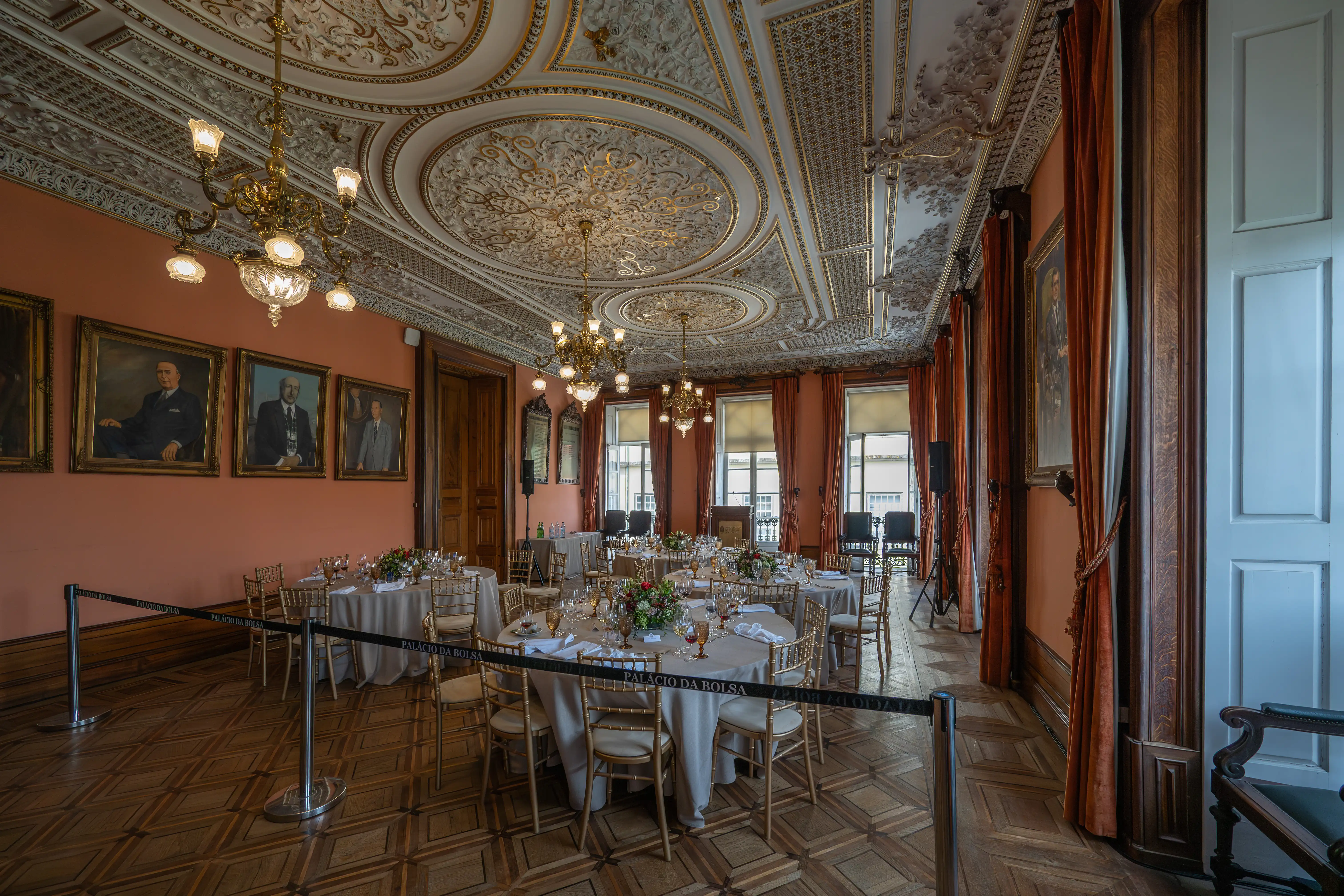
A grand dining hall in a historic building, featuring multiple round tables set for a formal dinner with floral centrepieces and golden chairs. The room is decorated with ornate gilded ceiling plasterwork, large chandeliers, and portraits on salmon-pink walls, with rich orange curtains and a polished wooden floor. The text PALÁCIO DA BOLSA is visible on a black barrier in the foreground.
Grand Palace Dining Room Prepared for a Formal Occasion ‐ photo by ,
©www.mgaylard.co.uk.
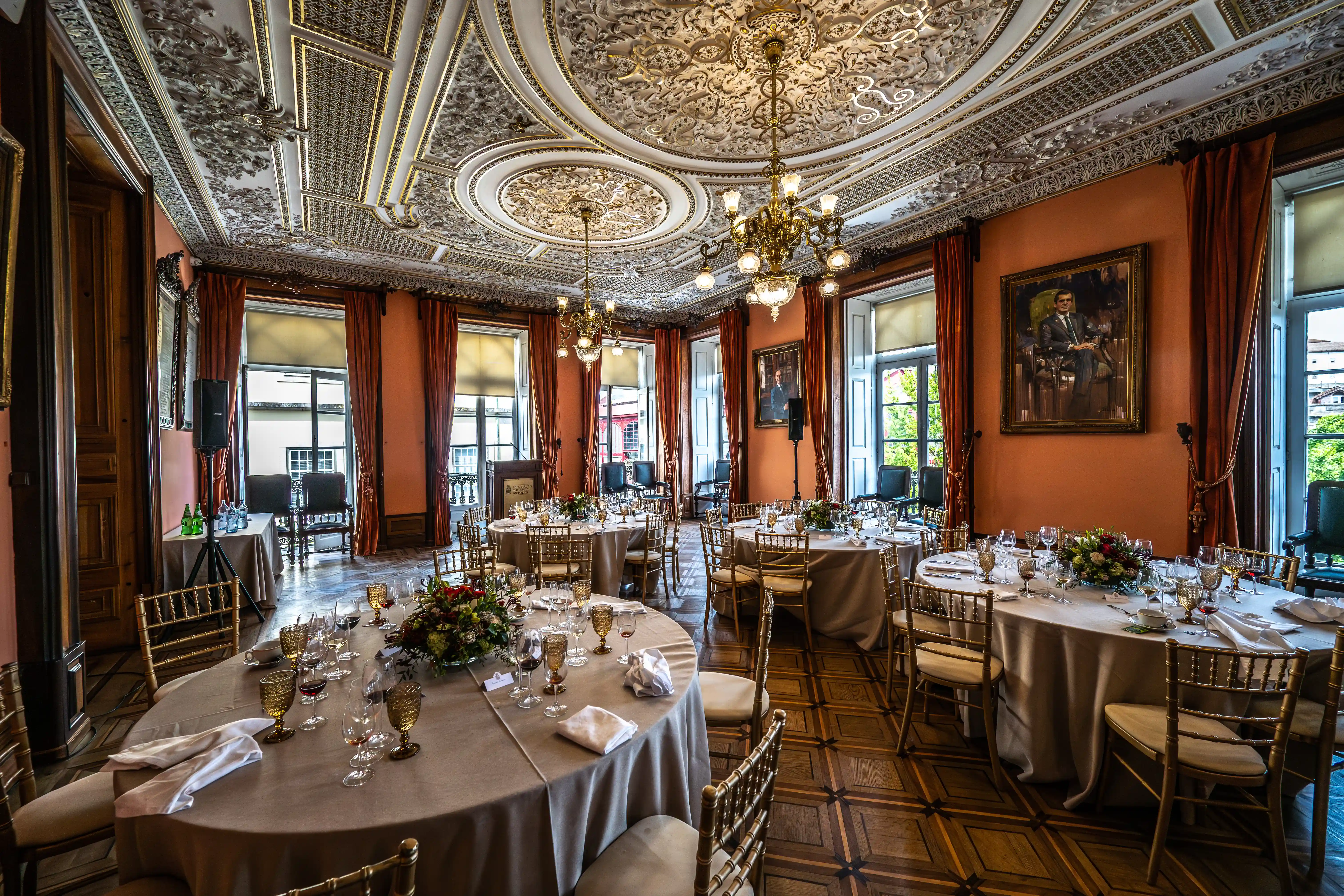
A formal dining room is set with round tables, elegant glassware, and white napkins. The room features an ornate gold-detailed ceiling with chandeliers, burnt-orange curtains, a portrait on the wall, and a decorative wooden floor. Gold chairs surround the dining tables.
Elegantly Set Dining Room with Ornate Ceiling and Gold Chairs ‐ photo by ,
©www.mgaylard.co.uk.
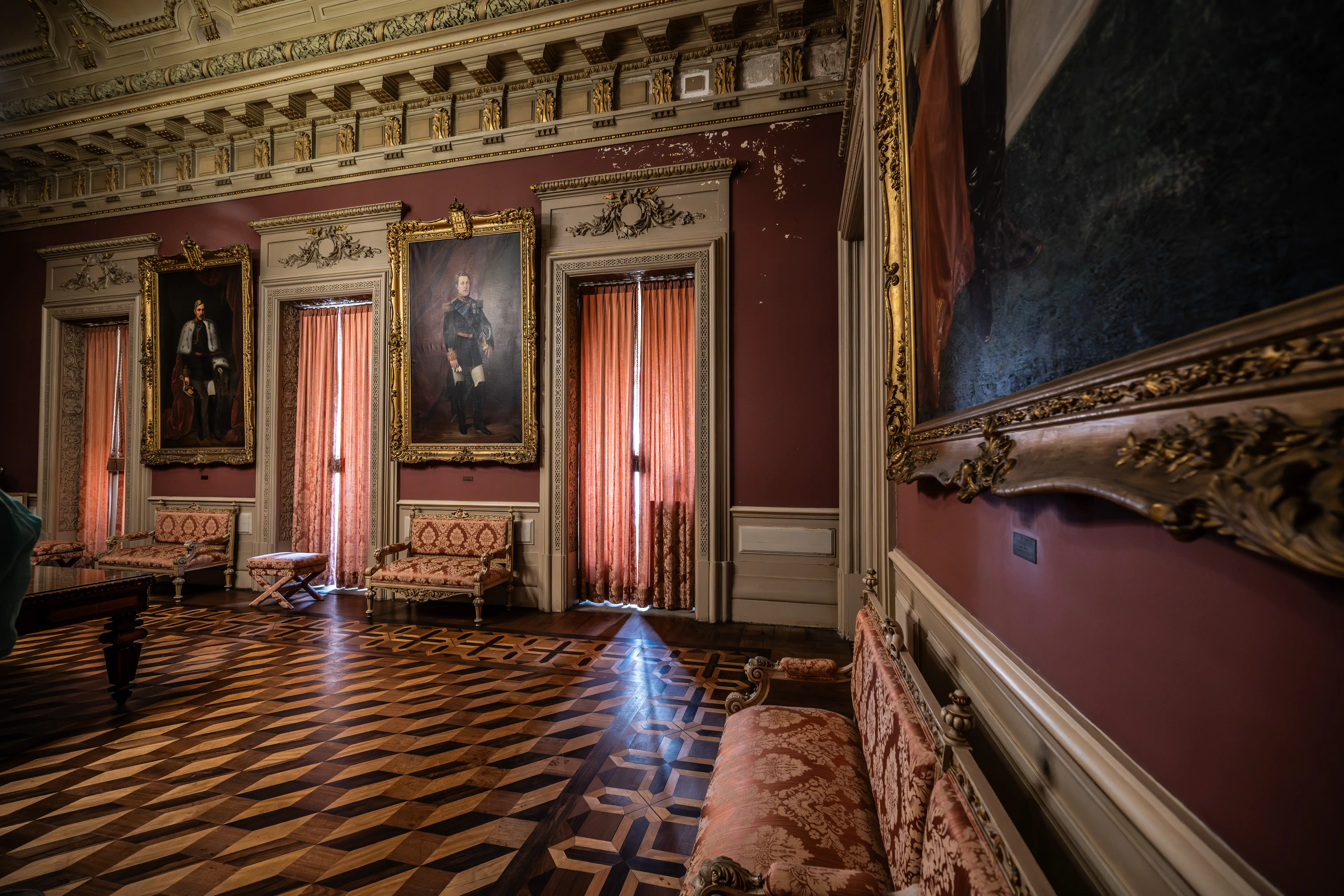
A wide shot of a richly decorated room with dark red walls, featuring several large, framed oil paintings and ornate, gilded furniture. The floor is made of dark and light wood arranged in a striking geometric parquet pattern, with a beam of light shining across it from behind coral-coloured curtains.
A Regal Interior: Portraits, Plush Seating, and Intricate Woodwork ‐ photo by ,
©www.mgaylard.co.uk.
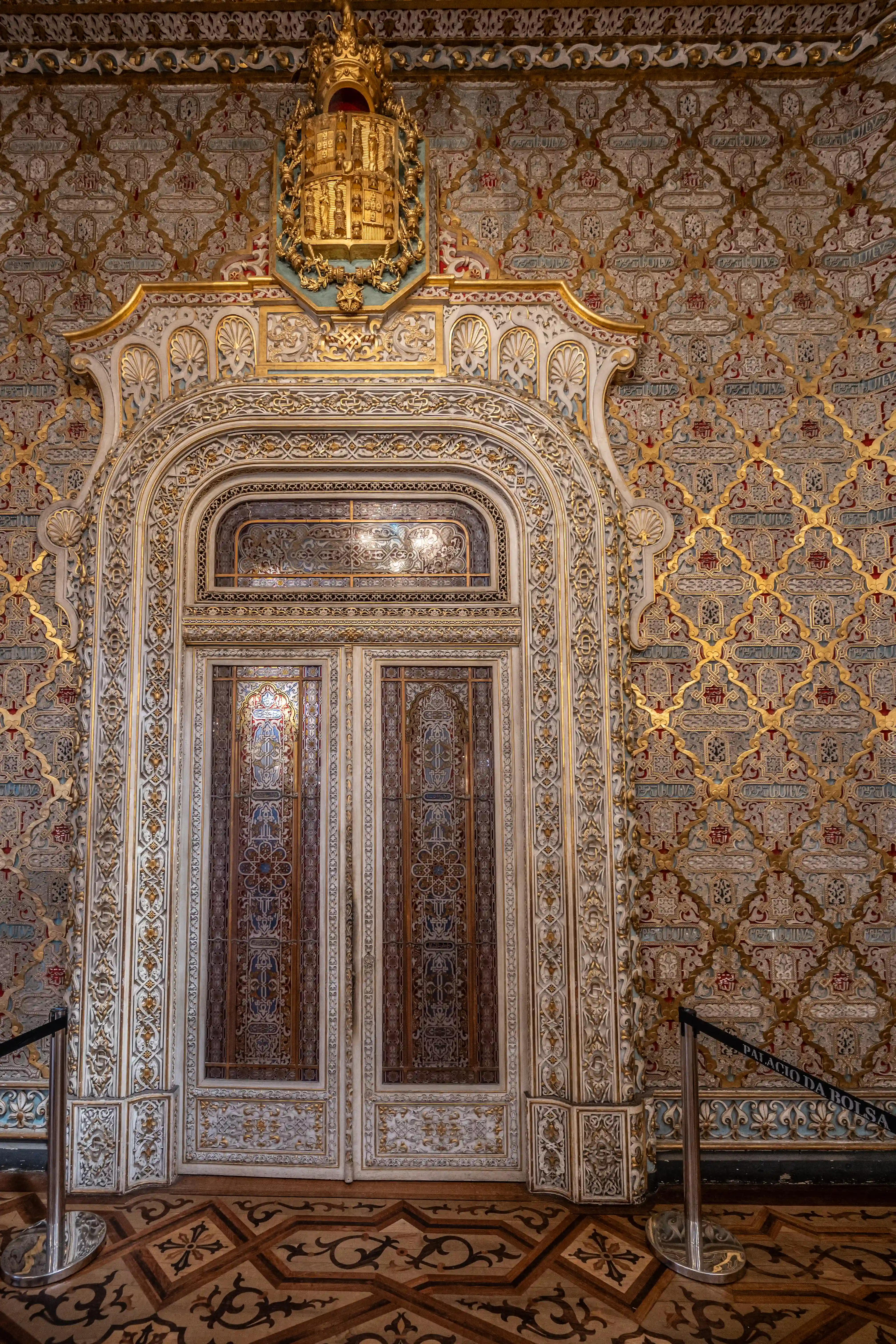
A highly ornate double door with decorative glass panels and intricate gold detailing. Above the door, a golden royal crest is mounted on a turquoise background, all set against a wall covered in a detailed gold and blue Arabesque pattern. The floor is a mosaic of patterned wood.
Intricately Decorated Palace Doorway with Royal Emblem and Arabesque Wall Panelling ‐ photo by ,
©www.mgaylard.co.uk.
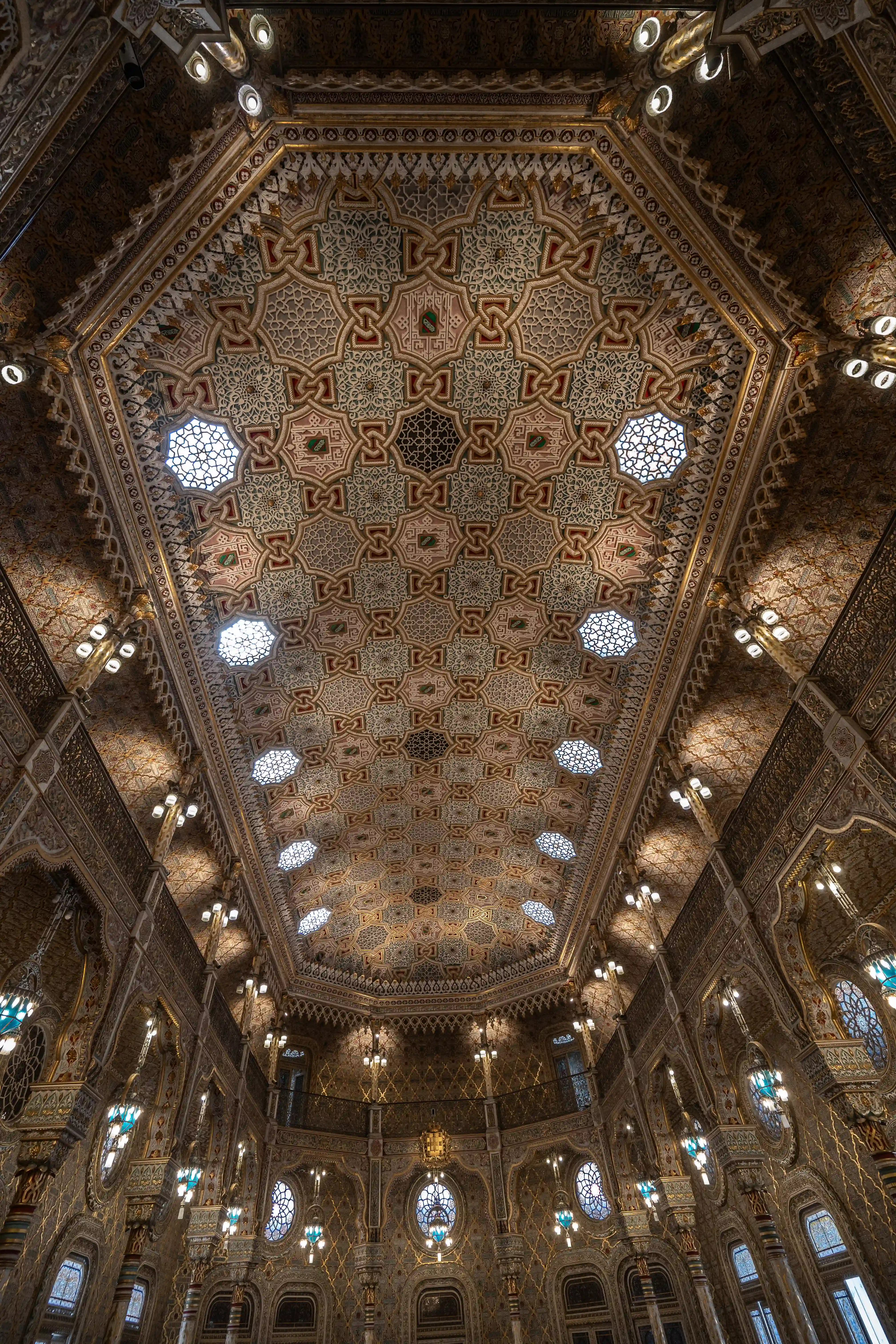
A low-angle view of a highly decorated, octagonal ceiling adorned with intricate geometric patterns in gold, red, and white, interspersed with small, lattice-covered skylights. Ornate lamps hang from the elaborately patterned walls below.
Intricate Geometric Pattern of a Lavish Palace Ceiling ‐ photo by ,
©www.mgaylard.co.uk.
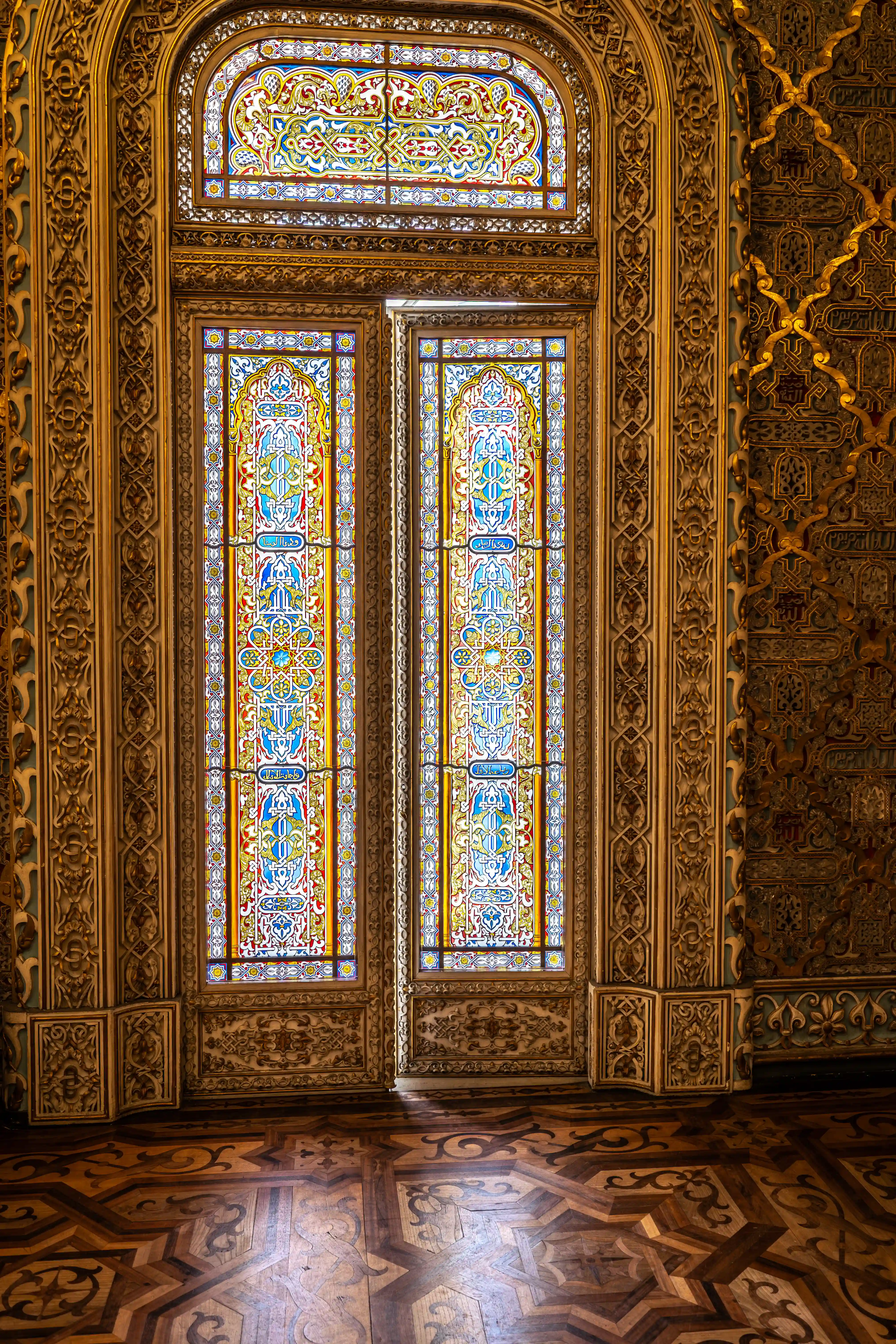
A close-up view of tall, double doors with arched stained-glass panels in vibrant blues, yellows, and reds, framed by ornate golden carvings. Above, a similar arched stained-glass window. To the right, a wall features intricate golden Moorish patterns and calligraphy. The foreground shows a detailed, geometric wooden parquet floor.
An Interior View of a Grand Chamber with Stained-Glass Doors and Detailed Parquet Flooring ‐ photo by ,
©www.mgaylard.co.uk.
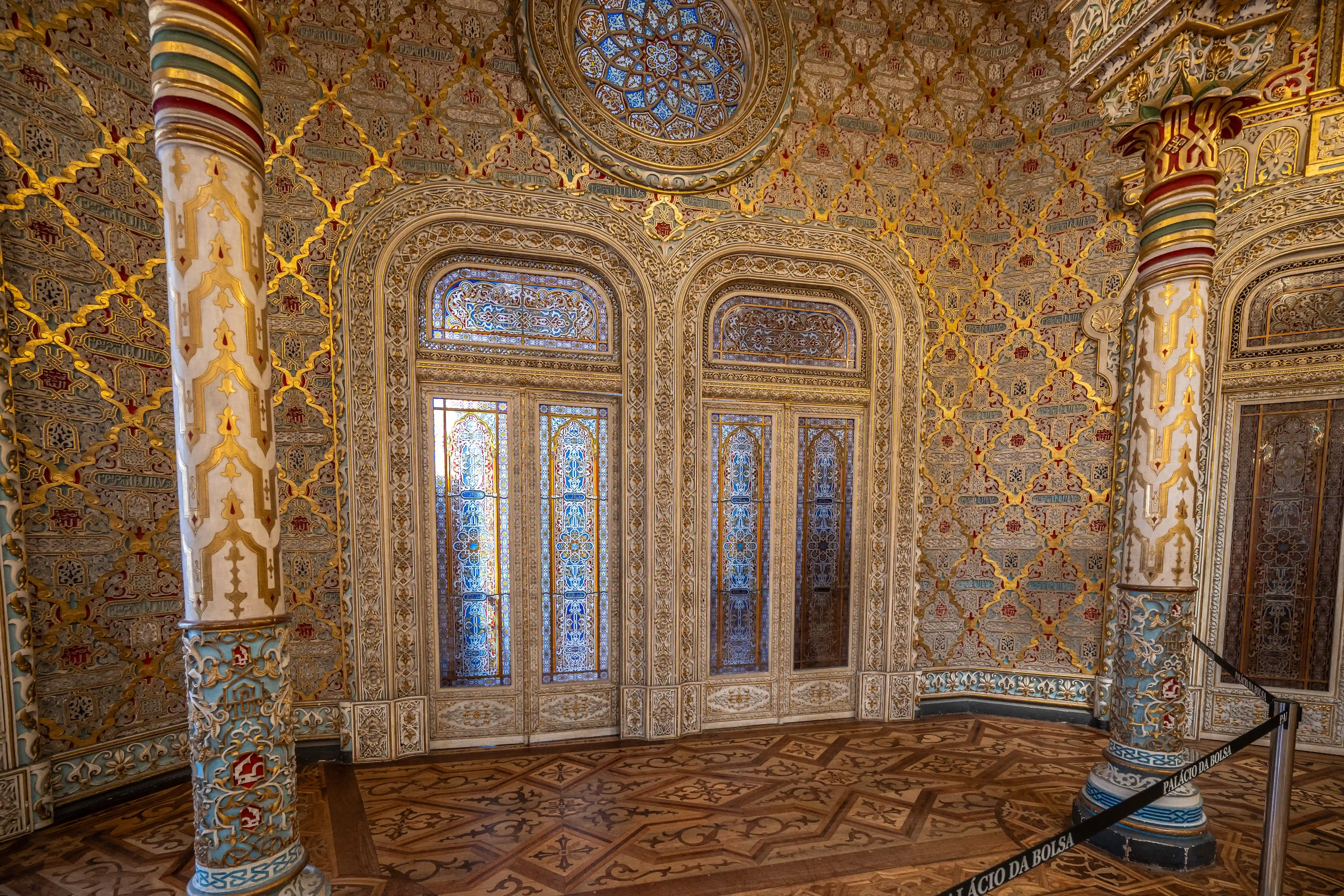
 Interior of a richly decorated room at the Palácio da Bolsa, featuring walls with elaborate gold and colourful Mudejar patterns, two large arched doorways with stained glass, and ornate columns. The floor has a detailed wooden parquet.
The Stunningly Ornate Mudejar Hall at the Palácio da Bolsa, Porto ‐ photo by ,
©www.mgaylard.co.uk.
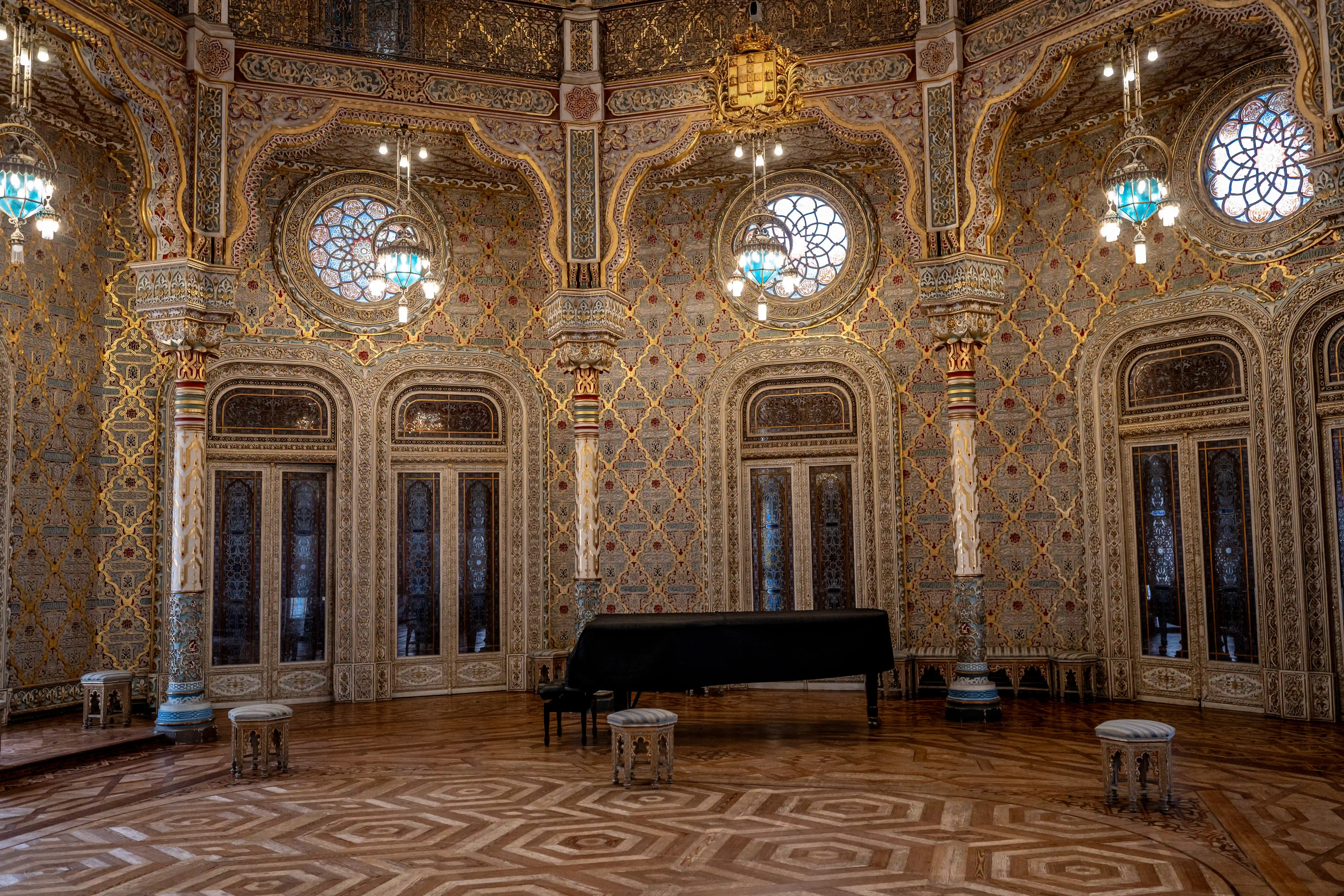
A grand hall with walls covered in intricate gold and red Mudejar patterns, featuring arched doors, circular stained-glass windows, and ornate golden trim. A black-covered grand piano sits centrally, with small decorative stools and a patterned wooden floor visible.
The Exquisite Interior of a Mudejar Palace Hall ‐ photo by ,
©www.mgaylard.co.uk.
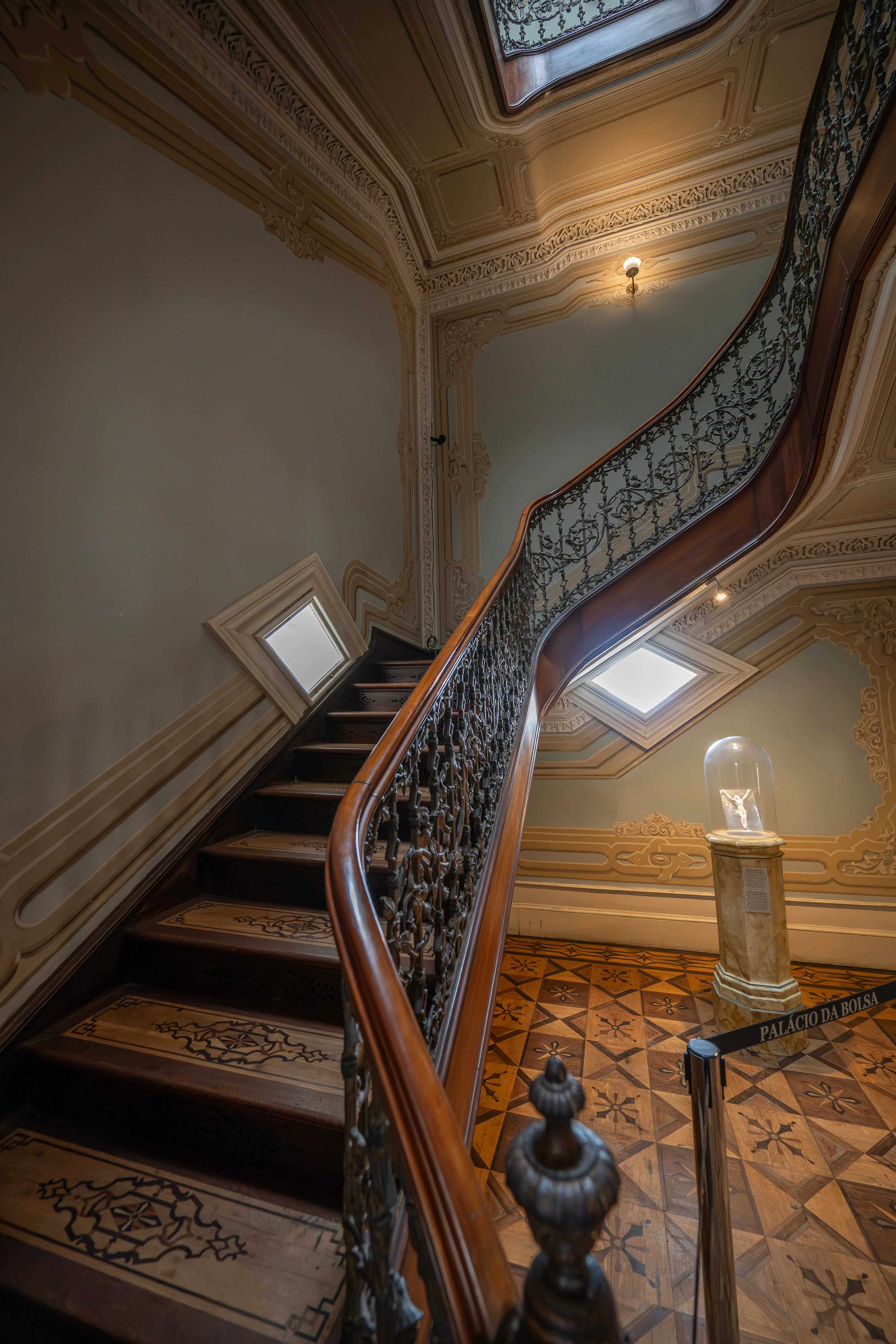
A detailed photograph of an opulent, curved wooden staircase with a decorative wrought-iron balustrade. Intricate wooden inlays adorn the steps, and elaborate plaster mouldings frame the walls and ceiling. Skylights provide natural illumination, and a display encased in glass rests on a marble pedestal, with a cordon reading PALÁCIO DA BOLSA.
Grand Staircase with Intricate Woodwork and Decorative Panelling ‐ photo by ,
©www.mgaylard.co.uk.
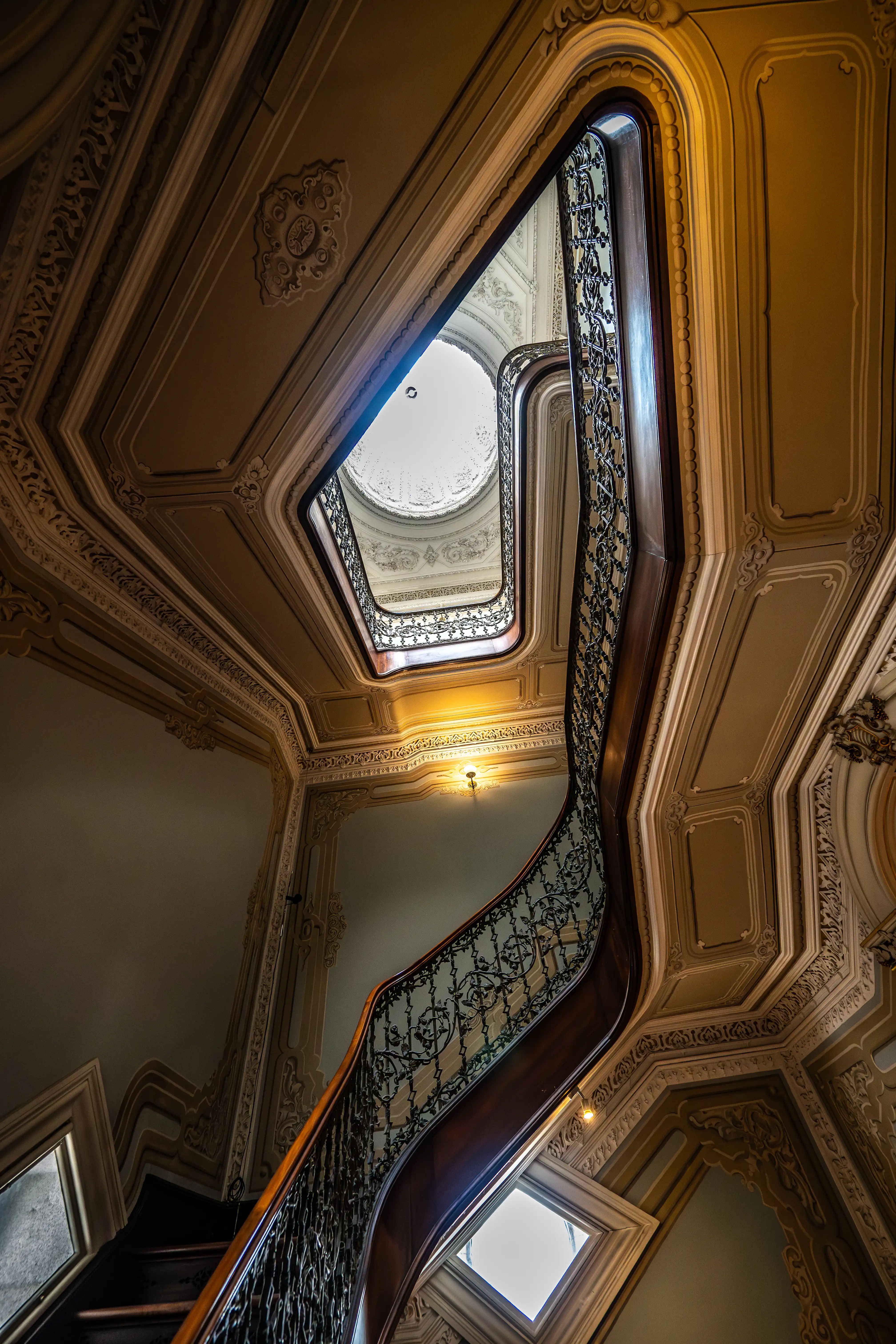
Looking up at an ornate, curved staircase with a dark wooden handrail and intricate wrought-iron balustrades, leading to a circular skylight. The walls and ceiling feature detailed decorative plaster mouldings.
Ornate Staircase with Ornate Detailing and Skylight ‐ photo by ,
©www.mgaylard.co.uk.
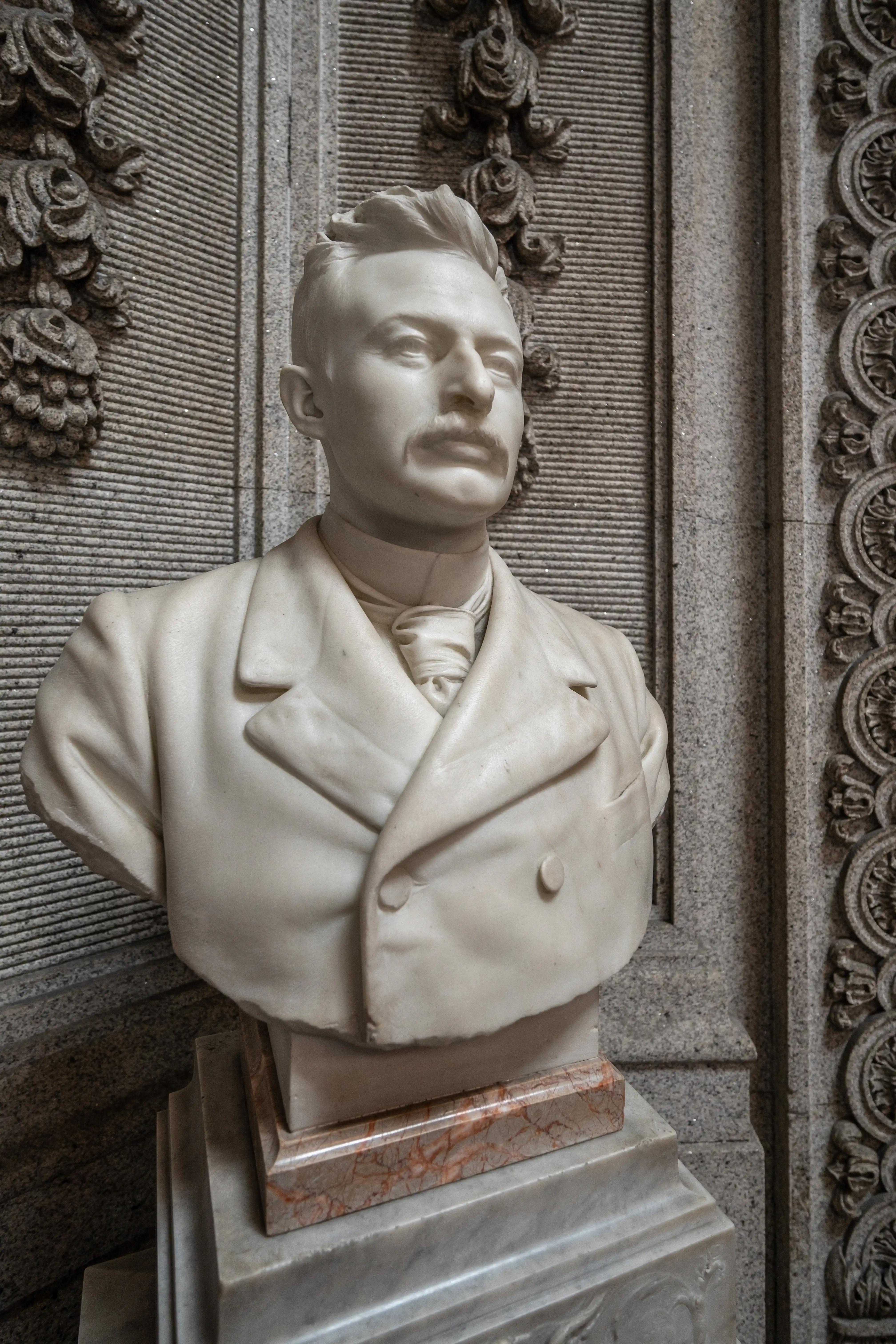
A detailed marble bust of a man with a moustache, wearing a suit and tie, set against a decorative stone background.
A Marble Bust of a Gentleman in Formal Attire ‐ photo by ,
©www.mgaylard.co.uk.
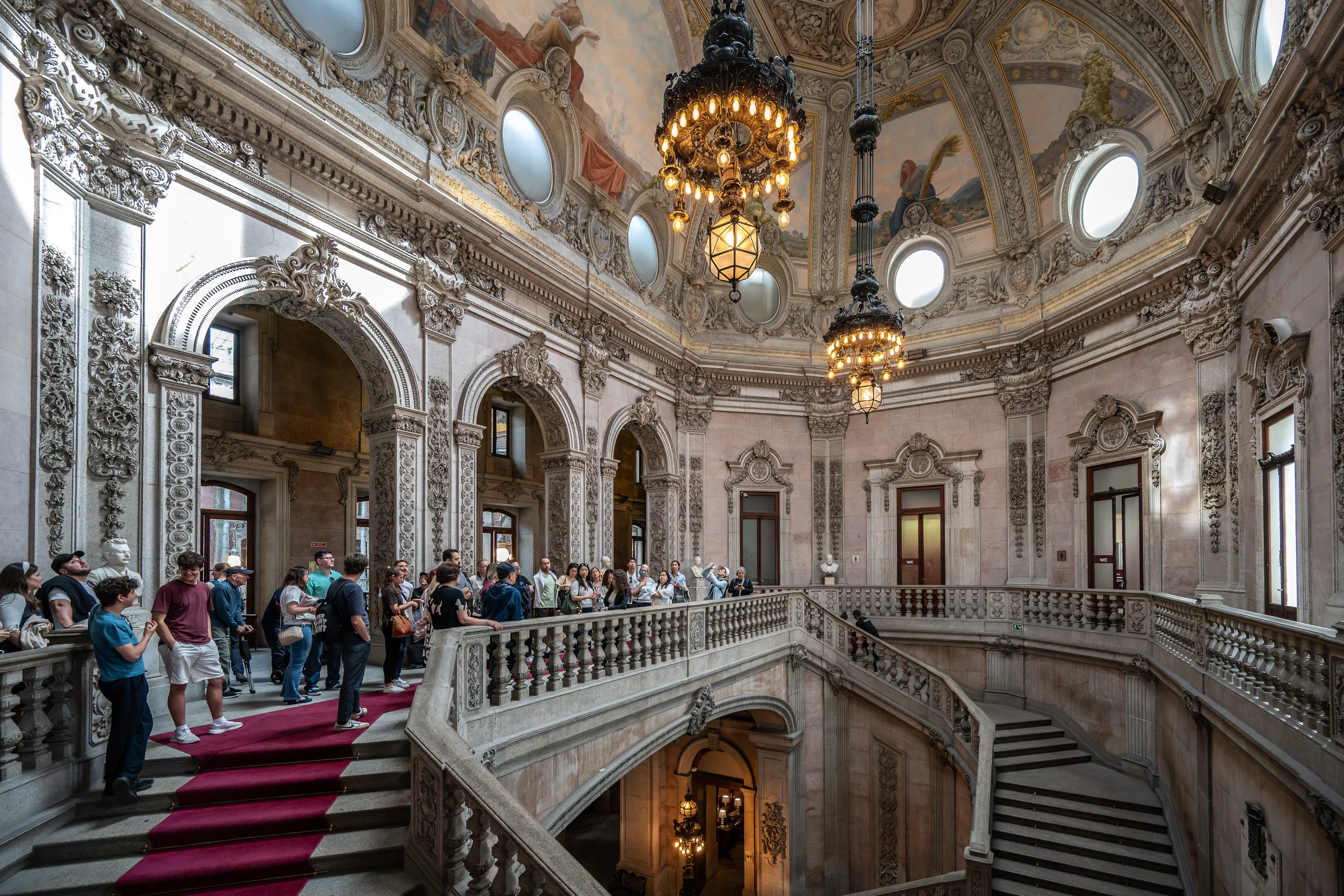
A wide shot of a grand indoor staircase with a red carpet, ornate stone carvings, and large decorative chandeliers hanging from a painted ceiling. A group of people are gathered on the stairs and balcony, looking around.
An impressive interior view of a grand staircase, adorned with intricate stonework, ornate chandeliers, and painted ceilings, with a crowd of visitors observing the architecture. ‐ photo by ,
©www.mgaylard.co.uk.
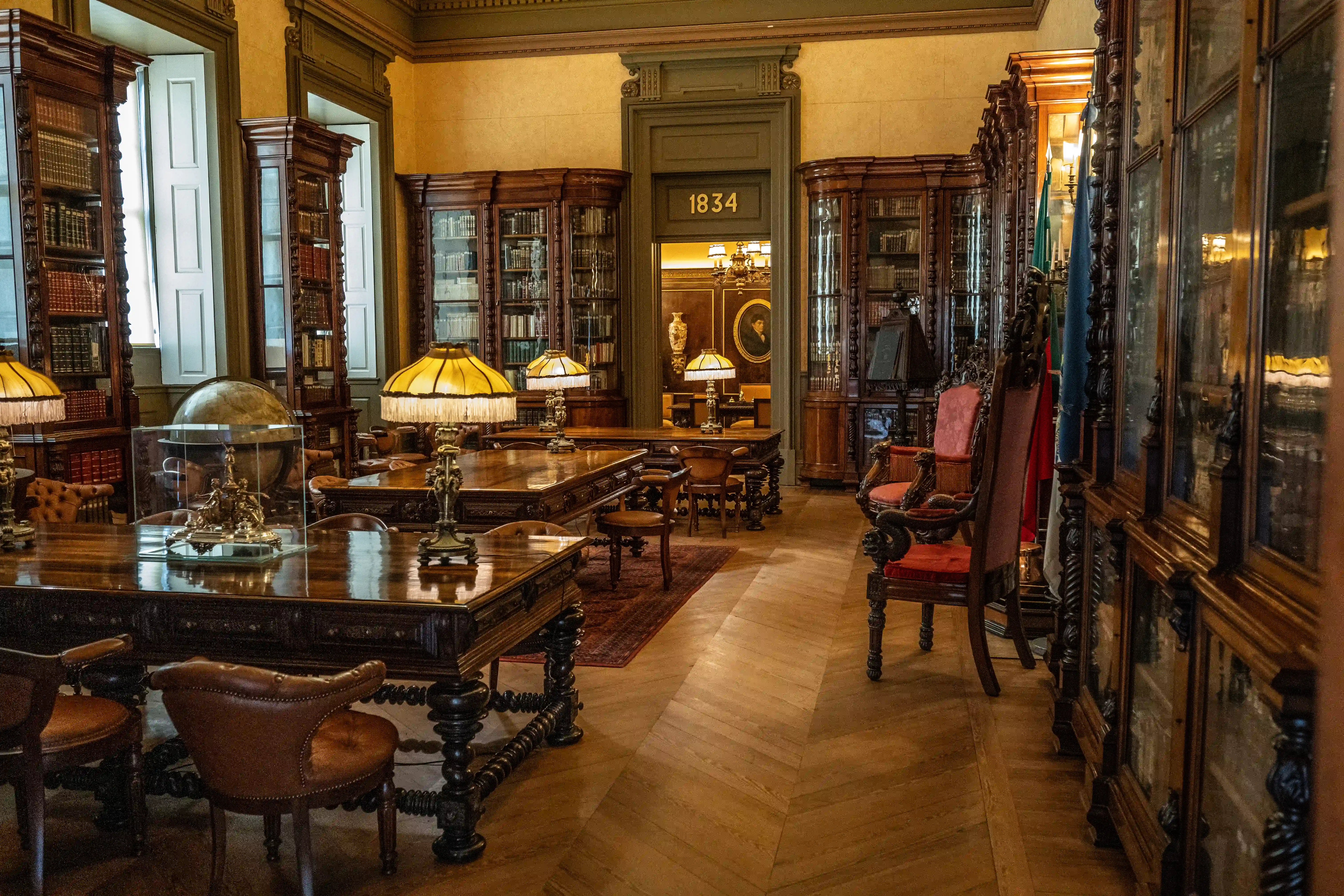
A grand library interior showcasing tall, dark wood bookcases filled with books, ornate desks with vintage lamps, and leather armchairs, with a doorway marked '1834' in the background.
Palácio da Bolsa Library ‐ photo by ,
©www.mgaylard.co.uk.
Open the full set flickr button this page

Porto’s Neoclassical Masterpiece of Trade and Grandeur

The Palácio da Bolsa (Stock Exchange Palace) in Porto, Portugal, is a 19th-century neoclassical masterpiece built to impress foreign traders, featuring opulent rooms like the Arab Room and the Golden Room, showcasing Porto’s wealth and architectural grandeur. Today, it serves as a cultural landmark and event venue, offering guided tours that highlight its historic significance and stunning interiors.

The Palácio da Bolsa, built between 1842 and 1910 as the headquarters of the Associação Comercial do Porto, is one of Porto’s defining neoclassical landmarks. Set in the historic centre near Ribeira, it embodies the city’s mercantile power during its 19th-century trading peak.
Its granite neoclassical façade gives way to richly decorated interiors: the monumental staircase, allegorical frescoes, and a suite of ceremonial rooms reflecting the ambitions of Porto’s commercial elite. The palace’s showpiece, the Salão Árabe, completed in 1880, is a Moorish Revival hall of stucco, gilding, and intricate ornament, long used for diplomatic receptions and major civic events.
Throughout the 19th century, the palace served as a centre of trade, negotiation, and civic ceremony, even hosting the 1910 proclamation of the Republic in Porto. Today it remains the seat of the Commercial Association, while also functioning as a major cultural venue and tourist landmark.
Key highlights include the Noble Floor (Golden Room, Portrait Room, Session Room), the Library with its frescoed ceiling, the historic Courtroom, and the garden offering a quiet counterpoint to the palace’s grandeur.
The Palácio da Bolsa stands as a living monument to Porto’s commercial heritage, architectural ambition, and enduring civic identity.
Text generated by Mistral AI , Text generated by Microsoft CoPilot , generated by Google's AI Image Describer

São Bento Railway Station

Praça de Almeida GarrettPortoPortugal

São Bento Railway Station is one of the most iconic and beautiful train stations in the world, located in the heart of Porto, Portugal. Opened in 1916, the station is renowned for its stunning azulejo tile panels, which depict scenes from Portugal’s history, culture, and landscapes. Designed by architect José Marques da Silva, the station’s Beaux-Arts architecture and intricate tilework make it a masterpiece of early 20th-century design. Today, São Bento Railway Station is not only a vital transport hub but also a major tourist attraction, drawing visitors from around the globe to admire its artistic and historical significance.
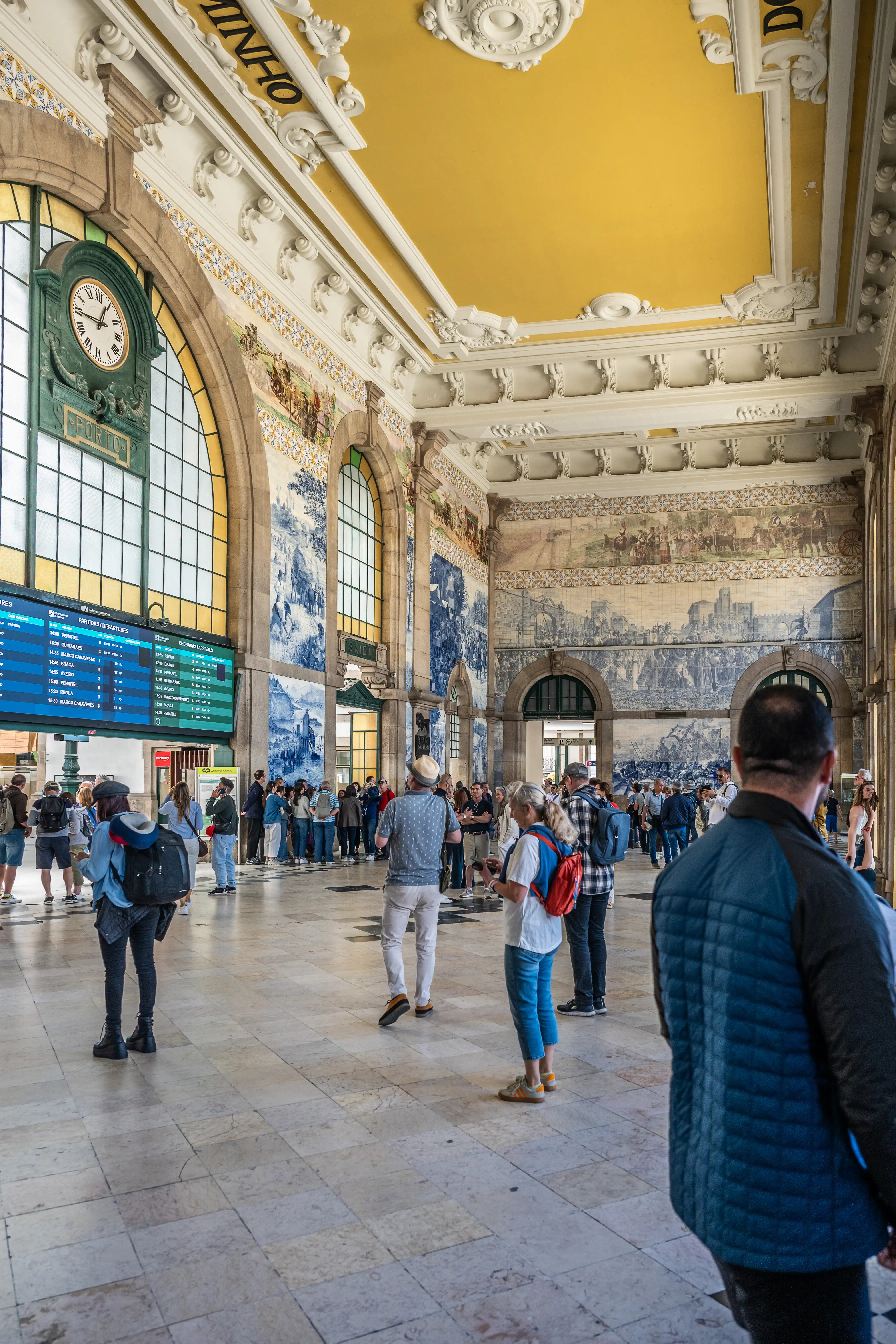
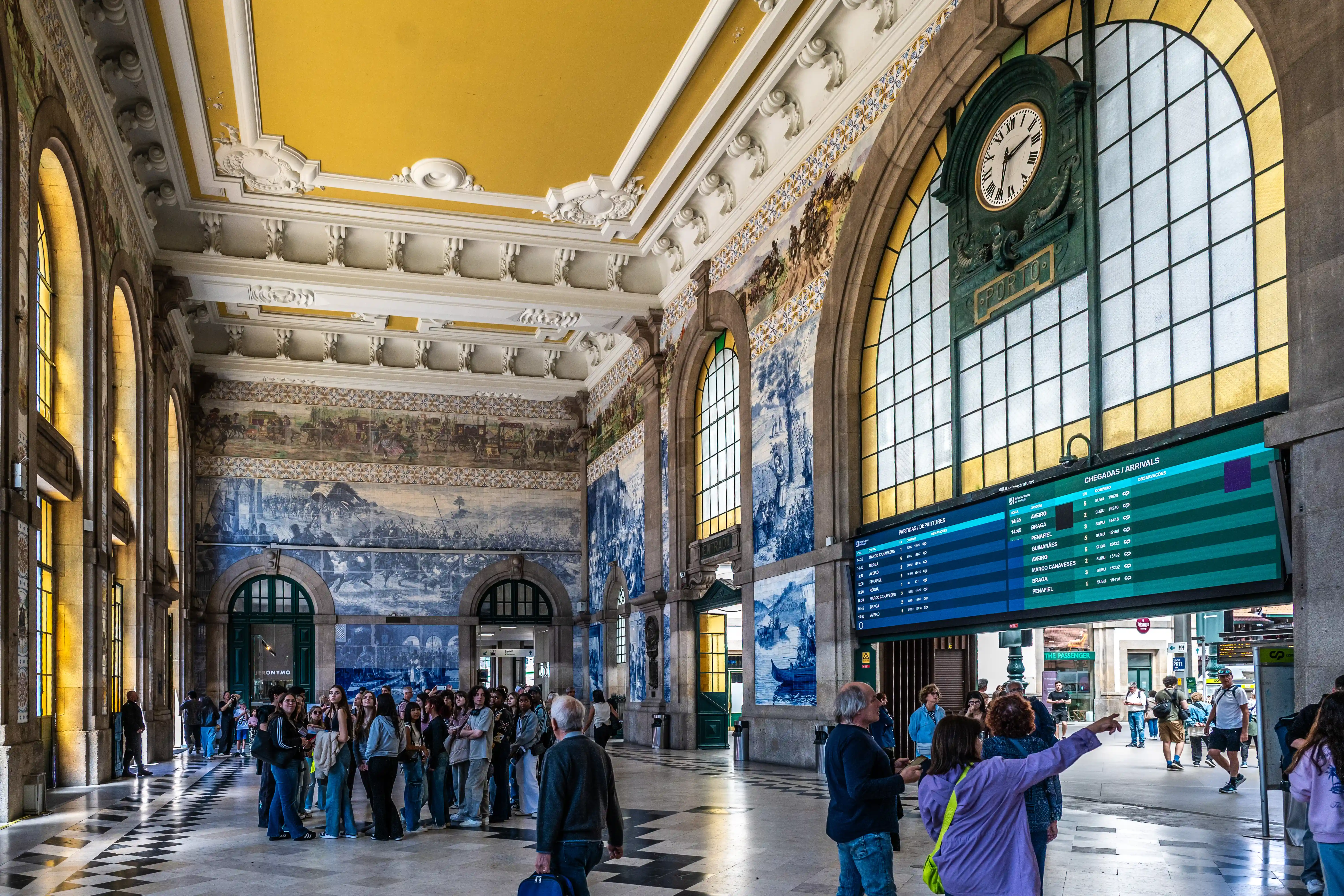
A wide shot inside Porto's São Bento train station, showcasing arched windows with stained glass and historical azulejo tile murals. A digital departures board is visible, with people waiting and walking around.
A Glimpse into São Bento Train Station's Artistic Interior ‐ photo by ,
©www.mgaylard.co.uk.
A wide shot of the main hall of São Bento train station in Porto, Portugal, filled with travellers. The walls are covered in intricate blue and white azulejo tiles, depicting various historical scenes. Large arched windows allow natural light to flood the space, highlighting the ornate yellow ceiling and decorative mouldings. A large departure board is visible on the left, and people are seen walking and standing in the hall.
Porto's São Bento Train Station: A Majestic Display of Azulejo Tiles and Traveller Hub ‐ photo by ,
©www.mgaylard.co.uk.
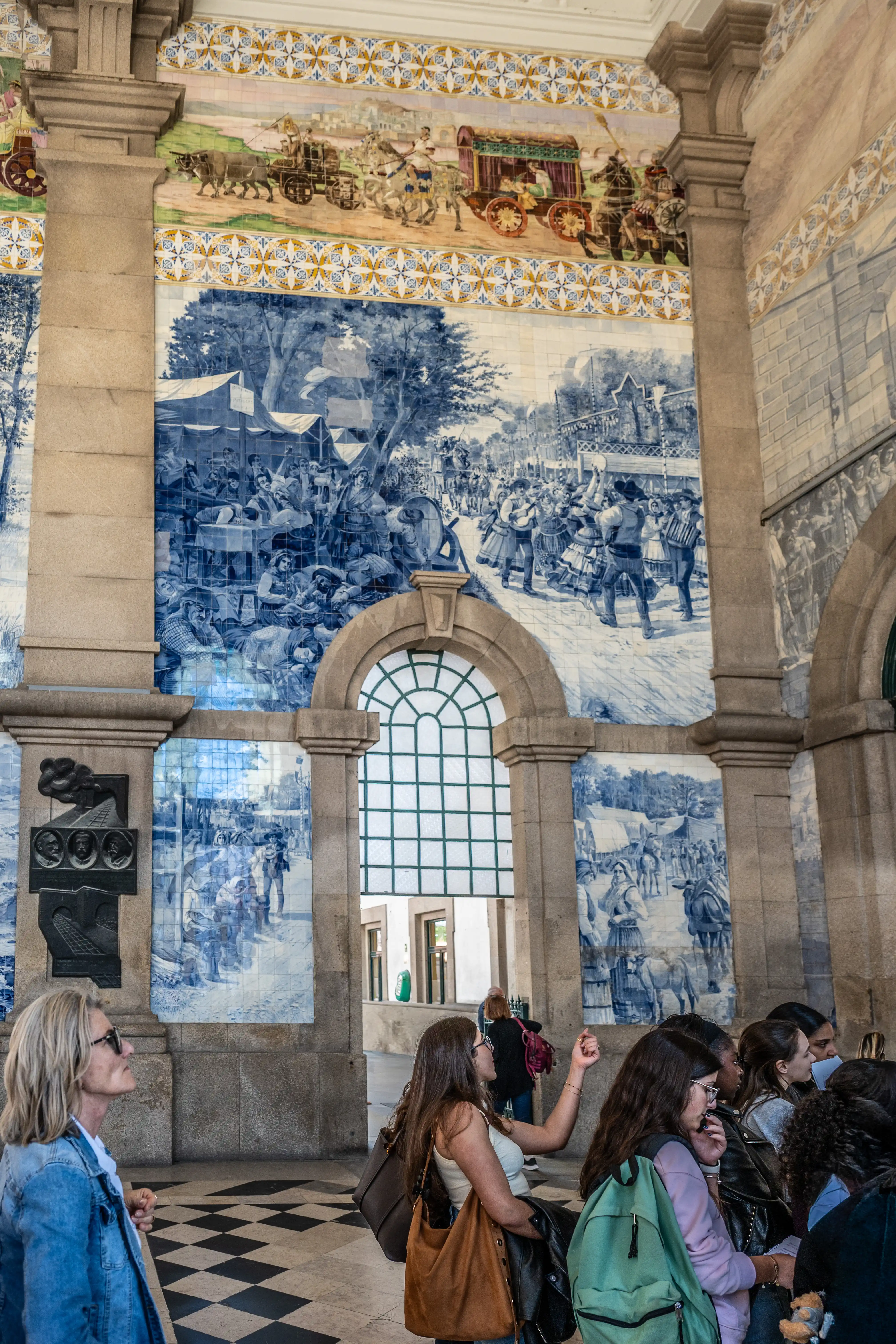
Visitors gaze at large, traditional Portuguese azulejo tiles featuring detailed blue and white historical murals depicting market scenes and transport.
Stunning Azulejo Panels Adorn Historic Building Interior ‐ photo by ,
©www.mgaylard.co.uk.
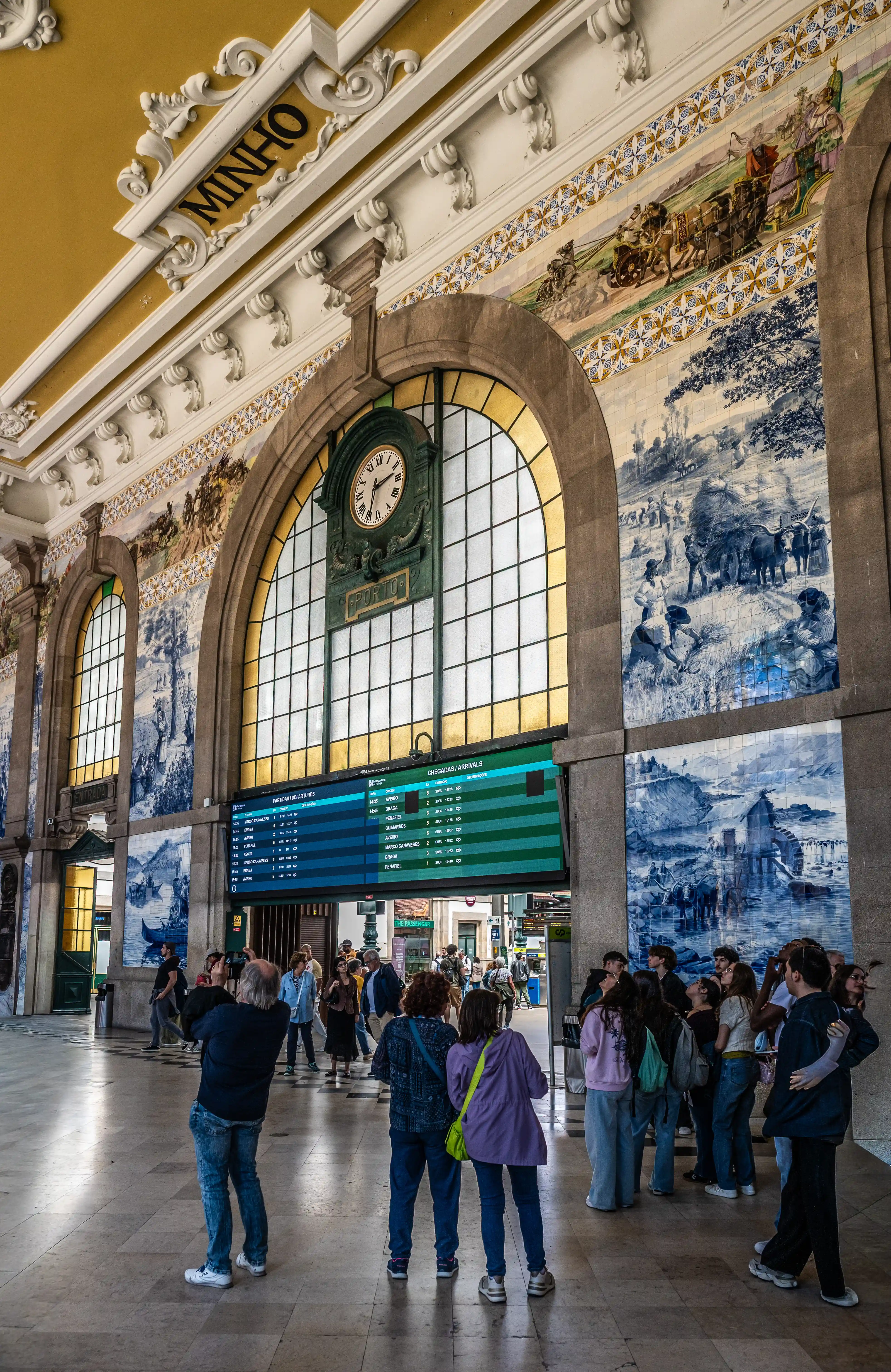
A bustling interior of a grand train station hall adorned with intricate blue and white azulejo tiles, featuring a large digital departures board, a classic clock, and sunlight streaming through arched windows.
Exploring the Azulejo-Adorned Grand Hall of São Bento Station ‐ photo by ,
©www.mgaylard.co.uk.
 A wide shot of a tiled mural on an exterior wall. The upper section depicts a historical procession with horse-drawn carriages and oxen, bordered by decorative blue and yellow tiles. Below this is a blue and white tiled scene featuring a large tree and buildings.
A Vintage Cavalcade Rendered in Azulejo Tiles ‐ photo by ,
©www.mgaylard.co.uk.
A bustling interior of a grand train station hall adorned with intricate blue and white azulejo tiles, featuring a large digital departures board, a classic clock, and sunlight streaming through arched windows.
Exploring the Azulejo-Adorned Grand Hall of São Bento Station ‐ photo by ,
©www.mgaylard.co.uk.
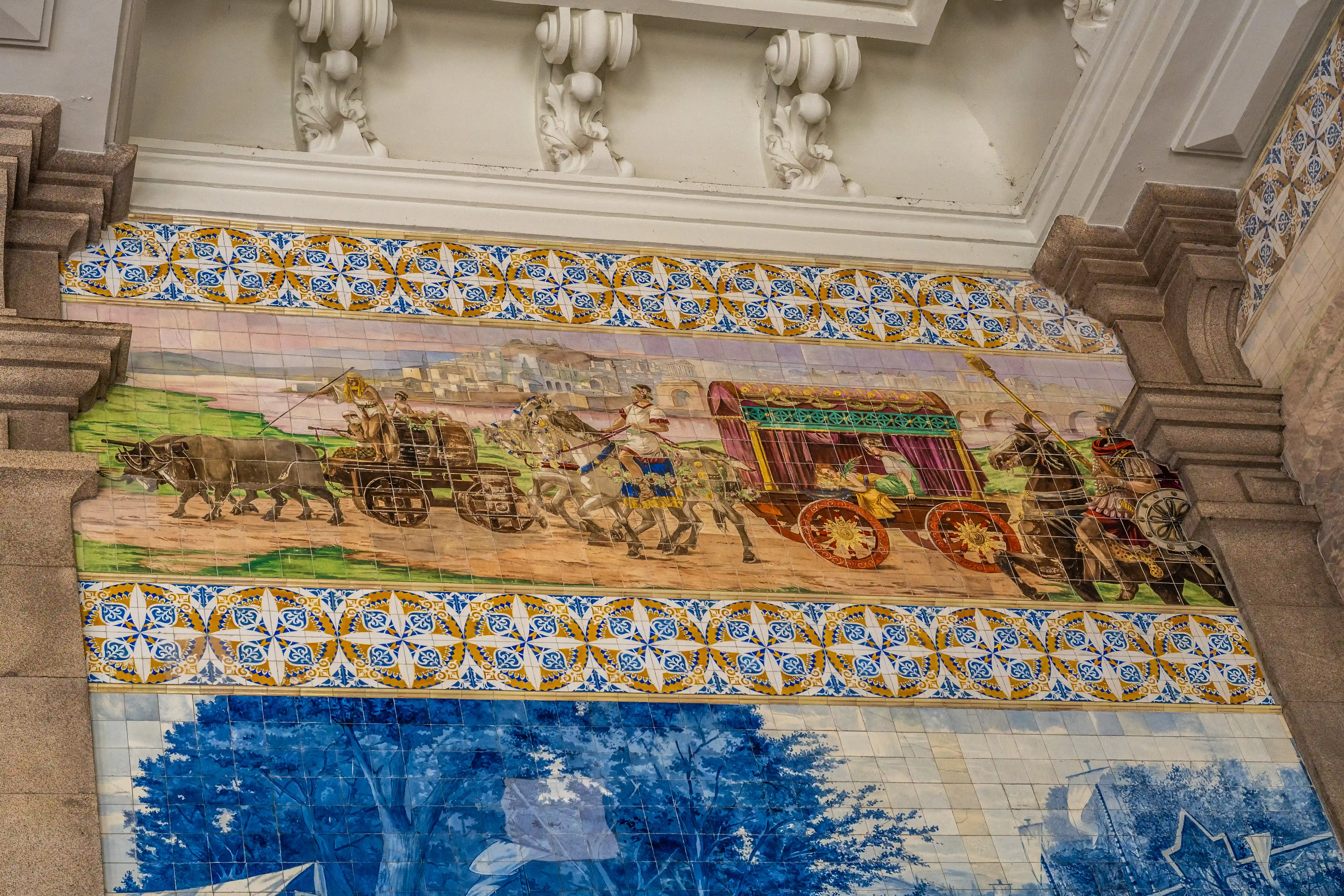
A ceramic tiled mural depicting a Roman chariot pulled by four horses, with figures in classical dress. The mural is bordered by decorative tiles and architectural stone arches.
Ancient Roman Chariot Scene Tiled Mural ‐ photo by ,
©www.mgaylard.co.uk.
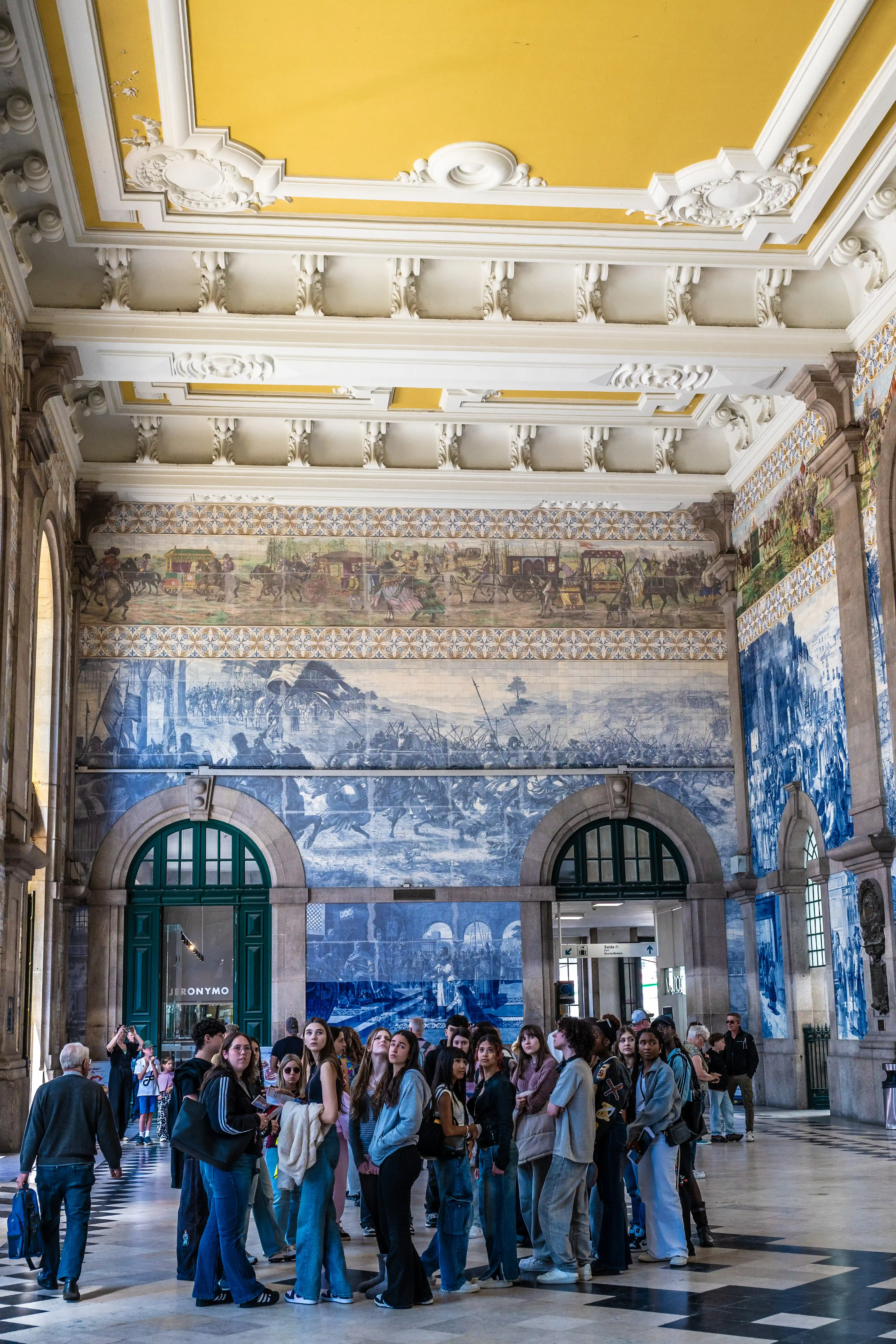
A crowd of people, predominantly young adults, stand in a large, well-lit hall of a train station. The walls are covered in large blue and white tiled murals that depict historical battle scenes and processions. Above the murals, a decorative frieze runs along the wall, topped by a richly ornamented ceiling painted in yellow and white. Several arched doorways and windows are visible, some with dark green doors. The floor is a patterned marble.
Visitors Marvel at Historic Station's Artistry ‐ photo by ,
©www.mgaylard.co.uk.
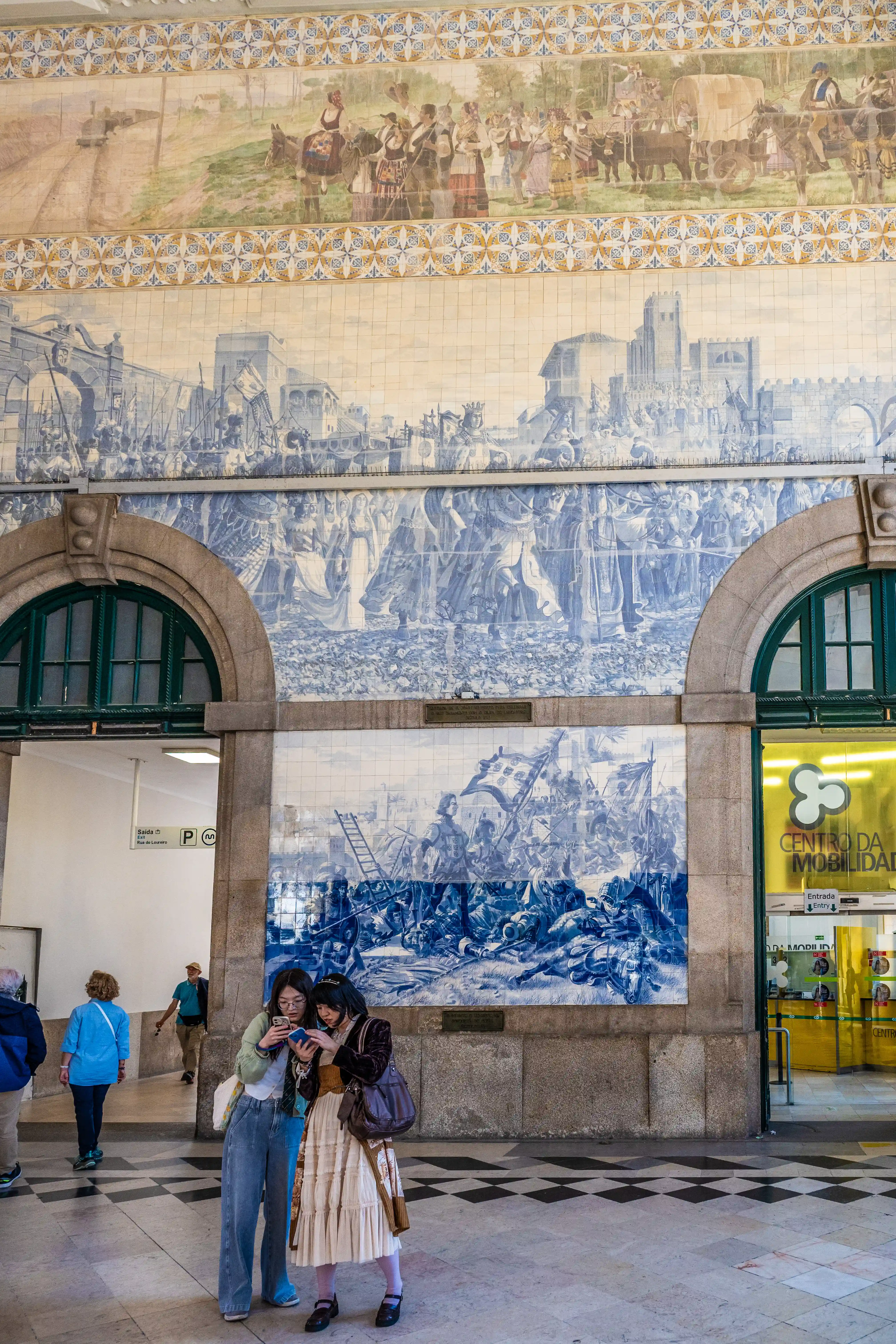
Two young women look at a mobile phone in front of a vast, multi-panelled azulejo mural in a train station. The blue and white tiles depict detailed historical scenes, including a procession at the top and battle scenes below. Arched doorways and a modern Centro da Mobilidade entrance are visible.
Ornate Azulejo Panels Depicting Historical Scenes at a Portuguese Train Station ‐ photo by ,
©www.mgaylard.co.uk.
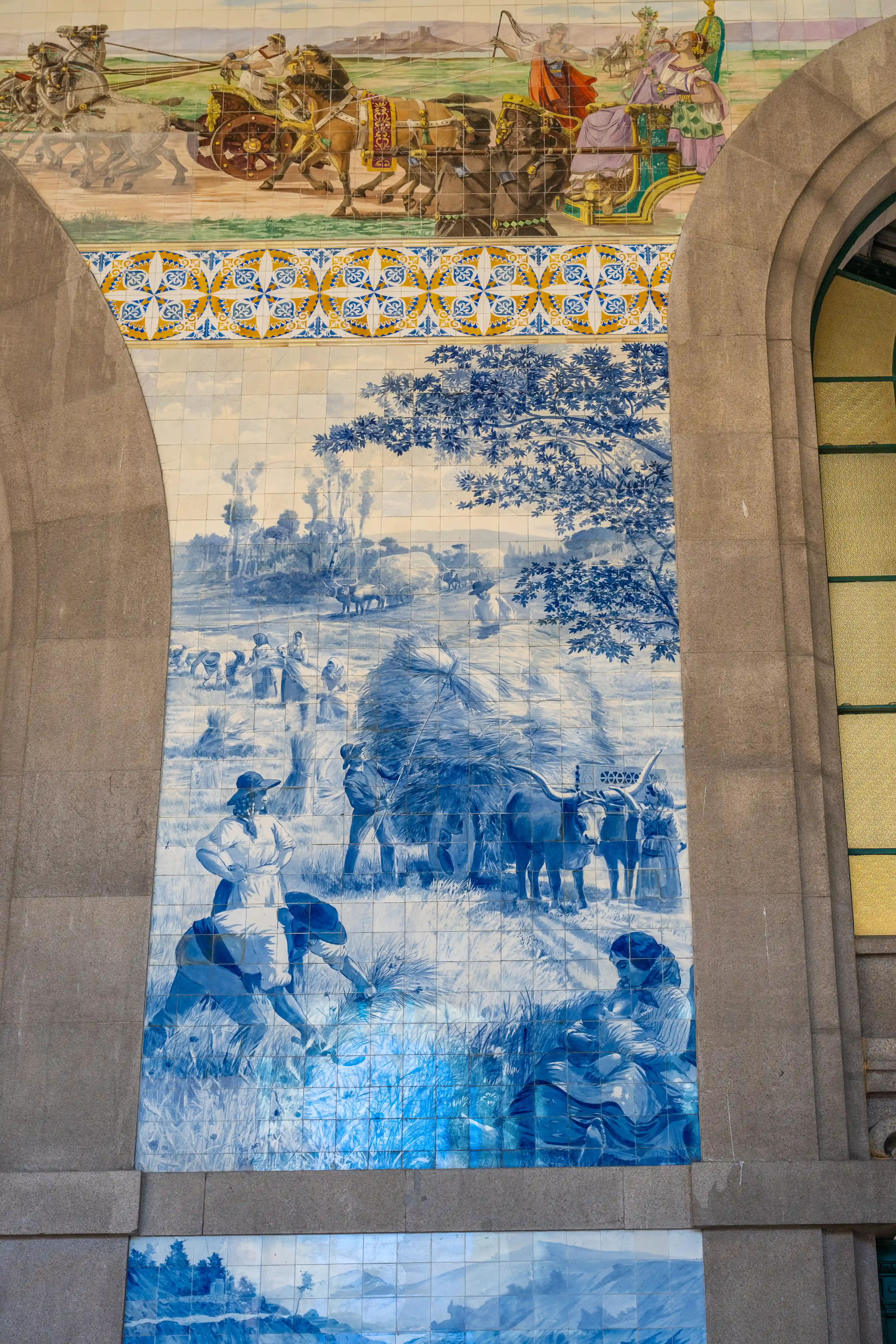
A grand tiled mural in blue and white depicting a busy rural harvest scene with people, oxen, and carts, set beneath a colourful frieze of Roman chariots pulled by horses.
Extensive Azulejo Mural Illustrating a Harvest Scene and Roman Chariots ‐ photo by ,
©www.mgaylard.co.uk.
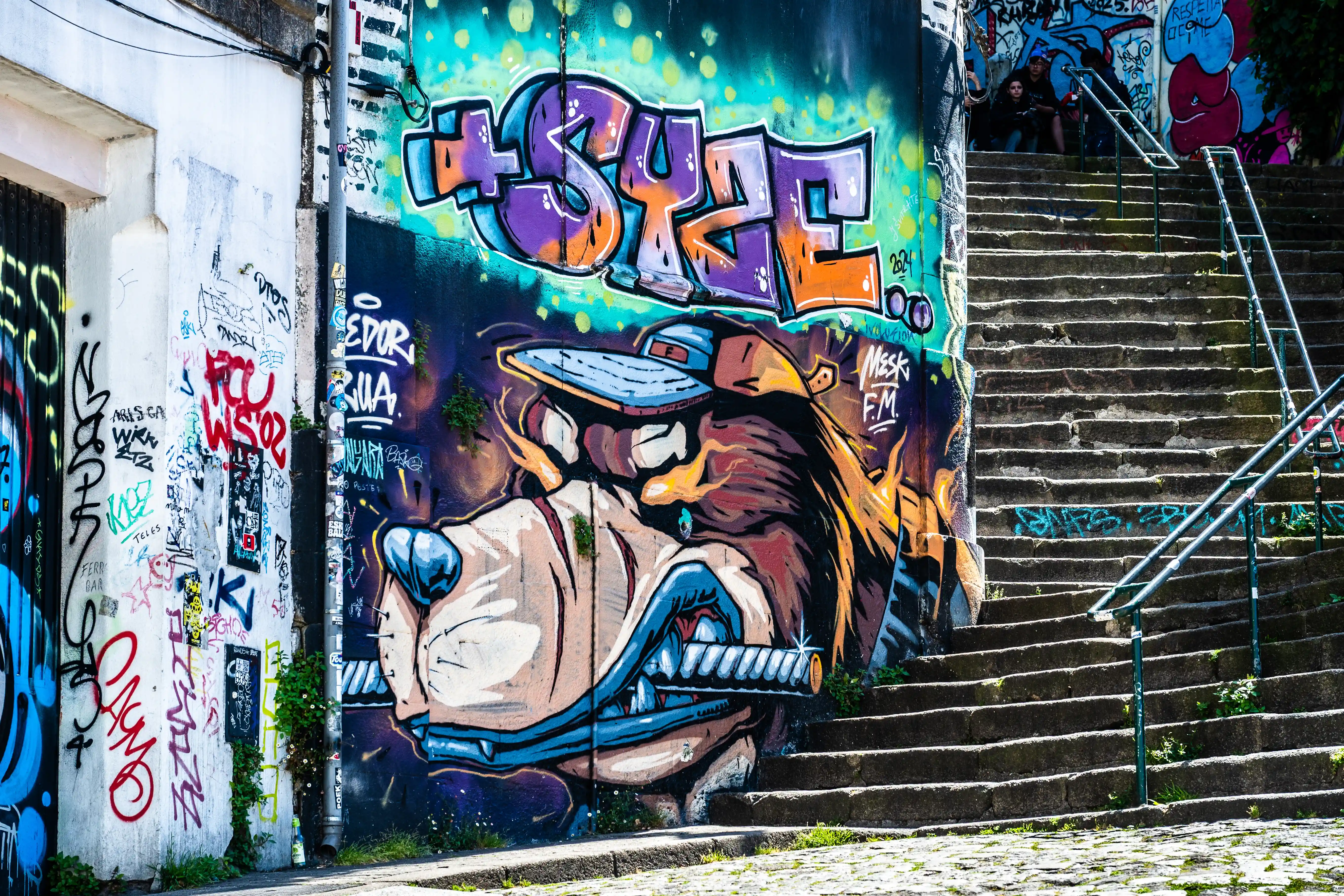
A colourful graffiti mural of a cartoon bear wearing a cap and biting a cylindrical object is painted on a wall next to a stone staircase. The mural features the word
Urban Art and Staircase with Graffiti at Escadas da Rua da Madeira ‐ photo by ,
©www.mgaylard.co.uk.
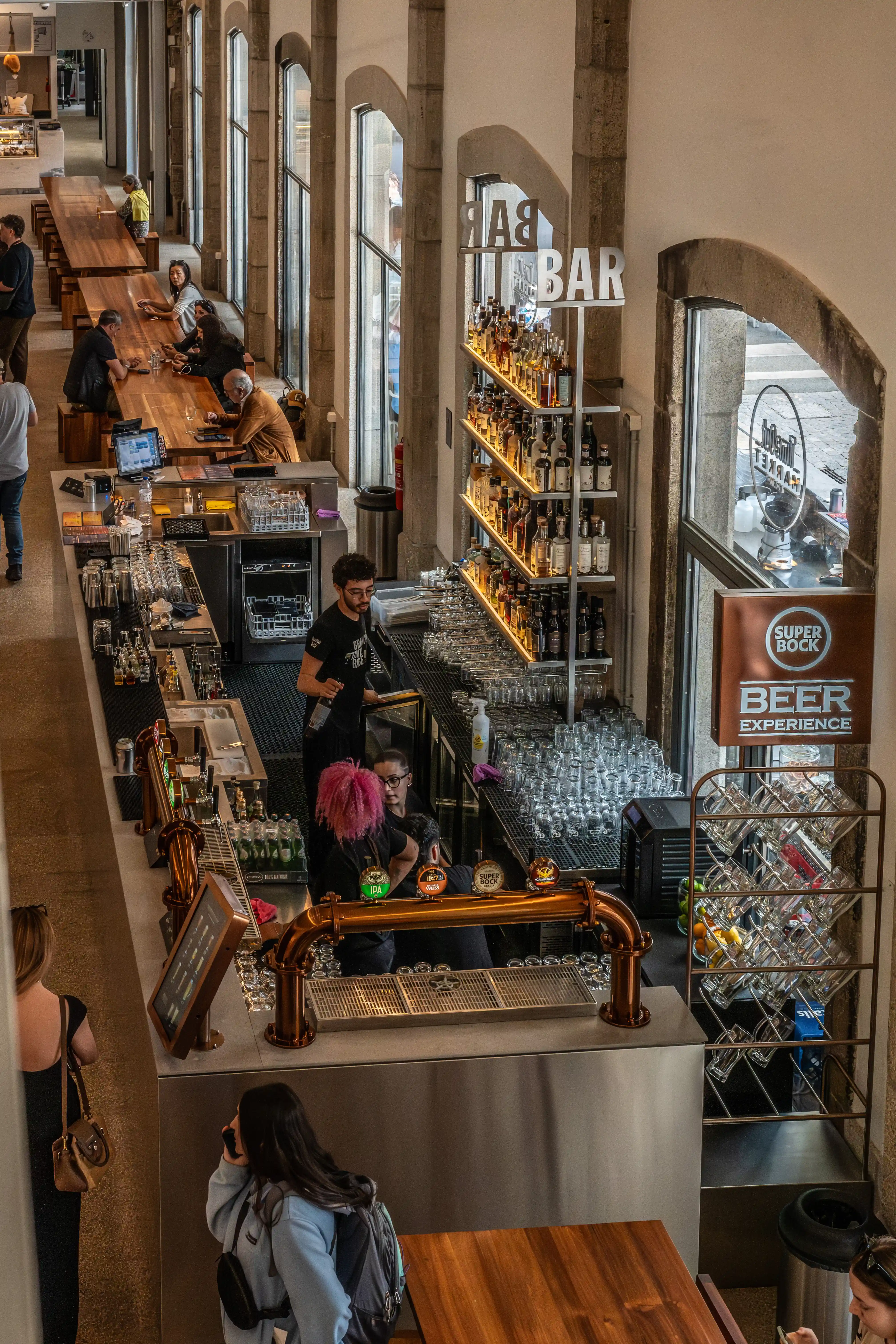
Overhead view of a busy bar and dining area with people sitting at long wooden tables, a bar stocked with drinks, and beer taps.
Interior of a Vibrant Market Bar and Restaurant with Communal Tables ‐ photo by ,
©www.mgaylard.co.uk.
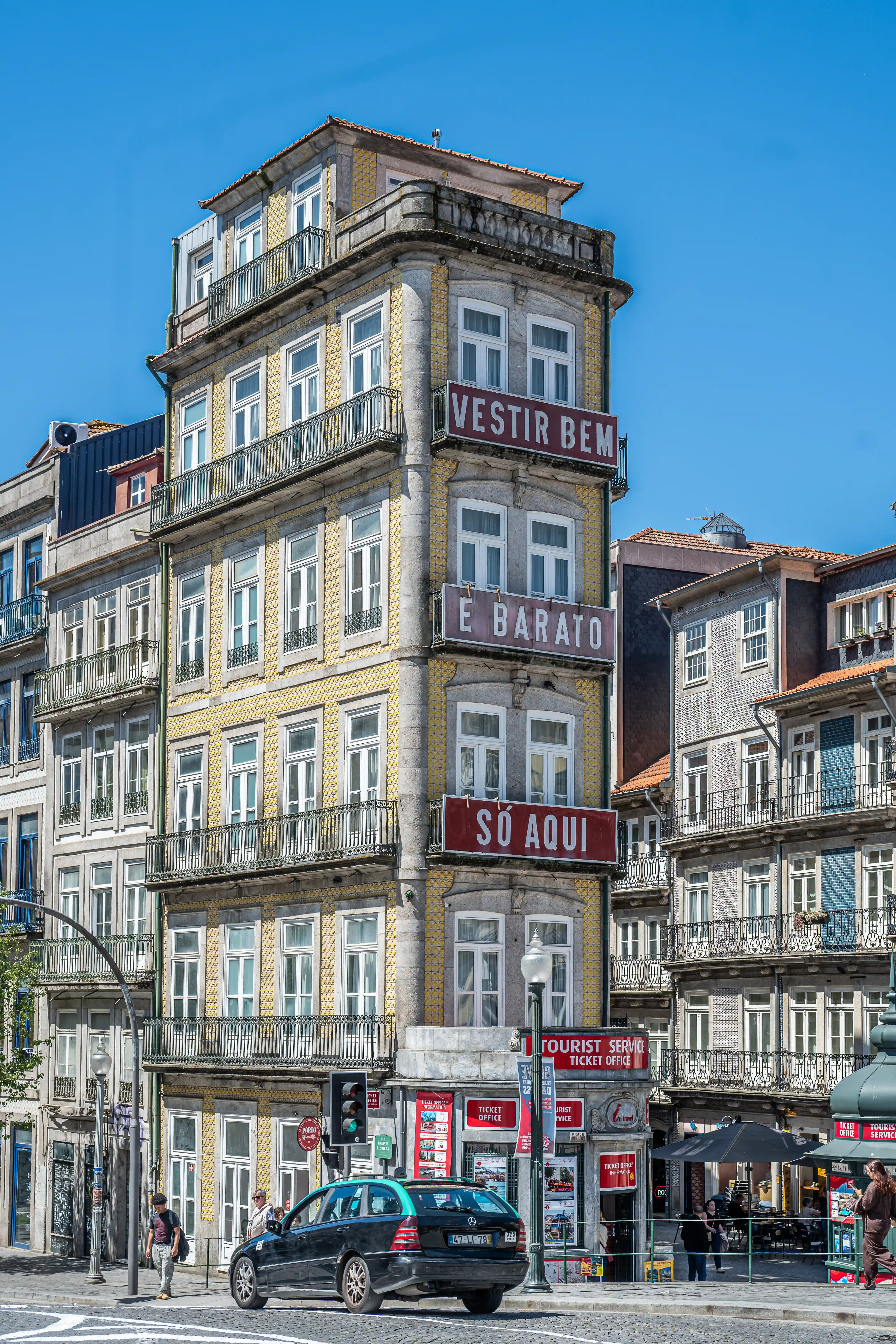
A striking view of a narrow, multi-storey building in Porto, Portugal, adorned with intricate yellow tiles and several balconies. Large red signs with white lettering, VESTIR BEM, E BARATO, and SÓ AQUI, are prominently displayed on the building's facade, indicating a retail establishment. Other buildings with similar traditional Portuguese architectural features, including tiled exteriors and decorative balconies, surround it. A black car is parked on the street below, alongside a building housing a tourist information and ticket office, and people can be seen walking. The image is set against a clear blue sky.
Traditional Portuguese Architecture and Commerce in Porto ‐ photo by ,
©www.mgaylard.co.uk.
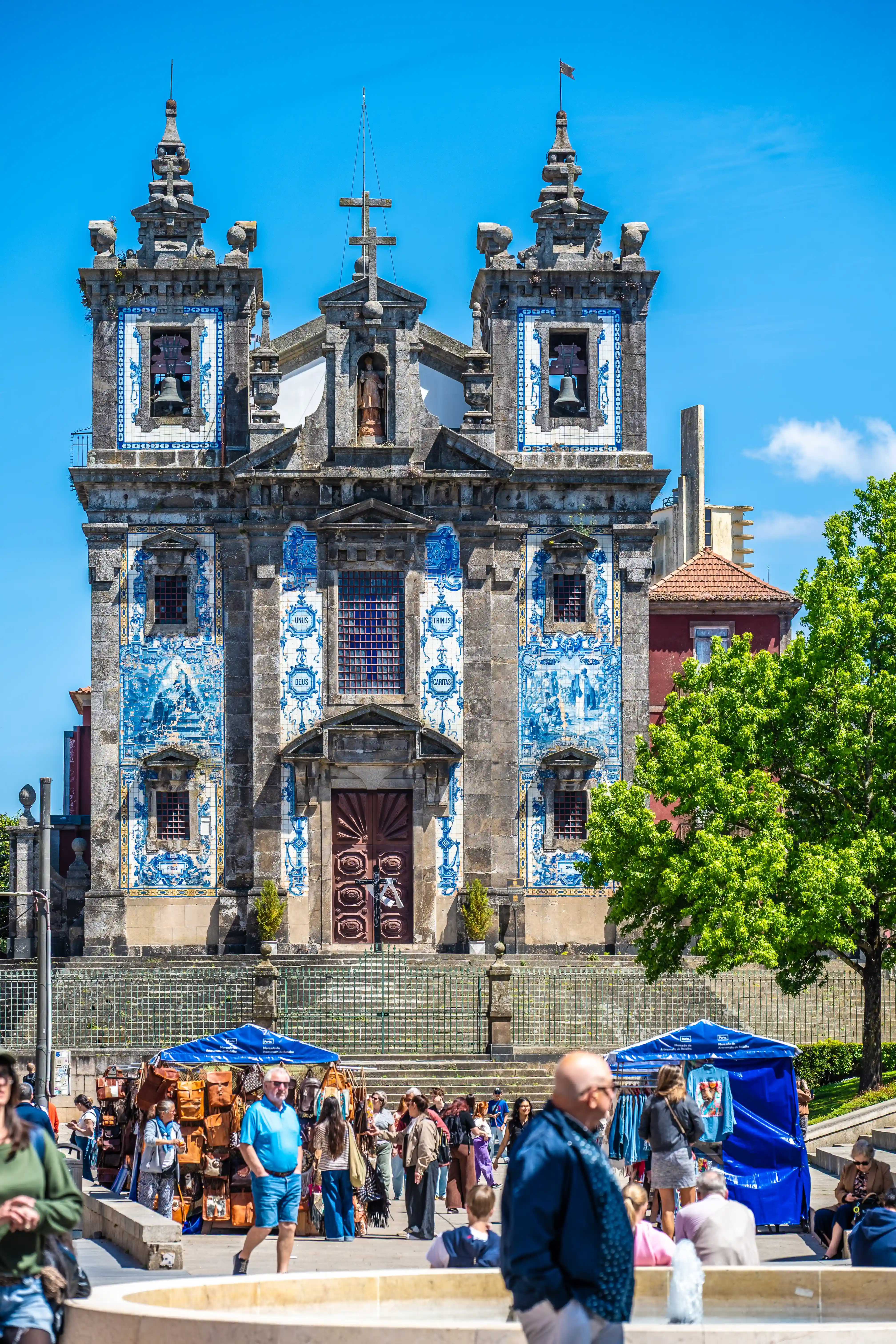
A detailed shot of the Igreja Paroquial de Santo Ildefonso, Portugal, featuring its elaborate azulejo-tiled facade and twin bell towers. In front of the church, a busy outdoor market is in full swing with stalls selling bags and clothing, and people are seen shopping and walking around.
Igreja Paroquial de Santo Ildefonso, Porto: A Blend of Sacred Architecture and Vibrant Street Commerce ‐ photo by ,
©www.mgaylard.co.uk.
Open the full set flickr button this page

São Bento Railway Station

São Bento Railway Station was inaugurated in 1916, replacing the older station that had been in operation since 1896. The station was designed by José Marques da Silva, a prominent Portuguese architect, and its construction marked a significant milestone in Porto’s urban development. The station’s azulejo tile panels, created by artist Jorge Colaço, are among the most remarkable features of the building. These panels, which cover the walls of the main hall, depict scenes from Portugal’s history, culture, and landscapes making the station a unique blend of functionality and artistry. Over the years, São Bento Railway Station has become a symbol of Porto’s architectural and cultural heritage.

Today, São Bento Railway Station is one of the busiest and most iconic train stations in Portugal. It serves as a major transport hub for regional, intercity, and international trains, connecting Porto to other cities in Portugal and Europe. Beyond its role as a railway station, São Bento is a must-visit tourist attraction, drawing visitors who come to admire its stunning azulejo tile panels and Beaux-Arts architecture. The station’s central location in Porto makes it a convenient starting point for exploring the city’s historic center, cultural landmarks, and scenic riverfront
Text generated by Microsoft CoPilot , Text generated by Mistral AI , generated by Google's Gemini AI
To the top
Powered by w3.css. The images are all stored on link to www.gaylard.co.uk Photostream on Flickr   This website is hosted by link to 123Reg Web Hosting